Historical December 1993 article. Dates, prices, services and contacts describe the source period; current availability has not been established.
What?! You say your dog doesn’t respond when you walk in the room? Your cat spends all night jangling the bell on his collar while scratching his ears? You just lifted your cocker spaniel’s ear, wondering where that foul odor comes from, and were sorry that you found out? Welcome to the world of otitis externa—inflamed ears. Ear mites! Not always. Puppies and kittens acquire ear mites more often than adult pets.
When adult cats are allowed outdoors, they sometimes come home with ear mites. Mites are easily and effectively treated with topical cleaning, medication, and occasionally with injectable medication. Indoor pets are not exposed and seldom get ear mites. Persistent cases are caused by mites harbored in locations other than ears: bedding, furniture, carpets, or other parts of the cat’s body; a cat curls up in a ball to sleep, putting its head near the rear quarters, leaving mites behind. No pun. So, the dark wax, itchy ears, and odor have another cause.
Now comes the chicken or the egg part of the story. Does an animal scratch its ears because they are infected, or do they become infected because of the trauma from the scratching? Infection is usually a secondary problem; it can be severe, but once treated, the pet will likely still be bothered with itchy ears. Allergy causes itchy ears in many pets. Food, inhaled or contact pollens, molds, and house dust can be the source of allergies.
An allergic pet shakes its head and scratches its ears excessively causing trauma to the external canal and ear flap.
The damaged tissues become secondarily infected with bacteria.
The resulting symptoms are pain, redness, foul odor and discharge. Owners need to bring their ailing pets to the veterinarian. Excess wax production and accumulation also may result from underlying allergy. Large accumulation of wax deep in the ear canal creates irritation, decreases hearing ability, and can instigate a bacterial infection. Dogs with floppy ears are prone to yeast colonization in their ear canals especially when the dog has an allergy.
The lining of the canal becomes thickened and moist, the perfect place for yeast to grow. Owners notice the strong odor from a dog’s ear when a yeast infection is present.
A complete otoscopic exam plus a microscopic exam of material from an infected ear will allow a veterinarian to prescribe appropriate treatment for an ear infection. Sometimes, a pet requires routine treatment or cleaning to prevent the return of an ear infection.
A pet with allergies needs evaluation and possibly long term treatment for the allergies to control frequent ear infections.
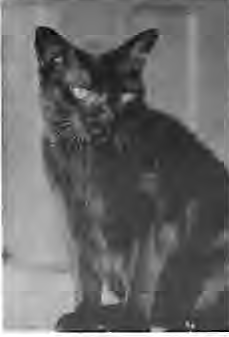
Original photograph caption
Cat. Photographer not credited.
Originally published in The Times of Skinker-DeBaliviere, December 1993.
Read this article in the original newspaper issue.
Original source: SD_Times1993_12.pdf, printed page(s) 4; PDF page(s) 4.
