此内容暂无简体中文译文,以下为英文原文。
Hamilton’s School Bell May Ring for the Last Time
On October 20, 2026, Hamilton Elementary hosted a St. Louis Public Schools (SLPS) meeting on the proposal to close the school. The families who attended came because losing Hamilton will have a personal cost. “I hate it, they're making it hard for people like us that live in the area,” said Shakeema Walker, mother of two Hamilton students. She wanted her child’s school close enough for her to respond when needed. Roughly eight families attended.
I attended the meeting as a reporter for The Times, but also as a local dad with two children under the age of seven. The closure would potentially affect me directly, even though we had already decided as a family to put our oldest daughter in a parochial school in the county (to be fair, it’s the school and church where we got married and where we held the funeral of my mother and grandfather).
The proposal would consolidate Hamilton with Dewey International Studies Elementary for fall 2027. The district’s October newsletter said the board was scheduled to vote on November 10.
Hamilton’s apparent demise follows years of changing assignments, neighborhood conditions and family choices that decimated the school’s student numbers.
That history includes white flight, population decline and the growth of school choice. Financial and operational problems have also played a role in the district’s recent accreditation history, and still do. The collection of individual choices made by families like mine may be justifiable individually but they left Hamilton and SLPS less diverse and supported.
Hamilton Was Once Remembered Fondly
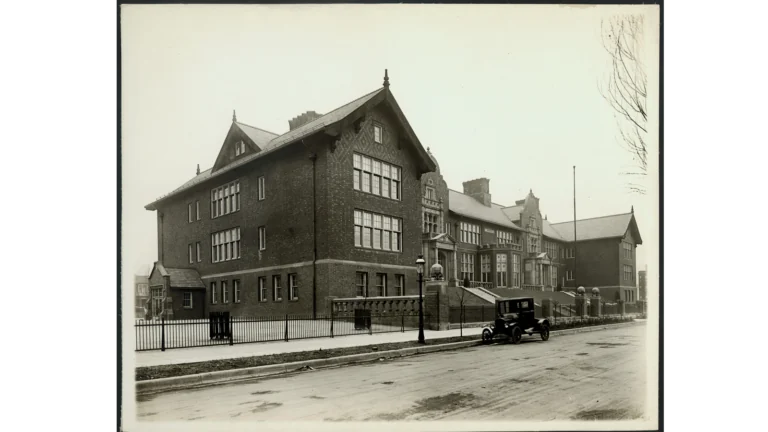
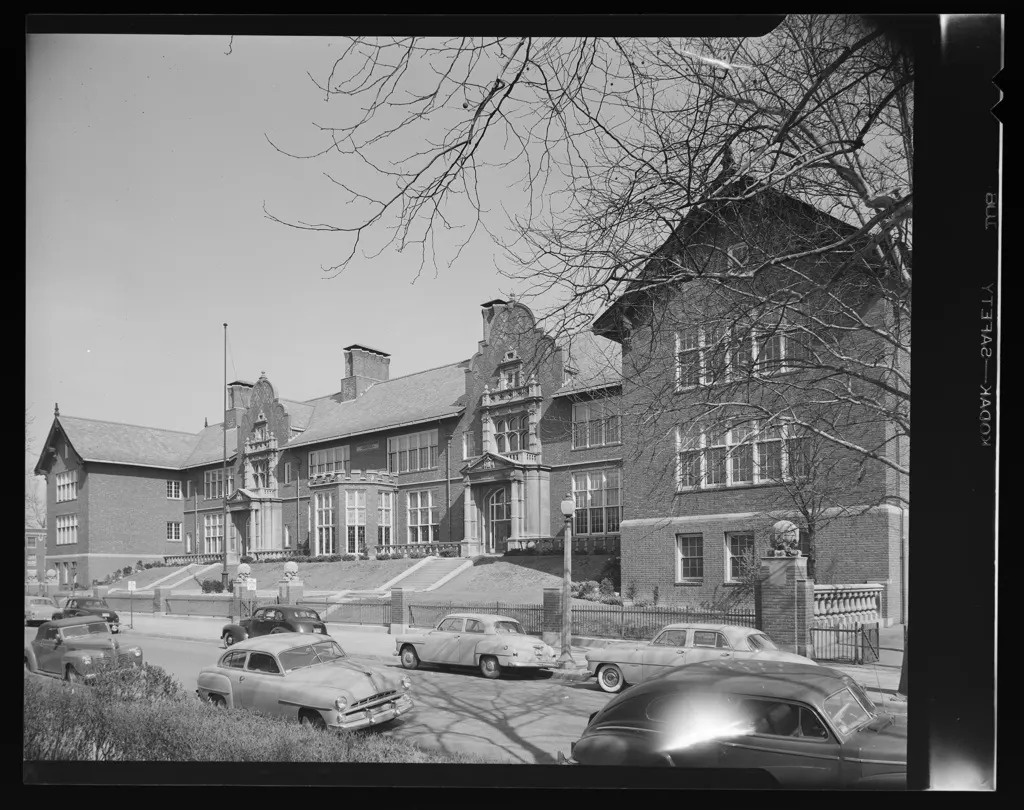
Hamilton began teaching Skinker DeBaliviere children even before its first campus opened, welcoming students to temporary quarters in 1914–15. A neighborhood history by Kathleen M. Harleman, Georgiana B. Stuart and Susan K. Tepas, reprinted in The Times in 1999, counted 377 pupils and nine teachers at the temporary school and dated the permanent building’s completion to February 4, 1918. Rockwell Menotti Milligan, the architect and St. Louis school-buildings commissioner, designed the majestic building.
Former Hamilton student Mary Jane Bartlett Conrades remembered walking to kindergarten in 1927. Eva Bell, another former student, recalled arriving from Germany in 1938 and learning English with another child’s help. Their memories appeared in a 2015 Times retrospective by neighborhood historian Jo Ann Vatcha. Former Hamilton teacher Julius K. Hunter recalled teaching there in 1965, inviting older pupils to reshape their classroom and take responsibility for it. They called it Hamilton Castle.
Hamilton actually grew in the postwar years. A 1963 district report recorded Hamilton’s November enrollment rising from 849 in 1955 to 1,149 in 1962. The district’s reported enrollment-per-teacher ratio improved over those years, as the school gained new teachers and students. SLPS’s fall enrollment topped 116,000 in 1967, according to court records during the desegregation era.
Integration, Suburbanization And An Uneven Change
The Supreme Court’s 1954 Brown v. Board of Education decision declared racial segregation in public schools unconstitutional. Hamilton’s racial transition followed quickly. A 1963 district report estimated its 1955 enrollment as entirely white but it also recorded both Black and white graduates by January 1961. Racial enrollment records were not kept prior to 1955, simply because everyone knew which races attended which schools.
The precise year of Hamilton’s first interracial class remains unknown. Court tables listed the school as 47.9 percent Black in 1962–63. A different tabulation in the district report gave 52 percent for October 1962. Either way, change happened quickly – court tables put Black enrollment at 93 percent by the fall of 1965.
Hamilton’s racial transition was part of a districtwide change. The desegregation court record lists 105,617 SLPS students in 1972–73, 68.8 percent of them Black. But as current residents of St. Louis know, desegregation occurred fitfully. Many areas resisted and it certainly was not (and is not) the case that every school was two-thirds Black.
So many people have tried to figure out what happened to public schools in St. Louis and beyond in the postwar and desegregation movements of the 1950s and 1960s. Nathaniel Baum-Snow, a professor of economic analysis and policy at the University of Toronto, found that postwar highway investment accelerated suburbanization. Leah Platt Boustan, a professor of economics at Yale University, identified racial responses in white departures from cities. Baum-Snow and Byron F. Lutz, an economist and deputy associate director at the Federal Reserve Board, found that desegregation orders changed residential and school-choice patterns, with suburban public schools an important destination.
In St. Louis, Highway 40 (or 64 if you must) and the growth of suburban housing fit that larger regional story. White families in Skinker DeBaliviere and other changing areas feared integration and real estate agents played on that fear by encouraging families to sell their houses and move before their home investments lost value.
After a period of mixed enrollment, Hamilton’s main school became overwhelmingly Black. By 1981, The Paper reported that almost all of Hamilton’s white pupils came by bus from the south side of St. Louis, rather than from Skinker DeBaliviere.
When Hamilton Had Too Many Children
It may be hard to imagine now but in April 1970, The Paper contributor Jody Creighton reported 1,968 pupils across Hamilton’s main school, branches and overflow destinations. The main building alone held more than 1,000 students. Hamilton Principal Edgar A. Burnett described a densely populated attendance area. Children were scattered across classrooms in the West End, including at Wheatley (known during segregation as Colored School No. 7) and Mitchell. Hamilton still offered tutoring, music and counseling and worked with university teacher-training programs, efforts to educate children amid overcrowding.
“We range from the worst cases of poverty to children who come from fairly affluent homes,” Mr. Burnett said. A third of pupils moved at least once a year, the article reported.
Accounts from the time differed on who was moving and why. Ms. Creighton’s 1970 story linked some crowding to displacement caused by redevelopment closer to downtown St. Louis. A separate April 1971 account of Mr. Burnett’s survey said most newcomers moved within the Northwest-Soldan district, contrary to assumptions that they came from public-housing projects.
Jim Hitchcock, another contributor to The Paper, reported that month that Black and white non-Catholic families hesitated to use Hamilton because of overcrowding. By 1973, plans called for smaller Hamilton boundaries and less overflow busing. A proposed Kingsbury redevelopment would have reduced the number of households by replacing existing buildings with lower-density housing, according to The Paper’s reporting that May. Calvin B. Stuart Jr., executive director of the Skinker DeBaliviere Community Council, said: “We have long said that the stability of the community is tied to the schools.”
While Mr. Stuart seemed optimistic in the reporting at the time, his hope for renewed confidence in neighborhood education did not pan out.
Hamilton’s Population Dropped, And Stayed Low, For Decades
By the mid-1970s, the main-school totals began to fall quickly. Court appendices list 881 pupils in 1975-76 and 463 in 1978-79. Grade assignments and attendance patterns changed again. The Paper contributor Stephen Brammeier’s June 1980 report described a proposed Dewey cluster: Hamilton and Roe (near Franz Park) would serve kindergarten through fifth grade while children from both schools would attend Dewey for grades six through eight.
Some Black children from the Hamilton area would attend Roe (now Wilkinson Early Childhood Center) and some white children from the Roe area would attend Hamilton. Hamilton Branch III would become a sixth- through eighth-grade magnet emphasizing academic and athletic achievement.
The Paper contributor Nancy Cohen’s March 1981 account described 360 Hamilton pupils, approximately 30 percent white and 70 percent Black, in kindergarten through fifth grade. Almost all the white children at that point came by bus from the south side of St. Louis.
Enrollment recovered somewhat in the 1980s with the arrival of new groups of children. Federal records list 412 pupils in 1986–87. A November 1988 Times report by contributor Sue Rothschild described 527 students, including 120 students learning English as a second language. The federal fall 1988 count was 468.
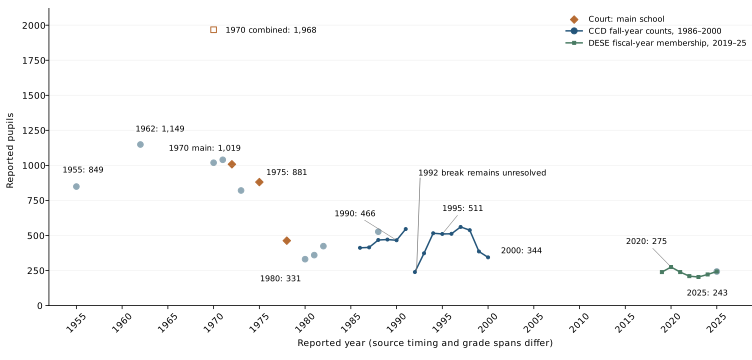
Sources: SLPS’s 1963 report, The Paper’s contemporary reporting, and federal school records.
Hamilton also remained a community institution. Hamilton Community School coordinator Michelle Lowery advertised adult classes and tutoring in The Paper in 1981. Times contributor Betsy King’s 1990s columns described children writing letters through “Wee Deliver,” along with music, science, volunteers and university connections.
Parents And Children Had Other Choices
The schools around Hamilton also changed. New City School opened in 1969 and was home to 150 students in 1975 and 283 in 1985. Its elementary grades overlapped Hamilton’s. Crossroads began as a middle school in 1974 and moved to Skinker DeBaliviere in 1981, adding a high school. Crossroads was not a direct competitor for Hamilton’s present elementary grades. It simply gave parents an alternative local landing spot for their kids.
St. Roch was a direct competitor. Mr. Hitchcock reported in The Paper in May 1970 that it would admit non-Catholic pupils that September, subject to space and a placement exam. First-child tuition was about $2,489 in 2025 dollars, with discounts for additional children. The article reported approximately 80 percent white and 20 percent Black enrollment.
Families could also look to the county. Nearby Wilson and Our Lady of Lourdes served elementary children. Getting there mattered, too. Not every Hamilton family had a car or the time for a twice-daily commute.
Private education has not been limited to families paying full price, then or now. New City’s history records need-based scholarships and its current profile reports substantial use of variable tuition. Magnet and charter schools have offered public alternatives under different admission rules. The region’s voluntary interdistrict transfer program also shaped family choices, although it stopped accepting new students after 2023–24.
Families with more resources generally had more ways to leave the SLPS system. It’s a choice that I recognize. I want SLPS and its students to succeed and I’d love my kids to go to a local public school. But if the academic outcomes are significantly lower relative to a private alternative, parents who have the time and money to leave are going to do so. They will say that they have an obligation to their child’s future that weighs more heavily than their desire to see the local public school flourish.
Private and parochial schools also faced uncertainty. St. Roch closed at the end of the 2023–24 school year. Times contributors Mike Stevens and Linda Cross reported in April-May 2024 that enrollment for the next year was projected at only 81; they connected the problem to uncertainty over the parish’s fate.
The St. Roch school closure makes clear that the decline of the neighborhood’s public elementary school did not mean neighboring private or parochial schools were bound to succeed.
The Tax Base and the Spending Record
SLPS’s revenue also changed. SLPS property-tax receipts fell from about $416 million in 1970 to $207 million in 1990 (measured in 2025 dollars) even as general revenue rose from roughly $735 million to $768 million.
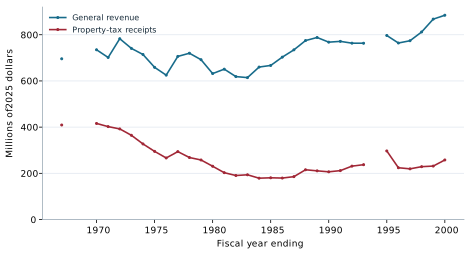
Sources: Census government-finance records, converted using the annual Consumer Price Index
In the annual federal comparison, SLPS current spending per student rose from $14,438 in 1987 to $23,729 in 2024, up about 64 percent after inflation. The national average rose from $10,775 to $18,083. Ladue’s latest figure was $16,105 and Parkway’s $15,046. Because the county figures do not include Special School District services, it’s not a direct city/county cost comparison. Also, construction and debt are excluded from this current-spending measure.
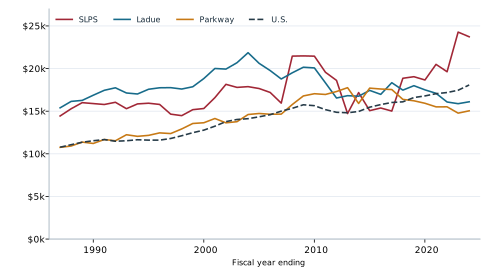
Sources: Census school-finance data, adjusted for inflation.
When enrollment falls and operating costs stay level or rise, spending is spread over fewer students. That is part of SLPS’s argument for closing schools and attempting to sell unused or underused facilities.
Effective spending can make a difference. A school-finance study by Clement Kirabo Jackson, a professor of economics at Northwestern University; Rucker C. Johnson, Chancellor’s Professor of public policy at the University of California, Berkeley; and Claudia Persico, an associate professor of public administration and policy at American University, found that sustained spending increases brought about by reforms improved later outcomes, especially for low-income children.
SLPS Salary Spending Per Student Does Not Stand Out
Instructional salaries offer a specific comparison. A DESE-based calculation divides K-12 instructional salaries by the same fiscal year’s reported K-12 enrollment, then adjusts for inflation. The SLPS figure rose from about $5,643 per pupil in 2001 to $5,889 in 2025, up about four percent in real terms. The 2025 figures were about $6,346 in Ladue and $5,891 in Parkway.
The Current State of Hamilton Is Not Good
SLPS has struggled in recent decades to improve students’ academic performance and to maintain accreditation. Missouri’s Department of Elementary and Secondary Education removed its accreditation in 2007 and the district came under a state-appointed board. The state granted provisional accreditation in 2012 and restored full accreditation in 2017.
SLPS returned to elected-board governance in 2019. In January of 2026, the State Board of Education again classified it as provisionally accredited, citing concerns beyond test scores such as financial and operational problems.
Hamilton’s student body today looks markedly different from the population of Skinker DeBaliviere. City Census tables show 581 neighborhood residents under 18 in 2010 and 478 in 2020, about an 18 percent decline. The National Center for Education Statistics listed 243 Hamilton students in 2024–25, including 233 Black students. The neighborhood’s Black population share was about 29 percent in 2020.
DESE’s Annual Performance Report (APR) is an accountability model that combines measures such as achievement, growth. Attendance APR is not the percentage of students passing a test. Hamilton’s 2025 single-year building APR was 15.7 percent.
In the same official 2025 building report, two St. Louis charter elementary schools – The Biome and Lift for Life Academy Elementary – scored 36.3 percent and 38.7 percent, respectively.
At the district level, DESE’s 2025 single-year APRs were 66.5 percent for SLPS, 90.5 percent for Ladue and 91 percent for Parkway. Selected charter local education agencies scored in between: City Garden Montessori at 62.3 percent, KIPP St. Louis at 64.7 percent and The Biome at 57.3 percent.
Private and parochial schools do not participate in Missouri’s APR system.
The Case For Closure And The Need For Student and Facility Plans
The district’s planning presentation lists Dewey’s APR at 58.1 percent, far above Hamilton’s 15.7 percent. That’s an indicator that something is amiss at Hamilton, but the district’s rationale also centers on facilities, how fully they are used, enrollment and access. Consolidation could reduce the number of occupied buildings and concentrate staff and programs, but that won’t automatically resolve the system’s instructional, financial and operational difficulties.
The cost of closed buildings remains an unanswered question. SLPS’s budget and Annual Secretary of the Board Reports do not provide a total for the carrying costs of vacant schools but it is unlikely that empty facilities will be immediately repurposed in productive ways that generate revenue for SLPS or the city of St. Louis.
At the October meeting, no specific future use for Hamilton’s building was mentioned. Maybe there will be savings, but that is left vague for now. An initial estimate should count staffing and operating-cost reductions as a result of closing Hamilton, but it must also subtract added transportation, transition and vacant-building expenses.
If Hamilton Closes, What Can Help Its Students?
SLPS representatives described two years of continued transportation for existing riders, followed by normal eligibility rules. Asked about staffing at the October meeting, Candice R. Boyd, SLPS’s director for special education, said: “We have not heard about mass layoffs.” The jobs would not necessarily stay the same.
There are ways that SLPS can help the affected students do better academically. A 2024 tutoring meta-analysis found substantial average gains, especially with frequent in-school sessions and trained tutors. Teacher-coaching studies also found benefits, but smaller effects when programs grow. If interventions like these are being considered, affected families and the neighborhood need to hear how they would work and what they would cost.
Keeping attendance rates high is also essential. A randomized study found that personalized communications can reduce chronic absence. Teacher continuity will also be important.
Hamilton’s history offers some places to start. Ms. Creighton’s April 1970 account described a federally funded Washington University teacher-training project in which apprentices tutored children and regular teachers received university tuition. Lowery’s March 1981 report named tutors from Washington University and the University of Missouri-St. Louis, college-credit courses through Forest Park Community College and programs with the University of Missouri Extension Center.
In December 1995, King reported on the Postal Service’s Wee Deliver letter-writing program, a Coro Fellows workshop and AmeriCorps workers Errick Moorehead and Amy Gronquist, who worked at Hamilton. A separate item on the same page identified the St. Louis Partners AmeriCorps Program and Operation BrightSide’s schoolyard work.
Asking universities and neighbors to help is important but Hamilton’s kids can’t depend on the goodwill of its neighbors. SLPS and its partners need to specify who will provide tutoring, how often it will occur, who will supervise it, how it will be paid for and how progress will be reported. Improvement will also depend on scheduled tutoring, transportation arrangements, attendance follow-up and public progress reports. The transfer must have independent oversight to ensure that student and parent voices are heard.
To come back to my own family, Hamilton’s closure makes me sad, even though I’m part of the problem. While I personally hope for the best, SLPS’s track record of student outcomes is just not solid enough for me to justify putting our children in whatever school replaces Hamilton.
I know that putting my daughters with SLPS would be better for the system. It needs deeply committed parents who intervene aggressively, who push for change and who ensure that proposed solutions actually come alive. When Pulitzer Prize-winning journalist Nikole Hannah-Jones committed in 2016 to placing her child in New York City’s public school system and working to improve the system from within, she was full of hope.
In her 2026 essay about how her choice played out in her own family over the course of a decade, she was less sanguine. While she committed her child to the public school system and herself to improving it and does not regret it personally, she has also noted that her daughter found it unfair to have to bear the cost of society's failure.
For myself, I feel empathy for our public schools, my neighbors and my own children. While I can’t justify to myself a decision to put our kids in the SLPS system as it stands, I hope it changes for the sake of its students.