by Kathleen M. Harleman, Georgiana B. Stuart, Susan K. Tepas
THE NEIGHBORHOOD TAKES SHAPE
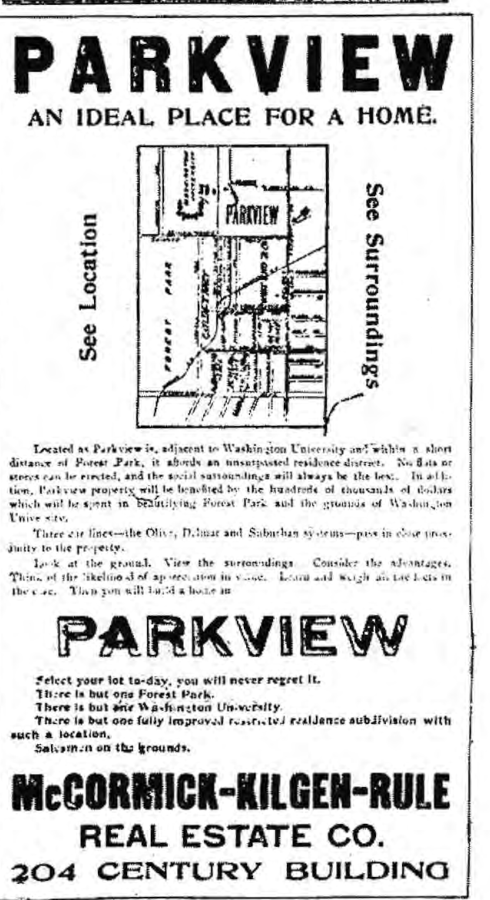
The year 1908 marked our neighborhood's actual beginning. Whatever the plans and schemes had intended, it was not until 1908 that people actually lived here. Gould's Directory (Blue Book) for 1908, which listed only "prominent" citizens living in the City of St. Louis and the metropolitan area, alphabetically by name and then numerically by street address, suddenly listed 17 families living in Parkview. One of these "first families of Parkview" was that of C. Marquard Forster, a signer of the Articles of Association and presumably a director of Beredith Realty. One member of the first family on Westminster was Elmore Cave, treasurer of Kilgen-Rule Real Estate Co. (8) and undoubtedly a relatively marriage of Adrian O. Rule. Rule had married Julia Cave in 1895 and had a son named Elmore. (3, p. 515) Washington Heights Subdivision (Rosedale-Skinker) had five families fisted in 1908, all living very near Skinker Road. Skinker was probably the only usable thoroughfare amidst the increasing construction.
In 1909, another 12 families had been listed in Parkview and 35 more in Washington Heights Subdivision. We can get an impression of our neighborhood's first residents by looking at Gould's Red Books, which listed alphabetically all citizens, their occupation and their residence. While they were certainly not the richest of the rich, these people were definitely well-to-do small businessmen (many real estate men), professional men (architects, physicians, many lawyers, etc.), and the upper-level management people in large or medium-sized business firms. (8)
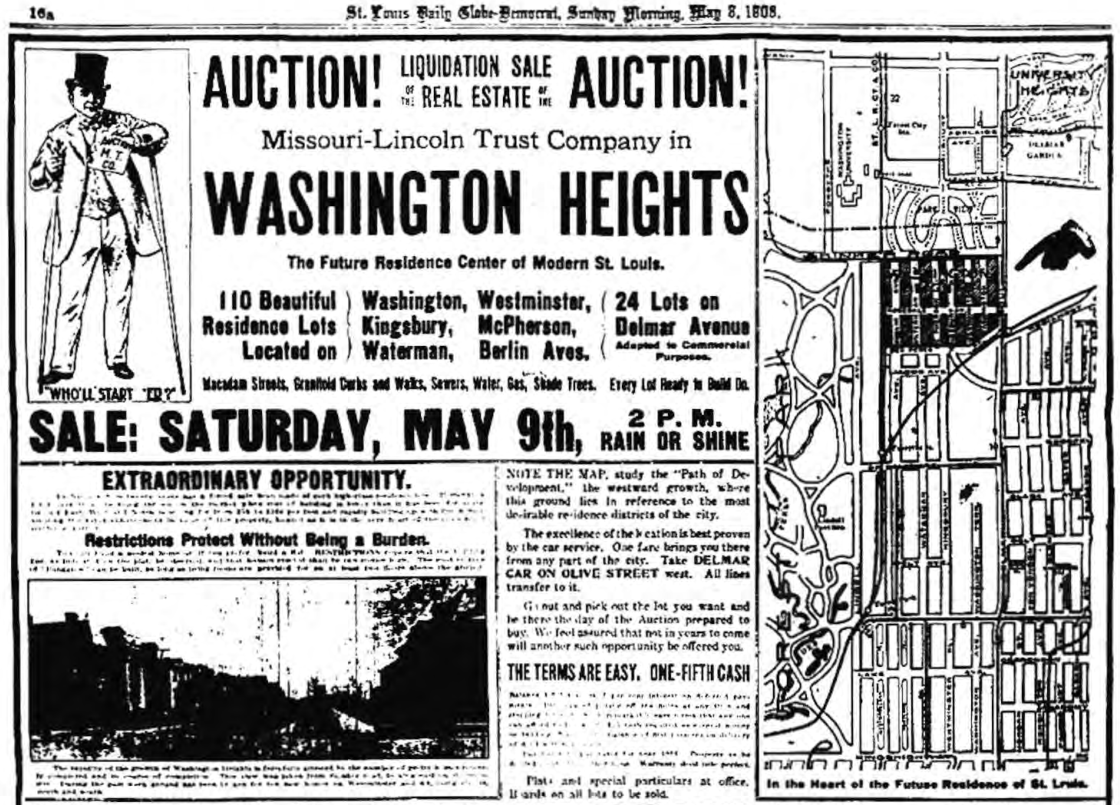
Apparently this area was considered ripe for continued development, for on June 18, 1909, the plat for Washington Heights 1st Addition (the major part of what we now call Washington Heights) was filed with the Recorder of Deeds. (59, Book 18, pp. 56-59) This large subdivision ran from Delmar to Forest Park Parkway, and Des Peres Avenue to DeBaliviere, excepting the plot of land between Laurel and DeBaliviere, Delmar and the alley north of McPherson. The developer was not West End Realty, who had owned the land in 1907, but Nina Realty Company, whose vice president, George Wilson, and secretary, Cliff H. McMillan, were vice president and secretary of Mercantile Trust Company, respectively.
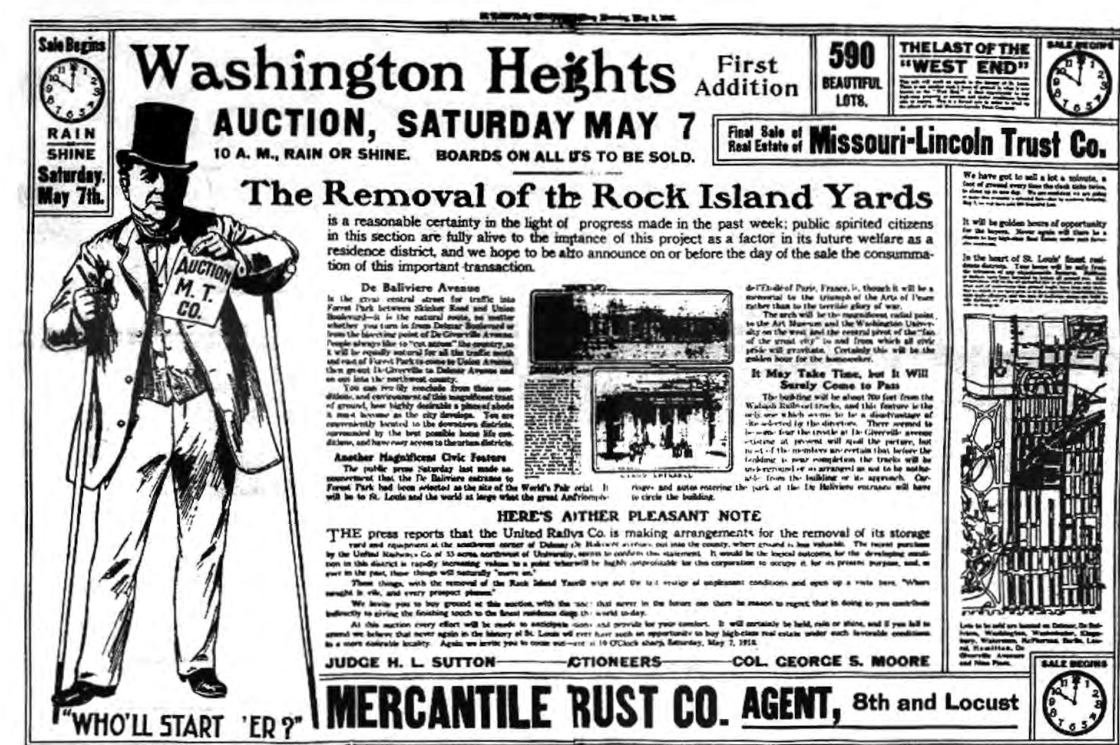
On May 4th and 5th, 1910, there appeared large advertisements about an upcoming auction May 7th for lots in Washington Heights 1st Addition with directions on how to get there by streetcar, Mercantile Trust Company was in charge of the auction. The long-awaited removal of the Rock Island Railroad yards (located just east of DeBaliviere near Lindell—see map p. 19) was emphasized as opening up to fine residential living the lost available tract in the city's west end. A more positive incentive for moving out here was the enhancement of the area by the soon-to-be constructed Missouri Historical Society building, at the south end of DeBaliviere where the gates to the World's Fair had been. (25)
Development of the existing subdivisions continued at a furious pace. When Gould's Blue Book for 1910 appeared, an astonishing number of new addresses were listed in Parkview and Washington Heights—101! Considering the painstaking methods of good quality construction, we can not only imagine the swarms of workmen everywhere, but con also readily admit the need for the limited number of basic floor plans used. Construction was managed carefully, as the surprising number of large trees still here attest. Some of the trees are from 100 to 150 years old. The question of whether or not each landowner bought the plans and changed them to his family's specifications or whether a single builder was responsible for most of the homes, has not been settled. Many of the records of that day are still in existence but not in order. Individual research by a present-day homeowner would probably yield more information than neighborhood-wide research.
George F. Bergfeld was an important builder on the 6100 block of Kingsbury, but was not responsible for all of the homes there. An example of prices of the time can be seen when looking at three of his houses. These three homes sit beside each other (a common practice in Washington Heights Subdivision development) and all are considered a full three stories today, but are listed on the building permit as two and one-half stories. All have the central stair-case plan, with a large art glass window on the landing, but they look quite different from the outside. These appear to be the most expensive homes on the block at $7,500 each to build. (57) A side-stairway plan home, only two stories (on the 6100 block of McPherson), with a building price of $5,000, (57) can today be insured for a replacement value of $70,000!
The phases of housing development of the present Skinker-DeBaliviere Neighborhood are understandable in light of the real estate transactions we have previously explored. But, perhaps anticipating the character of our present residents, early development went against the prevailing trend to westward movement. The 6200 blocks contained the majority of first homes, followed by the 6300 blocks, with a beginning of homes on the western end of the 6100 blocks. According to the Blue Books, (7) by 1910, Berlin Avenue (now Pershing) had two residences in the 6200 block, four in the 6100 block; Waterman showed eleven in the 6200 block, five in the 6100 block, one in the 6300 block and one in the 6000 block. McPherson Avenue listed 14 homes in the 6000 block, ten in the 6100 block, five in the 6200's and two in the 6300's. Washington Avenue listed 17 families in the 6200 block, 16 in the 6100 block, and 13 in the 6300 block. Westminster Place showed 24 residences in the 6100's, three each in the 6200's and 6300's and two in the 6000 block. Kingsbury Avenue (which does not go into Parkview) had 31 families in the 6100 block and seven in the 6000 block. At the corner of Skinker and McPherson (presumably where the Sinclair station is now) stood the first residence on Skinker Road, number 400.
Who were the people who established the basic character of our neighborhood? Quite a few of them were considered important enough in the life of St. Louis to be listed by The Republic newspaper in its 1906 and 1912 editions of The Book of St. Louisans, "a biographical dictionary of leading living men of the City of St. Louis and vicinity. (3, Title page)" Judging merely by surnames, our neighborhood was not only home to comfortably-fixed families of British and French origin, but also perhaps a rung on the ladder being climbed by late-arriving Germans, Irish and Italians. There were clergymen, real estate company presidents, architects, the Assistant Superintendent of Instruction for the St. Louis Board of Education, physicians, men involved with some aspect of railroad management, lawyers, lumber company and hardware company officials (their homes may have some little extra touches), the paymaster of the Hamilton-Brown Shoe Company, the manager of Fleischmann & Co. (yeast), several men involved in wholesale or retail dry goods, the secretary of the John Deere Plow Company, a few men in the insurance business, some in banking and some in groceries, the president of Smith's Auto Repair Co. at 501 DeBaliviere, two glass company presidents, (8) and a future Missouri Governor.
As the neighborhood continued to grow, a new feature appeared in 1911—apartment buildings. While some of the two-family homes so popular in St. Louis had already been built (NOTE: we have counted each part of a two-family as a residence), none of the "High-Class Apartments" mentioned in Parkview Realty's plans for the area in the 1903 Prospectus had been constructed. There is little doubt that the extensive range of streetcar service in the city's western end, greatly aided by the presence of Washington University and the diversions of Forest Park, made our neighborhood ideal for those whose only source of transportation was the streetcar. Automobiles at that time were for the wealthy and were unreliable enough that people who punched a time clock preferred the streetcars.
The apartment building developed first close to the car lines: in the 5700 blocks near DeBaliviere, along Skinker, Waterman and near Delmar. (7) Even today, we can see where the small clusters of shops developed at each major streetcar transfer point. Apartment dwellers could have spacious quarters, perhaps a block or so away from the car lines which would take them downtown to work or anywhere in the city, and they could do their shopping on the way home. With no need for garages, our planners placed their buildings close together and close to the street, making the apartments large and comfortable. In later days this would mean always overcrowded streets as every family in every apartment tried to find a space to park its car, and very little room for children to play in front.
By 1912, homes had begun to spring up in Washington Heights 1st Addition, along with the apartment buildings, and the 5800 and 5900 blocks listed their first residents. (7) The final area of full development for our neighborhood were the blocks near the Wabash (now Norfolk & Western) Railroad tracks, which then ran at ground level. Once plans had been made to sink the tracks to their present level, nearby construction was rapid.
On July 22, 1915, the plat for Washington Heights 2nd Addition (a smaller part of what we now call Washington Heights) was filed with the Recorder of Deeds (59, Book 19, p. 97) by the owner of the land, G. H. Dudley, secretary of the Edward K. Love Realty Company. (8) This 2nd Addition includes only two streets, Kingsbury and Westminster, from DeBaliviere to Laurel. This area, of course, was prime for development because of the activity all around it, and probably made a nice profit for whoever actually held the land until this time.
Any fast-growing neighborhood, such as ours was from 1910 on, finds its new residents spending a few years getting settled, establishing a new pattern of living and shopping, and making appropriate adjustments in their social lives. Once settled, however, residents begin to look outward and the creation of a true neighborhood begins. Parkview Subdivision, because of the terms of its trusteeship, followed the plan set down by its developers and as early as April 20, 1910, held the first meeting of the Parkview Association at the Mercantile Club downtown, to elect its officers and director. (41)
Another element in this creation of a neighborhood was the development of a local public school. The need for a neighborhood school had become evident as early as 1913. It was so urgent, in fact, that during the 1914–1915 school year, seven frame and two steel portable classroom buildings housed 377 students and nine teachers at the corner of Hamilton and Washington Avenues. This was the beginning of our public elementary school named for Alexander Hamilton. It was the third elementary public school in St. Louis to have this name. The two previous Hamilton school buildings, one at Twenty-fifth and Davies Streets and the other at Twenty-third and Dixon Streets, had both become totally unusable by 1909. (65) In the 1915–1916 school year two more frame portable buildings, one teacher and 100 pupils were added to the new Hamilton School complex. During that same year a contract was let to construct the present 24 classroom building. There were already 772 pupils (81 in Kindergarten) in the 1917–1918 school year. The building was not completed until February 4, 1918, but by the 1918–1919 school year, 27 teachers were serving over 1000 pupils. (55)
The three largest churches in our neighborhood, St. Roch's Catholic Church, Grace Methodist Church and Delmar Baptist Church (all currently supporting members of the Skinker-DeBaliviere Community Council), began serving residents of our area within eight years of each other. The first congregation to actually hold services here was St. Roch's with the celebration of the first Mass in the Skinker-DeBaliviere Neighborhood on September 17, 1911. Contrary to what might be expected, St. Roch's Parish was not established as a result of westward population movement from Cathedral Parish, but eastward movement from St. Ann's Parish in Normandy, Missouri. In the last quarter of the nineteenth century, St. Ann's served the forms of the north county. Eventually enough people settled east of St. Ann's to justify a second church, St. Rose of Lima in the Cabanne District. By 1902, the population south of St. Ann's and west of St. Rose of Lima called for another parish which became All Saints in University City. Since the population of this neighborhood was very sparse until after the World's Fair, St. Rose's and All Saints adequately served the Catholic population of this area.
After the Fair, Washington Heights and Parkview were growing rapidly and their inhabitants thought land for a church should be purchased while choice tracts were still available. Father Long, pastor of All Saints, agreed and in June of 1911, accompanied by a group of laymen, he called on Archbishop Glennon to present their plan for approval. The Archbishop assented and the group promptly purchased a tract of land on the southeast corner of Waterman and Rosedale for $55.00 a front foot. The Reverend George P. Kuhlman was appointed first pastor of this "nameless" parish.
The first problem confronting Father Kuhlman was establishing a suitable temporary church. Six parishioners contributed $100 each to outfit the church and helped Father Kuhlman find a suitable building. They eventually rented a small store at 6008 Kingsbury, installed a temporary altar, a portable organ and folding chairs. This building now houses the Skinker-DeBaliviere Community Council Office. Father Kuhlman moved into a room in the home of one of his new parishioners until a rectory could be constructed.
Father Kuhlman, an innovative problem solver, devised a plan that would not only provide a name for his new parish, but help raise money for its building fund as well. "He held a competition and after lively bidding in the old Park Theatre, Hamilton and Delmar, St. Roch was chosen patron of the parish. Thus it became one of the few parishes in the city named for a canonized layman. (34, p. 4)"
A year after his arrival at St. Roch's, Father Kuhlman was able to celebrate Mass in a temporary chapel in the completed school building on Waterman. The structure cost some $50,000 and included the chapel, four classrooms on the first floor and living quarters for Father Kuhlman. By 1915, the rectory was completed. Seven years later the present church at Waterman and Rosedale was dedicated for services. (34, pp. 1-8)
Grace Methodist Church was the second of these three churches to hold services in our area. Although ground was not broken for the church on the northeast corner of Waterman and Skinker until March 13, 1913, the congregation and even this very church building go back to the nineteenth century. The history of the congregation begins with Union Methodist Episcopal Church, which stood "at Garrison and Lucas Avenues in a location called Piety Hill (37, p. 3)" because of the numerous churches in the area. Since many of its members were leaving the old neighborhood to build homes farther west, the Official Board of Union Church appointed a committee to look into the matter of establishing another Methodist church west of Vandeventer Avenue.
At this time Lindell Avenue was quickly becoming one of St. Louis' most fashionable streets, and it was here that the committee chose a site for the new church. The exact location was the southwest corner of Lindell and Newstead, the land being "some lots recently carved from Lindell's farm. (37, p. 4)" When the new Lindell Avenue Methodist Episcopal Church held its first service in the new chapel in 1892, the membership was about 100 with 80 of these members having transferred from Union Church. Five years later in 1897, the main church was completed and dedicated.
During the next 15 years another shift in population took place, and the congregation decided to again follow the western trend. However, they decided to take their new church with them to the corner of Skinker Road and Waterman Avenue. Mr. Fred C. Bonsack, an active Board Member of Lindell Church was the architect for the removal and rebuilding of the church. The original plans of the church could not be obtained because the architect, Mr. Theodore C. Link, had died. Consequently, hundreds of measurements and innumerable photographs had to be made of the existing church to assist in its re-erection. The auditorium was rebuilt on Skinker just as it stood on Lindell, but a few changes were made in other parts of the church. (37, pp. 4, 5-15)
Former Lieutenant Governor Edwin O. Stanard (first President of the Board of Trustees of Lindell Church), who helped secure outstanding visiting preachers during the World's Fair, made possible the removal and rebuilding of the Lindell Church. He donated the lot at Skinker and Waterman on condition that the church be moved and rebuilt free of debt. In compliance with this condition, all the money necessary for the moving and rebuilding was subscribed before the work started. (37, p. 11)
Since the church was changing location, the congregation voted to change its name to Grace Methodist Episcopal Church. It remained that until "Episcopal" was eliminated when the three branches of Methodism united. (40, p. 5)
Ground was broken on March 18, 1913. "As the old edifice was torn down, the new one was erected in the new location, the top stones of the old church becoming the bottom stones of the new church. (37, p. 5)" First services were held in the rebuilt chapel on September 21, 1913; the church was completed on October 11, 1914. The building is distinguished by its beautiful art glass windows. The Niedringhaus Memorial Window is one of the few Tiffany windows in St. Louis. (37, p. 22) Another unique feature of the building is that a brick from the Great Wall of China is built into the west wall of the auditorium. The brick was a gift from Mr. and Mrs. Hanford Crawford, active church members, who brought it back from Nankow Pass in 1913. (37, pp. 33-34)
Delmar Baptist Church was the last of the three churches to locate in our neighborhood, but is the oldest of the three congregations, dating back to 1877. Like Grace Methodist congregation, Delmar Baptist's roots lie around "Piety Hill." On Garrison Avenue between Lucas Avenue and Morgan Street, 37 Baptists met and organized the Garrison Avenue Baptist Church. The congregation constructed a small chapel, and Dr. W. Pope Yeaman became its first pastor.
Two years later the congregation was notified that it must remove its chapel from the leased land it occupied. The decision was made to move the chapel rather than destroy it. The church was put on wheels and started its two-week journey two blocks west to Compton and Morgan. One Sunday with the building still on its wheels, five feet above ground level and right in the middle of the street, members trudged through snow to hold services as usual in their chapel. The next day's newspaper dubbed the church "The Church on Wheels".
Although the church building was never again actually "on wheels", the congregation did move several times before establishing itself at Skinker and Washington. The first move came in the early 1880's. In planning this move, officials first chose the corner of Grand Avenue and Washington as a new site, but this changed when a liberal contributor offered a substantial donation if the church would locate at Delmar and Spring. In 1884, the congregation moved into their new quarters and changed their name to The Delmar Avenue Baptist Church.
Within a few months Third Baptist Church moved to its new location at Grand and Washington. This precipitated a crisis for Delmar Church. Two Baptist churches were now within two blocks of each other, and Delmar Church was a much smaller congregation. Just two years after Delmar Church opened, representatives of Baptist churches in the city met and decided to disband Delmar. However, Delmar refused to be disbanded.
The problem of where to go and how to move without money was solved with a generous contribution toward a new location if the church would act immediately. A lot was purchased at Delmar and Pendleton Avenues, and first services were held in 1892.
After 23 years at this location, the decision was made to "move west" again. The church building was sold to the First Christian Church, and a lot was purchased at Skinker and Washington in 1916. World War I interfered with construction plans, and the new building was not completed for three years. At first the congregation used a gymnasium on the third floor of Lenox Hall, a girl's school at Washington and Trinity Avenues. Then they temporarily joined with Immanuel Baptist Church at 5850 Cates. Finally they rented the auditorium of the Clendenen Dancing School in Arcade Hall near Belt and Vernon Avenues. Construction of the present Delmar Baptist Church was begun in 1918 and completed in June of 1919. The "Church on Wheels" had found a place to rest. (33, pp. 4-12)
THE NEIGHBORHOOD MATURES
Until 1920 the events which shaped our history were recorded in public documents or private papers. As the neighborhood has matured, the pertinent facts have not as yet gone into the public record. Events subsequent to 1920 are recorded mostly in human memories and personal papers. It is from 1920 to 1960 that we would most like friends and neighbors to help us fill in the many gaps we found in years so closely past.
The Skinker-DeBaliviere Neighborhood seems to have prospered with the rest of the United States during the "Roaring Twenties". From all reports it has apparently always been considered a great place to grow up, with plenty of friendly homes and small shops, open ground in Forest Park and at Washington University. Judge Daniel B. Tammany and his family moved into the 6100 block of McPherson in September, 1918. Along with his adventures on the banks of the River Des Peres, he recalls that there were not as many children living here as there are now, and that he and his friends could play marbles in the middle of the street for an hour or more without a car passing by to disturb them.
William L. Rose moved into the 6100 block of Kingsbury in 1910, his parents being the original owners of their house. Mr. Rose lived there until the mid-1960s. He states he did not pay much attention to what was going on in the neighborhood until he was older, in the 1920s. He recalls that most of the residents were business or professional men and that almost everyone had a cook and/or a maid. Many people had automobiles, but many also used the streetcars. The neighborhood was considered to be very far out from downtown St. Louis.
Catherine Baier, who lived in Maplewood at the time, recalls this as the area where wealthy people lived. Judge Tammany says some people had daily household help, but he can recall no one who had help living in. There was a private night watchman for the (now) Rosedale-Skinker area.
The neighborhood seems to have been alive with small neighborhood businesses. For example, at the southwest corner of Kingsbury and Des Peres there was a fruit and produce stand. Next to it, where the Skinker-DeBaliviere Community Council office is now located (6008 Kingsbury), there was a grocery store where Judge Tammany worked as a clerk when he was a teenager. Jacob Mauer was the meat man and Martin Gorman was the grocer. Next to the grocery store was Bill Schottgen's Bakery, where The People's Clinic is now located (6010 Kingsbury).
Josephine Bureau had a building constructed in the 6100 block of Delmar in 1923, to house her Parisian Laundry. Mrs. Bureau and the laundry are still there, specializing in "fancy work" pleated lingerie and dresses, fine linens, curtains and blankets. Another business that Richard C. Hart says has been "forever" on the south side of the 5900 block of Delmar is Chester's Pipe Shop. It has a walk-in humidor where cigars and tobacco are kept in top condition. A few blocks farther east on Delmar, at DeBaliviere, was Moll's Grocery Store, "the" place for people from all over the West End to shop and distinguished by its large clock standing at the curb in front of the store. After Moll's, this became Bickle-Moll's grocery store until the building was torn down in the late 1960s.
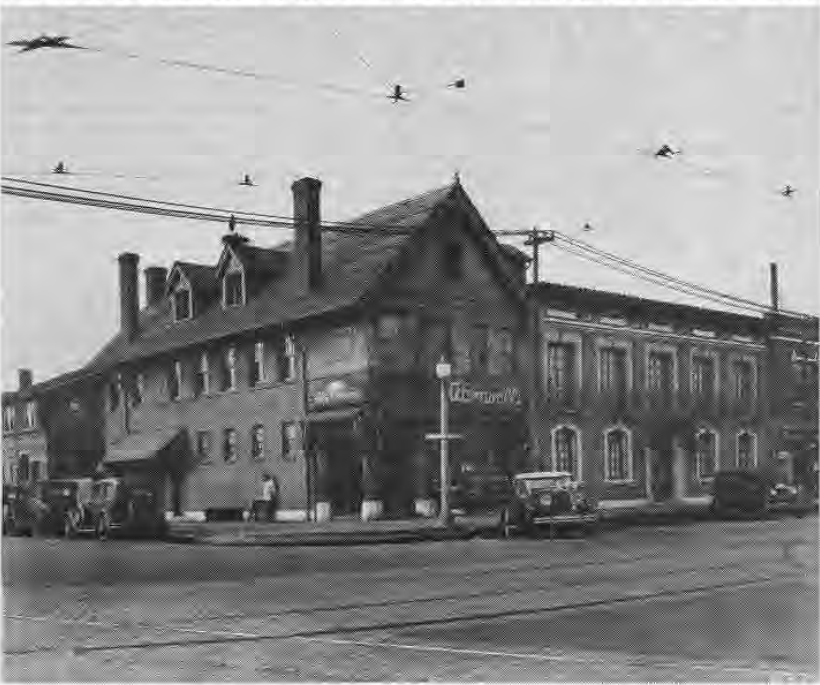
Garavelli's famous restaurant, still located on the corner of DeGiverville and DeBaliviere (now owned by Byron Tompras), was one of the first restaurants in town to have curb service. You could park your car on either side of DeGiverville, and a waiter would come out, take your order and bring it to your car when it was ready. (52)
There was a Kroger store on the south side of the 6100 block of Pershing near Des Peres. Judge Tammany walked in there on a Saturday afternoon in 1927, and the proprietor exclaimed, "Lindy made it!"
The above local businesses are just a few of those mentioned by Dick Hart and Judge Tammany. The point is that the residents of Skinker-DeBaliviere did not have very far to go to obtain most of the necessary services.
During the Depression of the 1930s, our neighborhood again seemed to follow the pattern of most of the rest of the country. A three-story house in good shape was sold for only $3,500. Dorr and Zeller moved out in the 1930s. It was located at the northwest corner of Waterman and DeBaliviere (now the site of the Technical Education Corporation), and was famed throughout the city for its ice cream, bakery goods and catering service.
One story that all the people we talked to recall is that of The Gardenia. The Gardenia was a flower shop (a frame building with no basement) which would be right in the center of what is now the intersection of Forest Park Parkway and Skinker. It was very popular with local boys for corsages because it was handy and the prices were reasonable. When, after legal battles, the building was torn down to widen the street, it was learned that the proprietor was really a "squatter" and had never owned the property on which he had built his business. (42)
The 1940s brought World War II, and Judge Tammany and Dick Hart recall that during the war the apartments in the neighborhood were mainly owner-occupied and well maintained. It was after the war, in the late 1940s and early 1950s, that the owners began to move from their buildings. Apartments were subdivided (quietly!) because of the housing shortage and rent ceilings.
Judge Tammany was first elected Magistrate Judge in 1950. He remembers our neighborhood as always politically active as well as being the home of political leaders. In 1940, the candidates for governor were Lawrence McDaniel, Democrat, and Forest Donnell, Republican. Mr. McDaniel lived on the south side of the 5900 block of Waterman, and Mr. Donnell lived in St. Louis County. Both were members and leading laymen at Grace Methodist Church. The present alderman of the 28th Ward, John G. Roach, and Steve Vossmeyer, State Representative, 86th District, now reside in our neighborhood, as do Judge Carl Gaertner and election commissioners of the City of St. Louis James S. McClellan and Wayne Millsap. Our neighborhood has always been in the 28th Ward. Judge Tammany commented that in the 1940s and 1950s the Republicans almost always carried the ward in city elections and the Democrats almost always carried the ward in national elections.
As we moved into the Fifties, the quality of neighborhood life seemed fairly consistent with that of preceding decades. The neighborhood was still characterized by residents as a "good place to raise a family". It was convenient to the principal shopping and commercial center—downtown St. Louis. Neighborhood stores provided residents with a variety of services. There were several drugstores, groceries, a bakery, cleaners, hardware stores and even an open-air fruit and vegetable market next to the present A & P (Tony Sansone's). A pet store, Mrs. Turner's Flower Shop and a sporting goods store offered some of the "extras" residents might desire. As for entertainment, residents were surrounded by choices. Restaurants provided food to fit almost any desire, from a Parkmoor hamburger to a pizza at Sorrento's to roast beef at Garavelli's. There were several convenient movie theaters. Neighborhood taverns offered places to get together with friends over a beer, and several night clubs flourished. The Winter Garden provided an indoor skating rink. An afternoon of bicycling in Forest Park began at a bike rental store next to the present International Market on DeBaliviere.
Along with this consistency there was one obvious change. Our neighborhood was in the midst of a "population boom". With the war over, college enrollments rose. The convenience of the area to both Washington University and St. Louis University attracted many new residents, some of whom were students and some faculty members. As the Fifties progressed, a building boom in the county eased the post-war housing shortage and continued a trend of "westward movement" that had been interrupted by the World Wars.
As we have seen throughout this history (which necessarily involves the history of the larger metropolitan area), the trend in St. Louis population movement has been westward. We saw how Daniel Catlin at the age of 79 was "moving on" from Vandeventer Place to Westmoreland Place. The stories of both Grace Methodist and Delmar Baptist congregations are classic examples of this movement. Added to this historic "westward population shift" in the Fifties, there was a very real reason for moving west. Urban decay had taken its toll in areas east of Grand Avenue. Large areas such as the Mill Creek Valley were declared blighted. With the buildings scheduled for demolition, residents had to move. It is probably the less obvious factors connected with our population boom and the renewed westward movement that were most important to what happened in the neighborhood later. During the years of housing shortages many owners of rental property occupied one of the dwelling units of their own buildings. As the housing supply increased, it was often the owners of rental property who made the move to the new houses beyond the city limits. Thus many buildings lost the supervision of an owner who was close at hand. Another result of the population boom was that it kept the demand for housing in our area high in the Fifties. Consequently, the emergency housing measures taken after the war continued to operate. The small apartments that had been carved out of the larger ones could still be rented, as could the "rooms to let" in the private homes. As the Fifties drew to a close, some rental buildings were beginning to show the strain of a decade of over-occupancy. A change in the concept of a "desirable location" went hand-in-hand with the western movement to the suburbs in the Fifties. Not only home buyers, but also commercial establishments looked to the suburbs as a place to move. For the most part, real estate people readily promoted this idea. For support of their position, they pointed to the advance of urban decay along Page Boulevard toward the Cabanne District adjoining our northern border. With the rental properties in our neighborhood already strained by overcrowding, they decided urban decay would be inevitable here. In the late Fifties some residents of the neighborhood realized that the problems of our area had to be tackled. At this time two neighborhood organizations developed. Washington Heights Neighbors' first murmurings in the fall of 1957 were over a backyard fence between several neighbors. (43) The murmurings soon developed into a letter sent to neighbors on January 2, 1958 which set forth the reasons why an improvement organization was needed: Dear Neighbor: Perhaps you, too, like some of your neighbors have been talking about our neighborhood. We have come to the conclusion that ours is basically a good neighborhood, and that we want to keep it that way. We believe that the only way for us to prevent blight in our neighborhood is for us to act together. (45)
One month later the Washington Heights Neighbors (made up of residents in the area bounded by Delmar Boulevard, Pershing, Des Peres and DeBaliviere Avenues, the Washington Heights 1st Addition and 2nd Addition subdivisions discussed above) was formally organized and moved against housing code violations. Legislation by the Rooming House Association was about to be pushed through the Board of Aldermen, and Washington Heights Neighbors joined with a city-wide organization of neighborhood associations to work against the bill. The neighborhood associations showed overwhelming strength; despite zero weather, the attendance at the hearing for the bill was so large that it had to be moved to Kiel Opera House. The proposal was soundly defeated. (45)
Washington Heights Neighbors concentrated on four other areas of neighborhood concern: Police Action, Traffic, Recreation and Education, and Sanitation. The beautification efforts of the association made news in 1961. Working in cooperation with the Washington Heights Garden Club and the St. Louis Parks Department, residents landscaped three plots of ground: "A triangular area at the intersection of Waterman Boulevard, DeGiverville Avenue and Laurel Street, and two circular tracts at Nina Place and Waterman and Nina Place and McPherson Avenue." (22) Washington Heights Neighbors initiated the practice of an annual house tour and again received publicity; their 1963 tour featured ten homes east of Des Peres. (23)
West of Des Peres Avenue, residents of the 6100 blocks of Washington through Pershing also felt the need to organize. Concerned primarily with the continued existence of full-scale rooming houses and numerous single-room rentals in private homes, these residents formed the Rosedale-Skinker Improvement Association. Annoyed by housing code violations, association members began a campaign of finding out where rooms were being rented illegally. Although their tactics, keeping track of who went in and out and even a record of license numbers, were often referred to as "snooping", the residents persisted and were successful. From their interest in this one housing code violation, the association members moved against other housing code violations and then toward improvements such as alley lights as well as barriers to slow and reduce the flow of traffic on their streets. (49)
Although there were some urban problems evident in our neighborhood during the Fifties, Dorothy Hogan, who was in grade school and began high school during this time, remembers this as a good place to grow up. It was a very "close-knit" neighborhood from Parkview to DeBaliviere. With a large number of friends available, drugstores, Forest Park, and movie theaters within walking distance, the Skinker-DeBaliviere Neighborhood was a great place for a teenager to live.
As the Sixties dawned, our increased neighborhood population needed more community services. Both the public school and the Catholic school entered the decade under the strain of increased enrollment. In 1961 Hamilton School added two steel portable units and then in April, 1963, opened the eight-classroom Hamilton Branch 1. (65) That same year, St. Roch's Church broke ground for its school annex which contained six classrooms, a large gymnasium, faculty rooms, a school office and increased library space. (34, p.19) The St. Louis Public Library opened the Des Peres Branch October 15, 1963, in response to citizen urging, with an initial book collection of about 5,000. (44)
In the mid-Sixties, the self-serving predictions of the real estate companies ten years before appeared to be coming true. The "strained" buildings were in much worse condition than they had been ten years earlier. It seemed to some that the Skinker-DeBaliviere area was a "changing neighborhood" with all the negative connotations of that phrase and its prediction of ultimate doom. The neighborhood did change. Some people moved out, but the change became a revitalization. The remaining residents and the new residents believed it possible for diversified groups to live together. They believed that urban problems could be combated. They believed, as had residents throughout the decades, that the Skinker-DeBaliviere Neighborhood was a good place to live and raise a family.
From the late Sixties to the present, stronger and more cooperative neighborhood feeling has grown up. This is evidenced by the birth of a number of neighborhood organizations and events. In the latter months of 1965, it became clear to many residents that their efforts would have more impact if they formed an area-wide umbrella organization with a budget so that a small full-time staff could be employed. It was felt that such a staff could concentrate the necessary effort in mobilizing the area resources that are so important for the welfare of the community.
The Skinker-DeBaliviere Community Council was formed in March 1966, as a joint effort by the following:
- The Rosedale-Skinker Improvement Association
- Washington Heights Neighbors
- St. Roch's Church
- Grace Methodist Church
- Delmar Baptist Church
- Washington University
The Parkview Agents became a supportive member of the Council in the fall of 1968. James L'Ecuyer was employed as the first Director of the Council, a position he admirably filled until late 1970. The new staff and the Board of the Council quickly turned their attention to those issues of the area that was by then designated by boundaries of Forest Park on the south, Parkview on the west, Delmar Boulevard on the north and DeBaliviere Avenue on the east. The first office of the Council was located in the 5800 block of Delmar. Later the office was moved to two locations at 425 DeBaliviere. The first site was a second floor office and later, to gain more space, the Council moved its office downstairs into a commercial space that had been used by a drug store. A fire totally destroyed the building and the Council then moved to 404 DeBaliviere. (61)
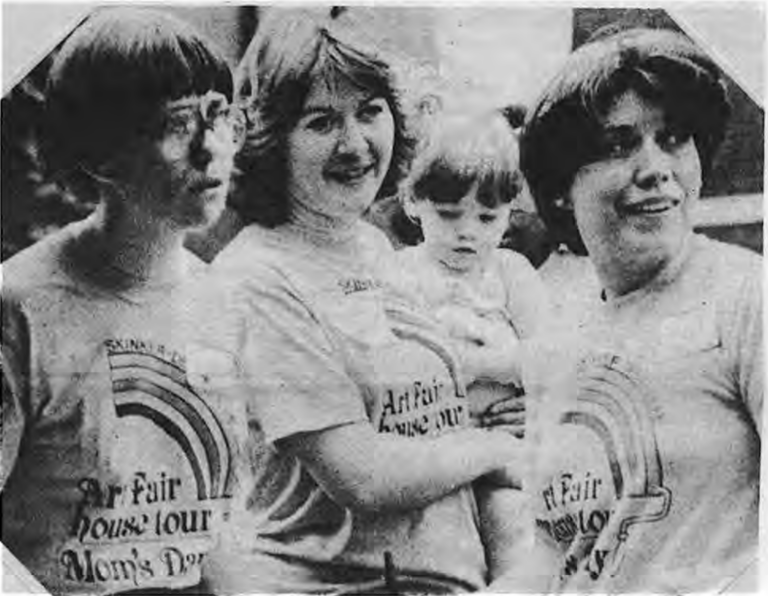
In 1967 Susan M. Roach, a new resident to the area, organized the first neighborhood Art Fair, using St. Roch's parking lot to display the paintings. That year there were 36 entrants contacted by leaflets left at art supply stores. Entrance fees were used to pay a judge and to award three $25.00 prizes. The next year an older custom, a neighborhood house tour, was revived by Joanne Budde in conjunction with the Art Fair. The location of the Art Fair was moved to the 6100 block of Kingsbury Avenue, and the number of entrants grew. By this time the neighborhood had the assistance of several resident artists who could either serve as judges or recruit fellow artists to volunteer as judges. From that point on, the Art Fair-House Tour has supported itself, using the profits of one year to defray costs for the next year. On Mother's Day every year, many hundreds of people from all over the metropolitan area came to our neighborhood to participate in this event. (67)
Thomas W. Flynn, age 20, who moved here at the beginning of the Sixties, has fond memories of growing up in our neighborhood during that decade. He remembers some of his schoolmates moving away, but there were always "a lot of kids" so there was never a lack of friends. Everyone on the block knew each other, and they especially liked outdoor games. He and his friends played Johnny Cross or British Bulldog every night after school. With longer daylight hours during the summer, early evenings were fine for kick-the-can although "neighbors yelled" if the players ran across lawns. For indoor fun there were classes at Jefferson Memorial and Saturday matinees at the Tivoli (now the "Magic Lantern").
As our neighborhood entered the Seventies, cooperation among the various organizations was so effective that Ralston Purina was convinced by residents that it would be detrimental to our neighborhood to have a "Jack-in-the-Box" restaurant located at Skinker and Delmar. The action taken against this large corporation indicated the determination of residents to exercise some control over the fate of the neighborhood.
The establishment of the Residential Service in the spring of 1970 is further evidence of this determination. Realizing that our neighborhood was not being properly represented by real estate companies, Susan Roach and Patricia Kohn organized the Residential Service. This is an entirely volunteer organization. It was originally established with six functioning divisions: promotion; block-unit real estate coordination (which sought to make block residents interested in real estate transactions on their own block); research and records (directed at identifying owners of property and avoiding straw party sales); available property records and research (which kept record of all rental and saleable property in the neighborhood); code violations (which involved a system of reporting and follow-up on code violations); beautification and sanitation (which aimed at improving the appearance of the neighborhood). (46, 68)
In the first year of its organization, the Residential Service found that an overwhelming amount of time was necessary to keep accurate records of available rental and for-sale property. The decision was made to concentrate efforts on property for sale. Several members volunteered to take over this task and became in effect a "not-for-profit real estate service". They kept accurate records on what was for sale and showed the houses to prospective buyers. The 1972 statistics show that the Residential Service was responsible for the sale of 22 homes in the preceding year. It is primarily "word-of-mouth" advertising which has been so successful. (54)
Although the other goals of the Residential Service have been preceded in importance by the sale of property, the Service did sponsor a neighborhood beautification project—the construction of a Tot Lot on vacant ground at the northwest corner of Pershing and Des Peres Avenues. With the design help of a group of Washington University architectural students known as Street Revival, donation of materials from local businesses and the energies of neighbors, the Tot Lot was constructed in the spring of 1971.
As the various parts of the neighborhood worked in closer cooperation, a need arose for a more comprehensive means of communication than the telephone or meetings. Thirty interested residents met in April of 1970 to organize a community newspaper. The Paper, as it is titled, is published approximately ten times a year. Editors and reporters are strictly volunteers. Although advertising is solicited, The Paper has not been entirely self-supporting. It is subsidized by money from the Skinker-DeBaliviere Community Council, The Parkview Association and occasional individual donations. (63)
In 1970, both the Skinker-DeBaliviere Community Council and Des Peres Branch Library moved to new quarters. In November 1970, in order to be more centrally located in the area it served, the Council office was moved to its present location at 6008 Kingsbury Avenue. In that same year there was a major change in the structure of the Council Board. To broaden the area representation on the Board, it was expanded by ten members who are elected from designated sections of the community. Presently, sixteen of the eighteen members of the Board are residents of the neighborhood. In January 1971, Calvin B. Stuart, Jr. became Director of the Council.
The Skinker-DeBaliviere Community Council continues to serve as an umbrella organization working closely with the residents and institutions of the area. The Council holds area-wide issues as its priority with a present emphasis on housing. The volunteer efforts of neighborhood residents are major factors in maintaining both neighborhood stability and growth. With this volunteer and institutional support, the Board of the Council is able to work towards meeting and solving those area issues that must be met to insure the diversity and quality of urban living that is so well represented in the Skinker-DeBaliviere neighborhood. (61)
The library was moved to the southeast corner of Des Peres and Kingsbury in 1970 to be housed in what was previously the Kingsbury Market. Added space was utilized to greatly expend the book collection, more than 20,000 books at present. The library circulates about 35,000 books per year or about five and one-half books per resident. With the move there was an expansion of services. Library users can borrow framed art prints, posters, records, magazines, newspapers as well as current best sellers. Special programs (magic, puppet and animal shows, plays, story hours, vacation reading club for school children) became regular features. (44)
In June of 1972 still another service grew up in response to the needs of the residents of our area and that immediately west of us. The Loop West End People's Clinic is located at 6010 Kingsbury. The clinic grew out of the interest and work of two groups—the Medical Committee for Human Rights and Community Collectives. The first of these is a national organization of people in the medical field. Community Collectives is a group of west area residents who organized to provide community services such as a food co-op. The clinic is entirely financed by donations, initially from interested contributors and now from patients as well. It is staffed by volunteers who are doctors taking their residencies at Barnes and Firmin Desloge hospitals and one physician who is in private practice. Volunteers from the neighborhood do the clerical work. The clinic cares for approximately 250 to 300 patients a month. (69)
Probably the most important development of the late Sixties and early Seventies was the return to neighborhood ownership of rental properties. Not only did many residents of the area begin buying local properties to revitalize, but outside funds also became available for use under the supervision of neighborhood groups through the efforts of both a private organization and the Skinker-DeBaliviere Community Council.
One private organization began such a movement here in 1970. West End Townhouse, Inc. was formed in the latter part of that year as a subsidiary of Continental Telephone Company. Philip Lucier, president of Continental Telephone, was primarily responsible for the formation of West End Townhouse. Based on the premise that existing urban neighborhoods can survive and grow if there is significant new outside investment, West End Townhouse initiated its program of renewing and maintaining rental property in this area. After Mr. Lucier was killed, the West End Townhouse corporation was turned over in trusteeship to the people of St. Roch's parish. It is now managed through a Board of Directors and trustees, and is responsible for the operation of approximately 126 dwelling units in the neighborhood. Recently Washington University and the Roman Catholic Archdiocese of St. Louis pledged to guarantee mortgage loans of the corporation in the amounts of $200,000 and $100,000, respectively. (51, 66)
The Skinker-DeBaliviere Community Council also felt the need to move against the abandonment and dereliction which had occurred in buildings in a portion of our neighborhood. Although the area is not large, it was felt that the deterioration was a threat to the rest of the neighborhood. As a result, it was proposed that the highly blighted area be designated for redevelopment. The proposed designation was discussed at many area meetings and once it had been determined that there was a favorable consensus, an ordinance was approved by the Board of Aldermen designating several areas of the city, including that in the Skinker-DeBaliviere Neighborhood, as available for redevelopment.
The Board of the Skinker-DeBaliviere Community Council, Inc., chose to sponsor and design a redevelopment plan for the area in its neighborhood. With the aid of the Washington University School of Urban Design and a planning group, Team Four, Inc., a thorough plan was submitted to and approved by the Board of Aldermen. Primarily, the approval of the plan meant the naming of the Kingsbury Redevelopment Corporation as redeveloper of the area. The Kingsbury Redevelopment Corporation is presently solely owned by the Skinker DeBaliviere Community Council, Inc. Its purpose is to plan, develop and finance approximately 200 units of new housing of the town house style, for mixed incomes. Eventually the Kingsbury Redevelopment Corporation may maintain ownership and management, but this is subject to change according to the necessities of the availability of financing sources.
The process of developing the program has been tedious and slow. This has much to do with the usual difficulties of residential development, the difficulties of not-for-profit sponsorships, and a recent slow-down and freeze of federally-insured housing through the Department of Housing and Urban Development. The necessary funds for early planning have been raised and the program will soon be submitted to the appropriate groups for funding and insurance.
Although the program has been the cause of some controversy in the area, it is generally felt to be an important factor in the continuing growth of the neighborhood. It is difficult to be absolutely sure of the outcome, but there is a sense that the effort of many people has been worthwhile and well expended. (61)
Even though adult residents have brought about these new organizations and events within our neighborhood, perhaps the best summary of neighborhood feeling can be found in the words of a current six-year-old resident: "One thing about our neighborhood is there are lots of friends here and lots of kids. I like the big houses—they look pretty and neat, and there are lotsa places to hide."
Acknowledgements
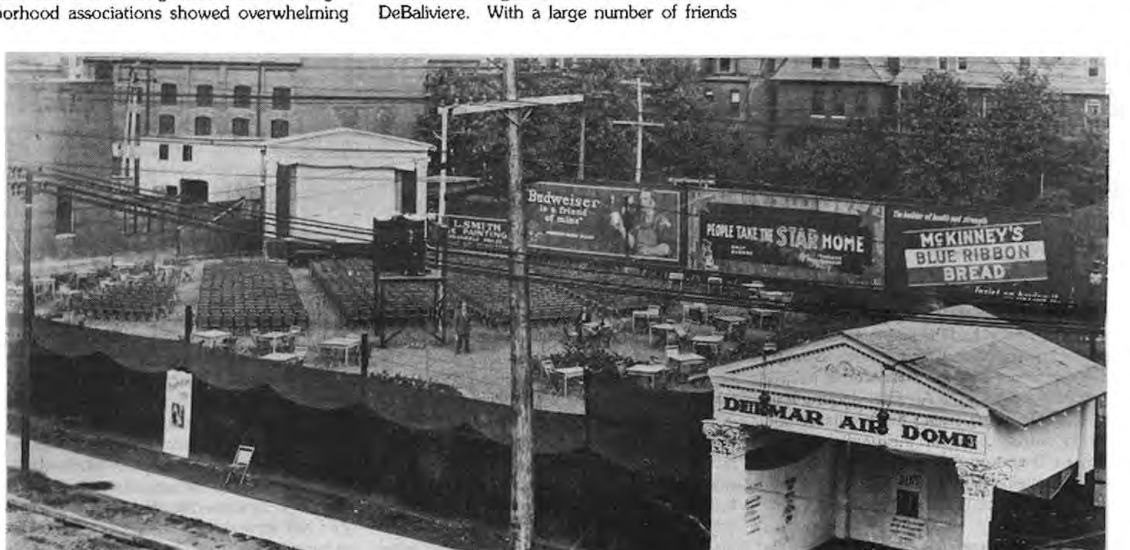
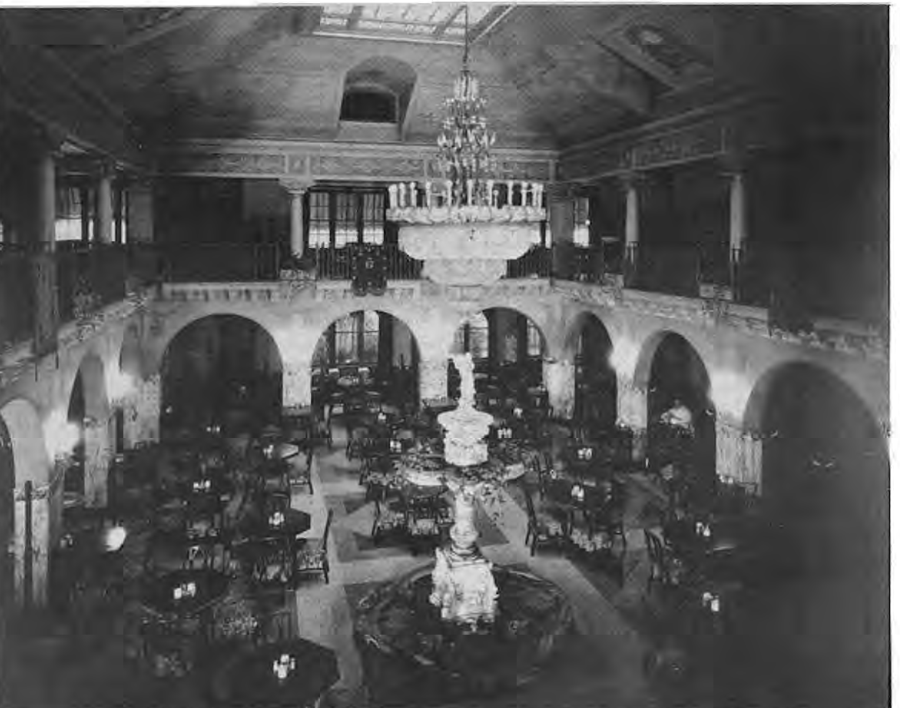
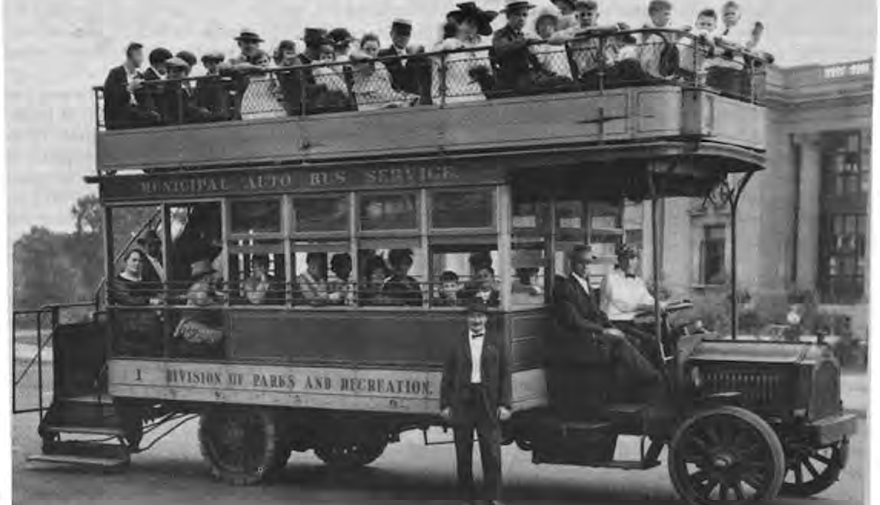
We again want to acknowledge the assistance of the Missouri Historical Society's Karen Goering. Photographs of Garavelli's, The Delmar Air Dome, The Municipal Bus, and The Garavelli's formal dining room were provided by the Missouri Historical Society. We are grateful for their support of our effort with these images.
Join us again in November for the final installment of 1973's The Neighborhood – A History of Skinker DeBaliviere.
Original newspaper source
Originally published in The Times of Skinker-DeBaliviere, September 1999.
Read this article in the original newspaper issue.
Archival date note: the printed issue is September 1999. Only its month or season is established; a first-of-month date is an archival indexing convention, not a verified publication day.
Source-proofing note: the printed page reads “Bonsack” and “expend,” retained here. One word in page 14’s West End Townhouse paragraph is damaged in the available scan; the existing reading “operation” remains provisional pending a cleaner copy.
Open the original issue PDF directly (fallback if the embedded reader does not load).