By JoAnn Vatcha, with assistance from Lana Stein. Originally published in The Times of Skinker-DeBaliviere, June–August 2000, pages 5–8.
Archival date note: the printed issue is dated June–August 2000. June 1 is used for archive indexing; it is not a verified publication day.
Between 1970 and 1980, the Skinker-DeBaliviere neighborhood had a loss in population of 1,132 persons. The area east of DeBaliviere now known as DeBaliviere Place lost 2,617 persons, about 2 1/2 times as great a loss. Thus, the larger area went from 9,574 to 5,825, a loss of over 60%. Our more single-family oriented area was struggling hard to retain its beautiful housing stock, despite redlining by banks and other obstacles. Most residents and leaders of the Skinker-DeBaliviere revitalization effort had definite goals for successful racial integration and worked hard at every turn to further that goal.
The drastic loss of population to the east had no one simple cause. Many of the apartment buildings had been converted to rooming houses during the Depression, and the housing shortages after World War II caused crowded conditions until the widespread move to the suburbs in the 50’s. White flight became a factor in the 60’s; apartment buildings with little cash flow and meager appraisal value were abandoned by owners who had exhausted depreciation and tax benefits. Redlining was the explicit policy of every bank, so possible buyers couldn’t get mortgages. Neighborhood activism against HUD policies and against slumlords also affected the rapidity of the evacuation.
Crime and drugs were serious problems. Events, such as the “West End Rapist,” who terrorized the area and actually turned out to be a policeman, exacerbated the perception of crisis. The “Women’s Crusade Against Crime,” many of whose original members came from the nearby private streets, joined with residents of Skinker-DeBaliviere. Many African-American women like Anna Busch participated with white residents like Suzanne Hart, to try to maintain the stability of the single-family part of the area while fighting blight.
Just imagine DeBaliviere east to the private streets in this seriously deteriorated, frightening state. Riding the bus downtown, I recall seeing vacant buildings on both sides of the street, with broken windows and missing doors. Once I watched unbelieving as a school bus dropped off a child on Clara, just off Pershing, imagining the fear of actually living in such an abandoned area. As one account of the era says, “The whole 106 acres contained block after block of abandoned, decayed buildings in a veritable ghost town.” (McClellan, p. 245). Our only grocery store, Bettendorf’s on DeBaliviere, closed when Schnuck’s bought the chain. Parkmoor Restaurant moved to Clayton Rd. The Apollo had become a porno theater.
West of DeBaliviere, one had only to look north of Waterman to see similar apartment houses and similar signs of blight. By 1971, 39 buildings had already been condemned by the City as unsound or unfit for occupancy. An abandoned Milner Chevrolet lot lay to the north of Kingsbury, and beyond that to the north was the Bi-State property, which had not been improved in many years.
KINGSBURY REDEVELOPMENT CORPORATION
Redevelopment of this “ghost town” area was critical, and the new Alderman, John Roach, was clearly the man to tackle the problem. Roach actually campaigned for re-election while sponsoring a controversial bill to gain redevelopment rights and to blight the area using 353 designation. Alderman Roach worked closely with SDCC’s Cal Stuart, Bob Moore, and Jack Wright; Laddie Cours and Bob Blackburn of Washington University; Richard Hart, and others. They held neighborhood meetings, leading to action by the Board of Aldermen in 1971.
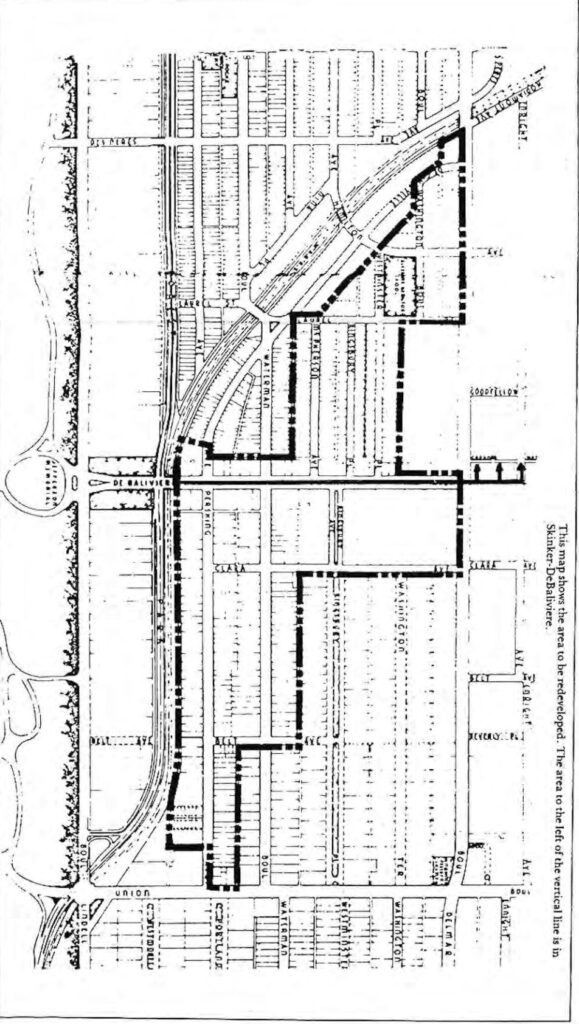
From the ordinance passed in 1971, the Kingsbury Redevelopment Corporation (KRC) was formed. Directors were Cal Stuart, then Executive Director of SDCC, a white neighborhood resident; Bob Moore, then Chairman of SDCC’s Board, and Jack Wright, both black neighborhood residents. The corporation hired the consulting firm Team Four to draw up a plan for the area bounded by Delmar to the north, DeBaliviere to the east, up to but not including DeGiverville on the south/west. The area included the 5700 blocks of Westminster, Kingsbury and McPherson and the 5800 and 5900 blocks of Washington (roughly the area now known as Kingsbury Square). KRC did not cover the area east of DeBaliviere.
The plan was opposed by many residents, especially as it proposed demolition of over 68 buildings, although 39 of them had already been condemned by the City as unsound or unfit for occupancy. Long-time neighbor Willis Lloyd recalled recently the methods used by Team Four, which included using “windshield surveys, not talking to individuals” and generalizing that every block east of Des Peres that had apartment buildings was blighted. Lloyd, who had been a postman in the neighborhood since 1967, and felt that conditions were much more individual and that you couldn’t preserve a neighborhood by tearing everything down. It reminded him of Mill Creek, the infamous urban renewal area around Union Station which had in the 50’s displaced a huge proportion of the African-American population of St. Louis. The very word “blight,” while required in the 353 legislation, brought shades of meaning to redevelopment which were never helpful in gaining support. The language of the report itself was blunt, too, for example, “the Developer’s best estimate is that approximately 1000 people will be displaced by the redevelopment—half by the already slated City program and half by the Developer.” (Team Four, p. 13)
To address the issues of race and fairness, a large Redevelopment Corporation Board was also formed, 40% of whom were black, locally active residents of the neighborhood, as well as William Douthit, President of the Urban League of St. Louis. The “Women for City Living” opposed including any subsidized housing. But the plan was eventually approved by the Board of Aldermen in 1972. A new Redevelopment Advisory Committee was formed to solicit input from the neighborhood and included Jean Eberle, representing Parkview, Council Smith, representing Washington Heights, and Ed Stout, representing Rosedale. This group held a series of meetings and wrote periodic pieces for THE PAPER to try and communicate issues and outcomes to the community.
Even with a plan on paper, for three years potential developers failed to find financing. During this time, redlining was rampant here and elsewhere—it was 1975 before the Community Reinvestment Act was passed by Congress. John Roach, who had worked on the Board of Aldermen to obtain funding for the City from the brand-new federal Community Development Block Grants, ran for Comptroller in 1973, then left the Board of Aldermen in 1975 to become the first Director of the City’s Community Development Agency. Roach instituted several programs patterned after the successful redevelopment efforts in Skinker DeBaliviere. When Conway became mayor in 1977, Roach left CDA to join Leon Strauss at Pantheon Corporation to implement development projects. From 1975 on, a new and energetic alderman, Vince Schoemehl, took the lead in redevelopment of the area.
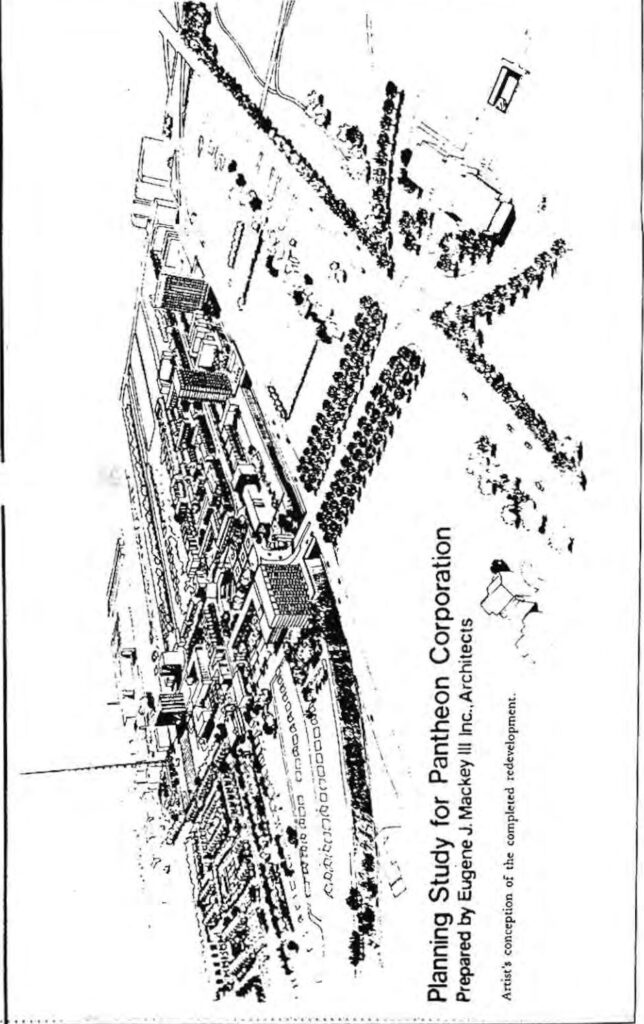
SDCC, after being granted several extensions by the City to find a developer, began in 1975 working with Pantheon, which had just completed Convent Gardens in the Central West End. According to Jean Eberle, who wrote in the October, 1975, issue of THE PAPER, the “History of Redevelopment in Skinker-DeBaliviere”:
A large factor in the Board’s decision was the knowledge that Pantheon had set up the proper structure to do the work and had financial support from the Mercantile Trust Company to begin…the imaginative plan presented by Mr. Strauss to begin the redevelopment near Pershing and Union and move west along DeBaliviere and north to Delmar and Clara and then into the ‘triangle area’…SDCC was also impressed by Mr Strauss’ enthusiastic reception to the proposed citizens’ advisory committee.
DISSENT
Although most residents were committed to the ideal of racial harmony and an integrated neighborhood, making the area both successful and diverse was a huge challenge, and suspicions and stereotypes among both black and white affected the redevelopment efforts. There was disagreement among the activists as well. In letters to the Editor in THE PAPER in 1977, Jack Wright, Esther Herron, Vivienne Dobbs, Richard Lake all wrote about being criticized for speaking out on the issue of a community center proposed for the center of the redevelopment area: “as a resident of this neighborhood, I’ll speak up on issues that I feel are detrimental” and “you should not want a Rubber Stamp Organization”, and “if this is not American where you can speak out, then where is it?” (PAPER, )
At the end of the 70’s, change was again at hand. Partly because of his success as Alderman, including the strong development efforts and coalitions built in the neighborhood, Schoemehl began his run for Mayor. Things changed at SDCC as Cal Stuart resigned as Executive Director to join his wife Gee in their apartment management company, McPherson Management. The beloved Father Peet retired from St. Roch’s. Truly a new era was about to begin in the neighborhood.
By 1980, when long-time neighborhood activist Ken Cohen wrote about Pantheon’s progress for THE PAPER, the Able Key and Hardware Store had been built, the Winter Garden senior building was rehabbed, Waterman’s condos were being completed between Clara and Belt, 242 apartments on Pershing were underway, and construction had begun in Kingsbury Square, after widespread demolition of the apartment buildings on Kingsbury and Westminster west of DeBaliviere, along with clearance of the old Chevrolet lot. Bi-State was ready to build its new garage as well.
These disputes also changed the dynamics of existing neighborhood organizations, including the Washington Heights organization. Instead, Block Units became the key instrument for stability and improvement throughout Washington Heights. Notable examples are the outstanding record of the 5900 block of DeGiverville, with such exemplary leaders as Esther Herron and Eddie Sanders; the 5700 block of DeGiverville, led by Al and Shirley Polk who have organized an annual picnic for 30 years bringing both black and white neighbors together. On the 5700 block of Pershing, Anna and Horace Busch’s leadership spilled over in many other activities, including St. Roch’s, SDCC, and the 28th Ward Regular Democrats. On the 5700 block of Waterman, Blanche Reel and Rose and George Storey worked hard to promote unity. Throughout the neighborhood, Block Units also supported other activities of the SDCC while it undertook the difficult decisions related to redevelopment.
The disputes over redevelopment of the area adjoining DeBaliviere resurfaced years later over Nina Place, which will be covered in our next installment.
DIVERSITY AND SUCCESS
Race was and is an important part of living in Skinker DeBaliviere. The proportion of black to white changed from 1970 to 1980 and then back again in 1990. 1970 Population-6060: 44% white, 55% black, 1% other. 1980 Population—4928; 35% white, 64% black, 1% other. 1990 Population-5601; 41% white, 56% black, 3% other. Between 1970 and 1990, our neighborhood actually became more diverse, as it became successful. A Loyola University Study states that only “5% of American Neighborhoods are racially diverse and stable (rather than in transition from say, mostly white to mostly black).” (Chideya, page 132). Despite, or maybe because of, its many struggles, and certainly because of the hard work by many individuals, Skinker-DeBaliviere is undoubtedly one of very few American neighborhoods to succeed in both integration and redevelopment.
AUTHOR’S NOTE
In addition to THE PAPER and its successor, THE TIMES, and interviews with individuals as noted, this installment also relies on the following sources:
1970, 1980 and 1990 Census Data from U.S. Census
Del McClellan, We Stayed to Fight for City Living
C1 Redevelopment Area, Development Plan of Kingsbury Redevelopment Corporation, Prepared by: Team Four, Inc. Urban Design and Planning, 1971
Loyola University study quoted in Farai Chideya’s book, The Color of Our Future
Watch for the next part of the updated neighborhood history, by JoAnn Vatcha, author/editor
St. Roch in the 1970’s
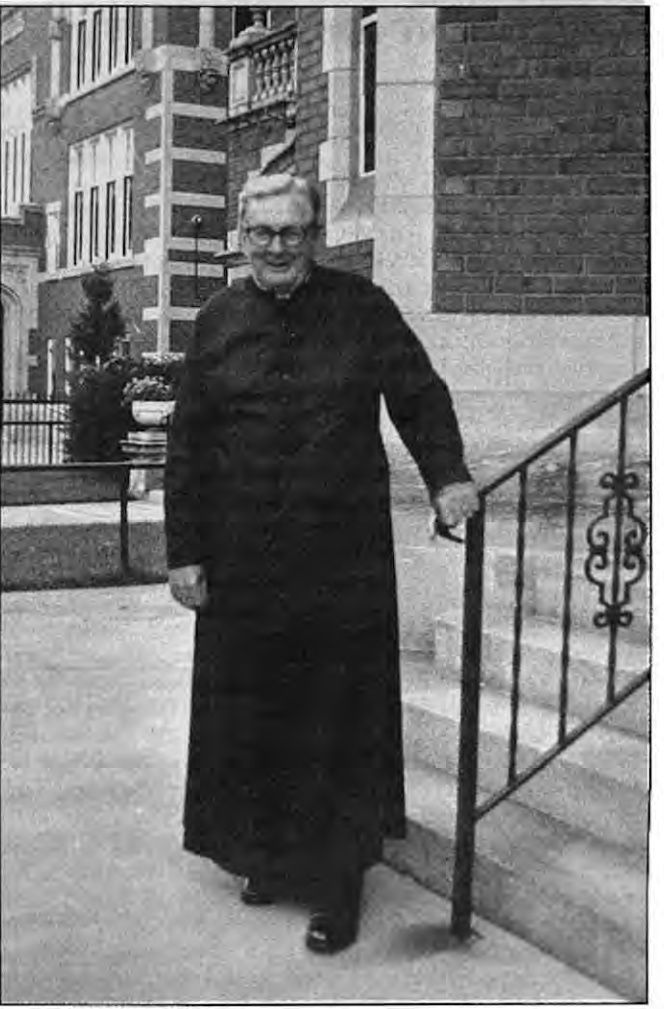
During the turbulent times of the 60’s and 70’s, Skinker-DeBaliviere benefited from the presence of St. Roch and its cleric, Father (later Monsignor) Robert Peet. The Roman Catholic Church divides metropolitan areas into parishes, and, generally, Catholics attend their parish church. Research in the Boston area (Gerald Gamm, Urban Exodus) has demonstrated that white Catholics are not as likely to flee an area when racial change occurs because of their parish ties. St. Roch Parish is a prime example.
Father Peet took part in the march in Selma, Alabama, during the civil rights movement and felt a deep commitment to equality. As Jean Eberle pointed out in 1981:
Father Peet has been an unobtrusive but dominant force in the revitalization of the Skinker-DeBaliviere area. When he arrived in May of 1962, the “smart money” people at real estate companies, lending institutions and insurance firms were writing off this neighborhood. At the same time the changes arising from Vatican II were going into effect in the Catholic Church, so many felt double uncertainty and frustration. One of Father Peet’s first announcements was that St. Roch’s would build a new school building which would include the long-needed gymnasium. This enabled the sixty St. Roch’s children attending other schools to return to St. Roch’s in 1964, and made space available for other local students.
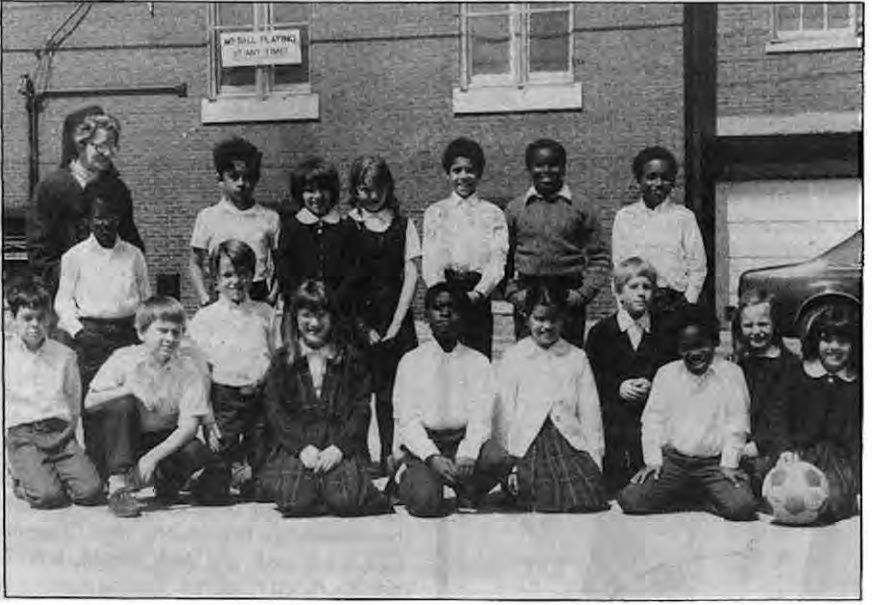
Then, in 1970, St. Roch’s made a bold announcement, that it would open its school to non-Catholics. Many, many parishioners worked hard with the larger community to make this experiment a success. Dr. Jose M. Sanchez, Jr., present of the school board, announced that “St. Roch’s intends to become a genuine neighborhood school, while continuing to maintain its traditional high academic standards.” Writer Jim Hitchcock pointed out in his 1970 article that:
St. Roch’s has consistently had the best record of any parochial school in the city…and ranked first in the Iowa Basic Tests…The school also boasts some distinguished alumni, including the late Dr. Tom Dooley, the famed Laos surgeon, and Michael Harrington, author of The Other America, a book credited with focusing national attention on the problem of poverty in the 60’s.
The school and the church were opened to the wider community. Many SDCC meetings were held at the church hall and “Scariot Hall” was the site of numerous parties, where Catholics and “social Catholics”, white and black, would gather. These events heightened the sense of community for all involved. People still reminisce about St. Patrick’s Day gatherings. Kathleen Hamilton would play the piano and Father Peet would croon. The laughter and warmth of those occasions can easily be brought to mind by those who were there.
It is fortunate for Skinker DeBaliviere that Father Peet, Sister Leo Ann, and so many parishioners believed in the neighborhood. One resident remembered that Father Peet used to walk around the neighborhood in the evening so that residents would see him and feel less afraid. He helped many through darker, more troubled times here. His continual human touch, his steady involvement with the Council and other neighborhood organizations, his approachability, and his linkage of St. Roch to the community played an immeasurable part in the neighborhood’s comeback. Sister Leo Ann Bub, principal of St. Roch’s School for many years, was also a fearless fighter for the children and neighborhood. She worked closely with non-Catholic parents and lay teachers, as well as the other Sisters of St. Joseph, Sister Charles, Sister Dorothy, Sister Herbert, and others who taught at the school during this challenging time. In 1981 Msgr. Sal Polizzi was named by the Archbishop as pastor of St. Roch’s. Msgr. Polizzi built on that strong foundation and ensured the viability and fiscal health of the school and the church for a long time to come. More about these later times will be explored in future installments.
Original newspaper source
Originally published in The Times of Skinker-DeBaliviere, June–August 2000.
Read this article in the original newspaper issue.
Source pagination: the main article runs on pages 5, 7 and 8; the companion “St. Roch in the 1970’s” sidebar appears on page 6. The page 5 continuation notice points to page 8, but the narrative continues first on page 7.
Open the original issue PDF directly, starting at page 5 (fallback if the archive reader does not load).





