Historical June 1996 article. Dates, prices, services and contacts describe the source period; current availability has not been established.
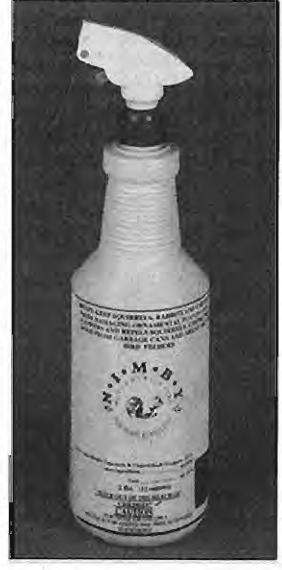
On April 30, 1996, long-time Skinker-Debaliviere residents Neville Vatcha (61XX Westminster) and George Genung (63XX Washington) received final EPA approval for their N.I.M.B.Y. (Not In My Back Yard) squirrel-repellent spray. EPA approval will allow them to begin bottling and marketing the spray through DMX industries, the company which they own.
The NIMBY spray is designed to repel squirrels, chipmunks, rabbits, deer, .dogs and other animals with a sense of smell.
It can be applied to plants and flowers to prevent these animals from damaging them.
The spray is non-toxic and is made from natural oils.
The smell irritates animals which come into contact with it, but does not cause any damage, Neville said.
The solution is water soluble and must be re-applied after a rain or after plants have been watered. Joe Giambalvo, the plant manager at DMX, used the spray in his garden last summer while NIMBY was still in the test phase. “We were having a dry spell and I decided to try it on my tomato plants and see how long it took before a squirrel took one of my tomatoes.
After I applied spray and we didn’t have any rain for a month, I watered the plants at the roots, not the leaves, so that the spray wouldn’t wash off.
It took a month before a squirrel ate one of my tomatoes.
Then I just reapplied the spray.” The spray can also be applied to areas around garbage cans to deter animals which might overturn them.
It can also be applied near bird feeders to repel other animals. Because birds lack a sense of smell, the spray will not repel .them and they will continue to use the feeder. Neville began working on NIMBY in March, 1993, after a conversation with George. George explained that when squirrels gnaw through the covering of outdoor electric wiring, power outages occur.
He was trying to develop a covering which would be thick enough or strong enough to prevent squirrels from gnawing through it. “I realized that squirrels will chew on and damage anything, even steel. What was needed was something to repel and deter squirrels before they could damage it,” Neville said.
After their discussion, they began working in Neville’s basement to develop a formula- For the first tests, they made small plastic containers, identical except that some were made with NIMBY in the plastic.
They filled the containers with peanut butter to attract squirrels and placed them in their back yards.
In a series of tests, squirrels ate the peanut butter in the untreated containers, but did not eat from the treated plastic.
While they had developed their product for industrial purposes, they also realized that it could have consumer uses. “This gave us access to a much larger market,” Neville explained.
During the summer of 1993 Neville and George began seeking EPA approval for a squirrel repellent which could be marketed to consumers. At this time, Neville’s wife JoAnn suggested the name NIMBY for their product.
In the fall of 1993 Neville and George drove to Washington, DC, and spoke with an EPA representative regarding the approval process.
After returning, they repeated their tests following more formalized procedures, and recorded their results for the EPA. “Our actual application was only 4 or 5 pages, but the supporting data is 300-400 pages,” Neville explained.
In the fall of 1994 they submitted the application. JoAnn handled most of the paper work which was involved from the time the application was submitted until they received approval. “I guess I understood some of the bureaucratic language, but I don’t think it helped spged up the process,” JoAnn said, referring to the 18 months which the EPA took to approve their application.
After an application is submitted, the EPA will reply within 90 days, noting anything which needs to be changed. “After we submitted the application, we received a list of concerns the EPA had.
Most of their concerns dealt with our label, where we put our warnings and our ingredients, what size type we used on our warnings, things like that.
We made the changes over a period of a few weeks and resubmitted the application. 90 days later we received a couple of new questions from them.
We went through this cycle five or six times before we had final approval,” JoAnn explained. Neville is now looking for a commercial bottler for the spray and hopes to have one by the end of the month.
Meanwhile George is working on marketing.
He and Neville hope that the product will be available at garden shops and nature stores by the end of the summer. Neville and George are also seeking clarification from the EPA which would allow them to market plastic strips treated with NIMBY which could be wrapped around the trunks of trees and keep away animals such as deer which might damage the trees. Earlier this month, Neville, JoAnn, George and his wife Debbie were all named recipients of the Boatmen’s Bank excellence in minority small business award for 1996 in recognition of the work DMX has done in building their business over the last two years.
Original photograph caption
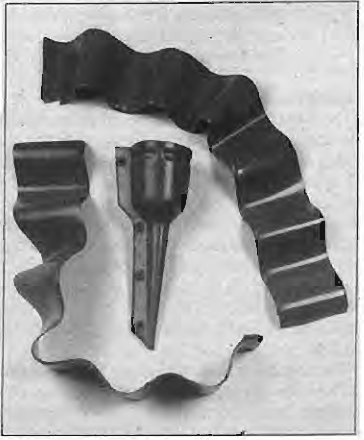
Objects pictured with frontpage NIMBY story teaser. Photographer not credited.
Originally published in The Times of Skinker-DeBaliviere, June 1996.
Read this article in the original newspaper issue.
Original source: SD_Times1996_06.pdf, printed page(s) 3, 1; PDF page(s) 3, 1.
