Historical Fall 2001 article. Dates, prices, services and contacts describe the source period; current availability has not been established.
In the 20 years since Father Salvatore Polizzi arrived in the neighborhood, there have been many changes at St. Roch Church and School.
On the occasion of the 75th Anniversary of St. Roch’s in 1986, neighbor and teacher Joan Breun wrote of the stabilizing force Polizzi was.
The number of families in the parish had doubled in that five years.
The church had been rejuvenated, with many physical improvements and repairs.
The finances of the church had been stabilized, and successful fundraising efforts had been undertaken.
As Msgr. Polizzi says today, Fr. Peet opened the church and school to the entire neighborhood, changing St. Roch’s future, making it a place of diversity and inclusion during hard times in the neighborhood.
It was up to Polizzi to learn to work with a strong parish with a large African-American membership, a school with many non-Catholics, and many women leaders, in addition to the traditional male parish leadership. Polizzi undertook the job with energy, the force of his personality and the reputation for activism he brought with him from The Hill. St. Roch’s did not become an Italian parish, but it didn’t stay Irish either. By 1987, the school had followed societal changes, for example, expanding to a full-day kindergarten and a daycare program. Sister Leo Ann Bub was principal for 24 years, from 1967 until 1991.
As Jean Eberle wrote in 1991, “Realizing that her students needed a safe and stable area, she and former pastor Msgr. Robert M. Peet threw their support behind efforts to integrate the neighborhood successfully.” By 1991, there was not only a stable school population, but many new activities, including a theatre club, a speech club, participation in the Greater St. Louis Science Fair, as well as the regional Math Contest and the many sports activities run by parish ioners and other neighborhood residents.
In 1991, the first lay principal came to St. Roch’s School. Gloria Oppenlander, principal over the past ten years, has restructured the curriculum and worked with parents and teachers to refocus on the individual way each child learns. Along with many new programs, the sense of structure and self-discipline remains strong. Team sports have continued to be strong, led by school sports coach icon Judge Michael Hart, whose mentoring of coaches has enabled several generations of St. Rochers to succeed in basketball, as well as other sports.
As St. Roch’s enters 2001, both church and school seem to have retained a sense of their very important past and their service to the neighborhood, demonstrated clearly in the outpouring of respect and affection at Msgr. Polizzi’s 20th Anniversary Celebration.
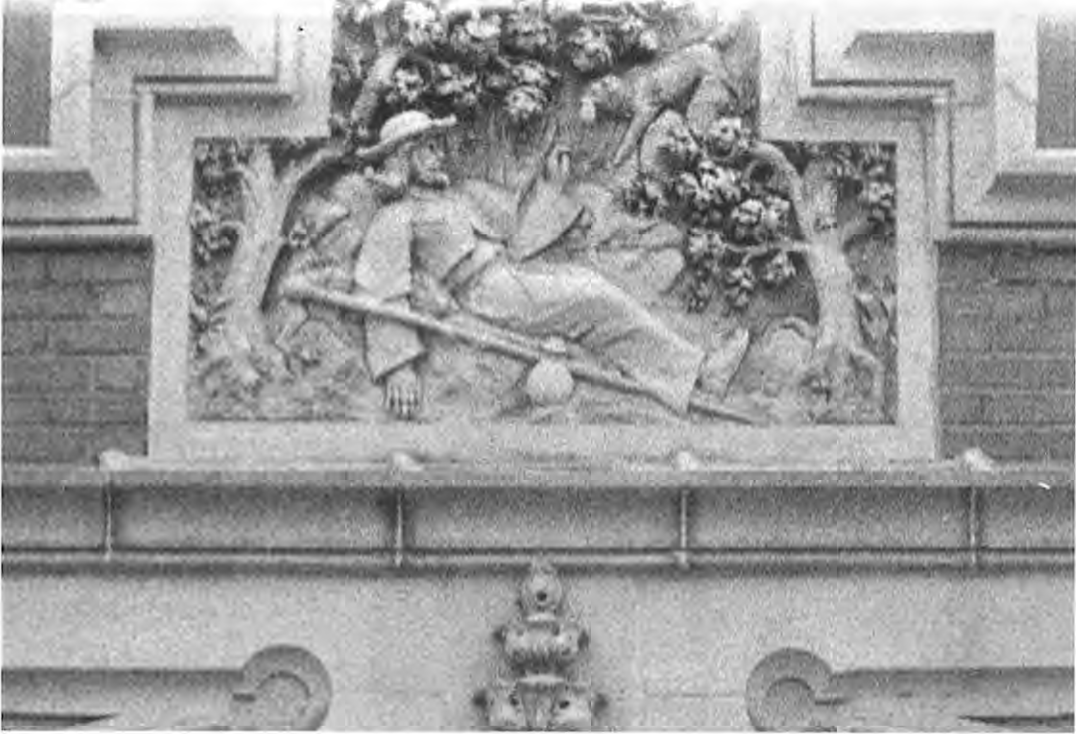
Original photograph caption
Often depicted with a dog by his side, St. Roch was born in Montpelier, France, at the end of the 13th Century. He was canonized for his miraculous cures of plague victims in Italy. Upon becoming ill with the plague himself, St. Roch disappeared into the forest so he would not infect or be a burden on others. Legend has it that his dog brought him bread, sustaining him through the disease. He recovered and returned to France only to be jailed as an Italian spy. St. Roch died in prison after five years. The frieze pictured is located on the porch of St. Roch’s School on Waterman Blvd. The name for the parish was selected in 1911 by a fund-raising competition in which the name was the high bidder. Thus the parish became one of very few named for a canonized layman, an interesting sidelight considering its more recent history in serving both Catholics and non-Catholics. During Sister Leo Ann’s 24 years as principal of St. Roch’s, the connection of St. Roch to his dog seemed singularly appropriate, as Sister was seldom without her faithful companion black lab. His image even showed up on the school T-shirts!
Originally published in The Times of Skinker-DeBaliviere, Fall 2001.
Read this article in the original newspaper issue.
Original source: SD_Times2001_09.pdf, printed page(s) 5; PDF page(s) 5.





