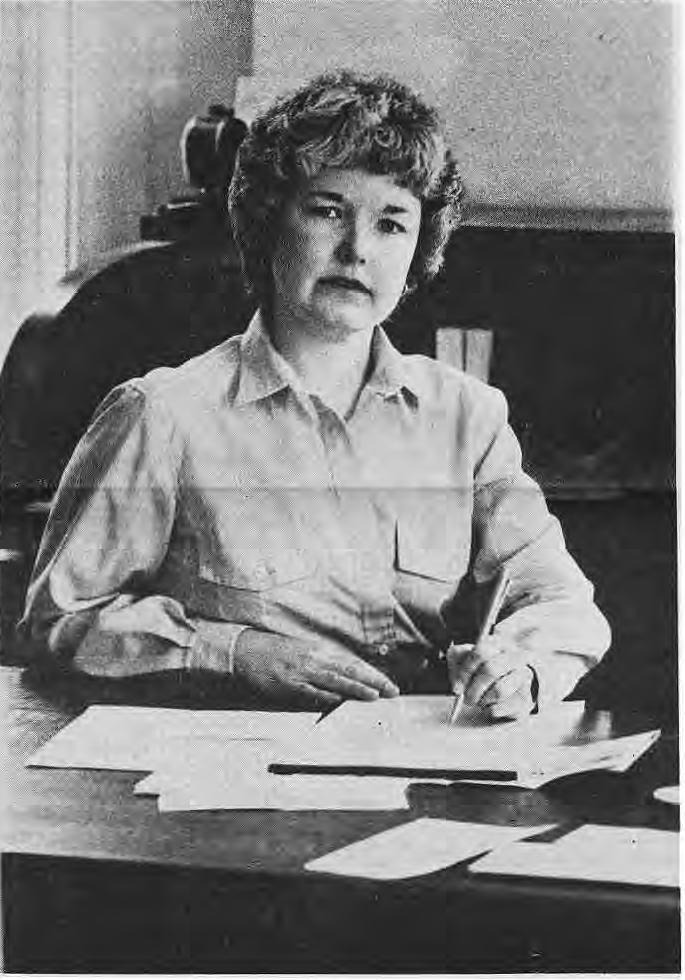
Historical candidate profile, May 1982. Statements about campaign plans and anticipated vote totals are period expectations, not election results.
Along with spring come filing deadlines for state elective office. Marcia Kerz, a resident of the 6100 block of Westminster, will be meeting the deadline for state representative from the newly structured 59th District. Why does she want to run for state office?
As Marcia explains, “There’s nothing more exciting than having the opportunity to work through some of the problems and be involved in the legislative process.” Emphasizing the need for competent legislators able to deal with many different issues, Marcia predicted that federal changes will create more responsibility for the General Assembly with less available money.
Her background in education, taxation, and the legislative process will be an important asset in facing those responsibilities. Marcia’s experiences include being Executive Director of the 1976 Missouri Governor’s Conference on Education; Legislative Educational Supervisor and Budget Analyst for the Illinois House of Representatives; and most recently, Executive Director of the Conference on Education, a nonprofit educational organization. Why now? “I always said that if the right opportunity arose, I would take it,” explained Marcia. “When Steve Vossmeyer decided not to run again, and with redistricting . .. it seemed that this was the best time.” Marcia’s husband, Marv, enthusiastically supports her candidacy.
A third-year law student at St. Louis University, Marv grew up in the 6000 block of Kingsbury, so the Skinker-DeBaliviere portion of the 59th District holds special feelings for them. Marcia pointed out the diverse nature of the new district which also includes part of the Central West End, Parkview, and a section north of Delmar.
The latter is part of the old district of Representative Nat Rivers, who will probably be Marcia Kerz’s major opponent in the Democratic primary election race. Identifying important local issues, Marcia mentioned the large number of elderly citizens, transportation problems, the need for job opportunities, and equitable taxation.
She also feels that it is important to have more female representatives in the General Assembly (currently only about 13 percent of the total, according to Marcia), “but I’m more concerned about competent people in public office, regardless of their sex.” What about campaign strategies? Marcia plans to do as much door-to-door campaigning as possible. “This is the most unique district in Missouri,” she points out, its diversity requires unusual techniques.” Confident that “the voters are becoming more sophisticated,” she will not be a oneissue candidate. Marcia fully expects to campaign evenings and weekends straight through Primary Day on August 3.
Although representing approximately 30,000 Missourians, the primary winner will probably receive only 2,500-3,000 votes.
So each vote really does count. Won’t all that campaigning be rough? “That’s the fun part,” says Marcia. “I get a very warm feeling from people.” I can understand why.
Even though the tape recorder was humming away, Marcia’s direct, detailed answers to questions and her comfortable manner in doing so left no doubt that she will be a formidable candidate as well as a valued neighbor.
As I walked down the street, past the mayor’s residence, past the alderman’s residence, I wondered just what it is in Skinker-DeBaliviere that seems to make it the hardest running neighborhood in St. Louis.
Original photograph caption
Marcia Kerz. The Paper, May 1982, page 1. Photographer not credited.
Originally published in The Paper, May 1982.
Read this article in the original newspaper issue.
Original source: SD_Times1982_05.pdf, printed page(s) 1; PDF page(s) 1.
