
Historical May 1980 report or notice. Original dates, prices and contacts describe the source period; current availability has not been established.
Most people in the neighborhood will concede that it is only a matter of time before someone raises again the question “. . . and just what kind of architecture is St. Roch’s?” The question seems to come up in the spring when outsiders wander in to see how we cope with city living.
First thing you know they have seen —or heard — the church tower and want to know about it.
Of course the tower is Gothic, but is it French? German? Tudor?
Until recently I, for my own part, hadn’t cared.
I knew that whoever designed the church had got a little bit carried away with the facade, but I could live with that.
Then last summer, quite unexpectedly, everything changed when I ran across the photograph of a painting that rendered what appeared to be the tower of St. Roch’s Church, though inexplicably surrounded by a mediaeval town of steep peaked roofs.
I was astounded.
Of course the tower was not St. Roch’s at all, but the resemblance was remarkable.
Even the colors of the tower were the same: warm colored brick with details in stone.
I was so excited. I would tell the whole neighborhood about it. I would show them the picture. I would write an article for the Paper about it.
The painting was by a Flemish artist, and the little town was Bruges, so I looked for and found a larger photograph of the painting in a book on Belgian Gothic.
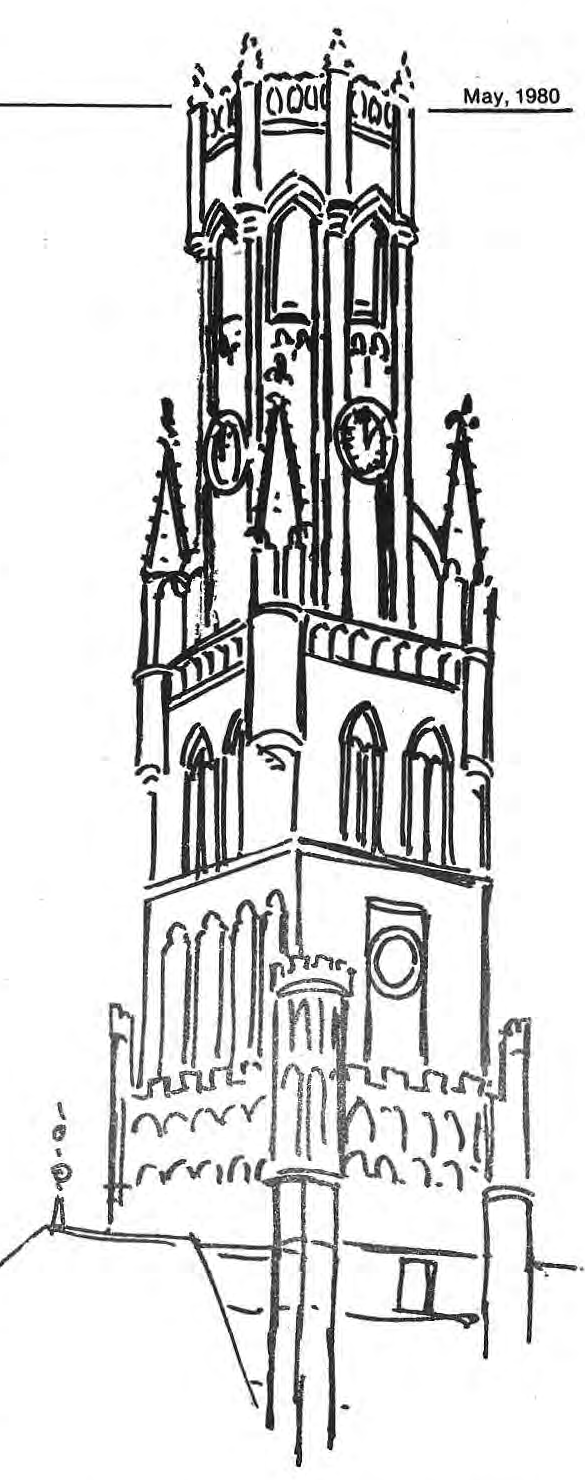
This I traced and have reproduced here for you to see.
As it turned out, the mediaeval tower that looked so familiar was the famous Bruges Belfry. (Bill Kohn, our artist on Kingsbury, says he sketched it many, many times while in Belgium.) You may be surprised to learn that the Bruges Belfry is not on a church but on a trade hall — or, more precisely, on a cloth hall — where cloth from the weaver’s trade was bought and sold.
The hall was begun in 1248, while the upper part of the tower belongs to the 15th century.
It is the upper part of the tower, with its octagonal shape, that resembles St. Roch’s.
From the same book, Gothic Art in Belgium (Van de Walle) I sketched the pictures of windows whose shape and motifs were similar to those of St. Roch’s. (See insert) Of course gothic styles overlap into the architecture of other countries as influences spread with the craftsmen and artisans that created this great art, thus making it difficult to pin a true “nationality” on much of the Gothic we see.
But with such strong similarities in these two towers, the peaked roof line of the rectory and the red brick stair step motif above the doorways of the church itself which are all suggestive of the Flemish architecture that surrounds the belfry at Bruges, a nationality does seem to emerge.
And so, as to the question of what is the architecture of St. Roch’s, I can only say that for some the answer will always be arguable, while for me — well, I can hardly wait for the next person to ask!
Original photograph caption
St. Roch’s Church. The Paper, May 1980, page 11. Photographer not credited.
Originally published in The Paper, May 1980.
Read this article in the original newspaper issue.
Original source: SD_Times1980_05.pdf, printed page(s) 11; PDF page(s) 11.
