此内容暂无简体中文译文,以下为英文原文。
Historical February–March 2025 article. Dates, prices, services and contacts describe the source period; current availability has not been established.
Late winter (February to March) is a good time to prune shrubs and trees. People have known for thousands of years that cutting a plant back could improve it.
According to one ancient legend, a donkey introduced the practice of pruning to people.
When the donkey fed on a wild grapevine, people noticed that the vine produced more grapes. Today there are four main reasons why people prune – to maintain health, to remove damaged or diseased parts, to improve or maintain the size and shape, and to improve flowering or fruiting. Removing new adventitious growth can often be helpful to a plant because plants often dedicate too much energy to producing new growth. Removing new branches like suckers or water sprouts will allow a tree to send more energy to existing leaves, flowers, and fruit buds. Branches that cross or rub against other branches are also removed to limit the risk of damage from rubbing, which gives pests a route to the inside of the plant. Branches damaged by pests or heavy weather, like ice or thunderstorms, can damage or cause disease. Removing these damaged parts prevents further injury to the healthy parts of the tree.
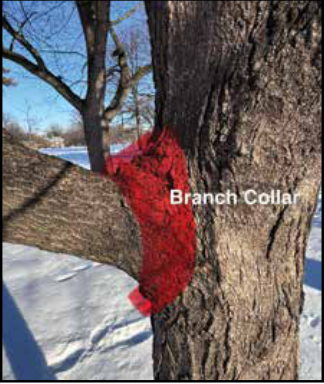
On large trees, you can often spot disease before trees even leaf out from the presence of fungi, differences in bark, or the lack of small twigs. Many shrubs and fruit trees can be rejuvenated or renewed by the right kind of pruning. Shrubs that you have had for a long time and no longer look nice can be reborn by pruning them down to the ground. Examples are forsythia, weigela, privet, honeysuckle, and hydrangea This is typically done in late winter. Shrubs can also be renewed by less aggressive, selective pruning, where you remove ⅓ of the oldest stems yearly for three years. For the health of the tree or shrub, it is important to recognize the branch collar when you are pruning.
The branch collar is a slightly raised ring, noticeable where a branch attaches to a larger stem. Often the collar’s surface looks slightly different from the rest of the branch.
It is considered best practice to prune at the branch collar. You do not want to leave a stub or cut too flush on the larger branch. Either one can prevent the plant from recovering from the pruning cut.
The branch collar allows the plant to properly compartmentalize the wound, keeping out weather, insects, and disease.
The most useful tools are hand pruners, loppers, and small pruning saws.
It is important to use sharp and clean tools to prevent unnecessary damage or disease. Experienced pruners often carry a spray bottle of disinfectant to clean tools before moving to a new plant. Hand pruners are most effective on branches up to ¾ inch thick. Larger than that and you risk
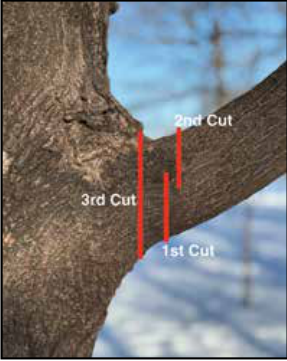
tearing bark around the cut, causing injury. Loppers generally cut well up to 1 ½ to 2 inches, but again beware that cutting larger branches may increase the chances of tearing the bark and causing injury. For larger branches, use a pruning saw. Often, people prune larger branches with the three-cut method.
This involves first cutting ⅓ of the way through the bottom of the branch (this prevents bark from being torn off), followed by a cut further up the branch (to take it off), then a final clean-up cut near the branch collar (to give the plant a chance to compartmentalize). Using this method, the bark collar is more likely to grow over the cut, repairing it. You can use this method for larger branches too, but be aware that your safety is the most important priority. Leave branches very large or high in a tree for professional arborists. For full-grown trees, an arborist is a smart idea.
The larger the tree, the more valuable it is, and arborists are experts at detecting the signs of problems early, saving a tree.
While pruning is important, overpruning can be bad for a plant. Overpruning can cause wild growth, introduce decay through wounds, and removes the leaf area necessary for the plant to photosynthesize.
Most recommendations are for a max of 15-25% of leaf area pruned in a season. Late winter is a good time to prune because plants are not actively growing, which provides several advantages. Because most plants are bare, it is easy to see where plants would benefit from pruning. Many plant diseases are not active in cold weather. Shrubs and trees are still dormant – they are not allocating much of their energy to producing leaves, flowers and fruit, so they can spend their energy to repair wounds. So get outside; it is time to prune your shrubs and trees.
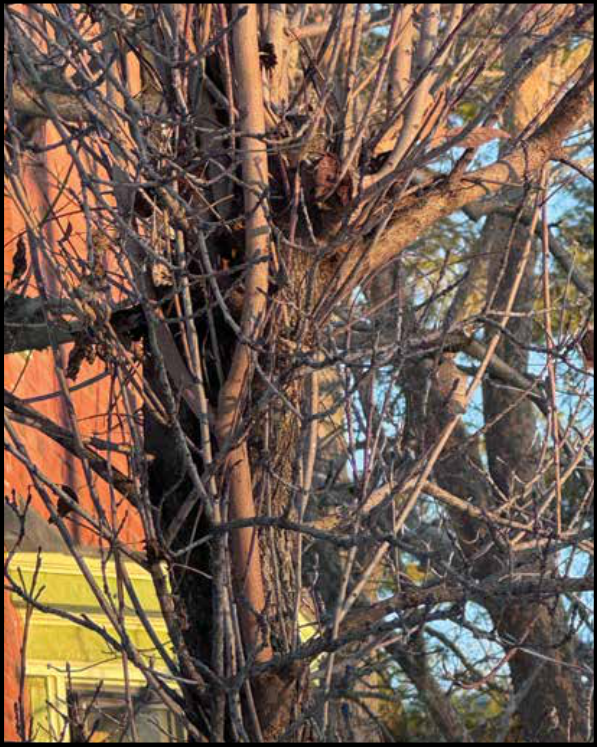
Original photograph caption
Shrub accompanying pruning article.
Originally published in The Times of Skinker-DeBaliviere, February–March 2025.
Read this article in the original newspaper issue.
Original source: SD_Times2025_02.pdf, printed page(s) 6; PDF page(s) 6.





