此内容暂无简体中文译文,以下为英文原文。
Historical November–December 2024 article. Dates, prices, services and contacts describe the source period; current availability has not been established.
This is a call to compost uneaten food.
We are lucky to live in a community with rich food traditions – restaurants of all types, international grocery stores, farmer’s markets, and lots of neighbors who love to cook, but we may avoid thinking about the consequences of uneaten food when it is thrown away. Food waste is a problem.
The Environmental Protection Agency has reported that 31% of our food supply goes uneaten, and the vast majority of that goes into landfills. Uneaten food in landfills is an environmental problem because it is a large source of methane, a greenhouse gas. Methane emissions from food waste are roughly equal to the greenhouse gases produced by about 50 million gaspowered cars. Because food is not cheap, uneaten food also costs us financially.
There are several ways to easily reduce your food waste, which saves you money and keeps waste out of municipal landfills. You can eat more leftovers, cook fruits and vegetables that are beginning to soften too much for fresh eating, and use your freezer.
After you’ve used up the thrifty options, composting what remains is the best tactic for the environment. Composting is helpful for many reasons.
The process keeps the food scraps out of landfills, reducing methane. Compost can be used for gardening, returning valuable nutrients to the soil. Unused food can be composted in a variety of ways from simple backyard methods to large-scale industrial systems.
Some cities, such as New York City, have started municipal composting programs, but currently, the City of St. Louis still needs composting facilities.
If you want to make sure your food waste is composted and don’t want to do it yourself, you can use a service like Perennial City (https://compost.perennial.city/) which provides you with the container for your food waste and picks it up. Their compost is used by local growers.
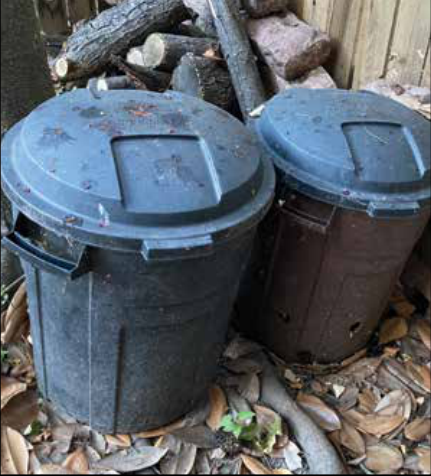
The best backyard composting method is simple. Get two 20 or 30-gallon plastic trash cans and a container for the kitchen. Composting is done in layers, so you’ll use the kitchen container for food waste (“greens”), and one of the two trash cans for storing “browns”.
The second trash can is for the composting process.
In the kitchen container, collect all the fruit and vegetable scraps that would otherwise go in the trash. Avoid meat, milk, and dairy, because they can create bad smells and attract pests.
In one of the trash cans, collect “browns” – older, woodier, longdead materials, like old leaves, wood chips, hay, or shredded paper. Leaves from your yard work great.
In your second trash can, used for the composting process, drill openings or holes in the other to let air in. Airflow prevents the kind of oxygen-free decomposition that creates more greenhouse gases.
Some people also put holes in the bottom of the composting can to allow worms to come up from the soil.
Then start the composting process by layering “browns” and “greens.” Most people use a ratio of 2:1, two parts “browns” to one part “greens.” Start with browns, and make sure that a layer of “browns” is always on top, there is plenty of air, and that everything stays damp to keep the bin healthy.
After a few months, at the bottom of the bin, you will have compost.
It should be dark brown, crumbly, and smell like damp earth. You can use it to improve your garden soil and, along the way, you will have done something to help slow down climate change.
Original photograph caption
Two bins illustrating composting method.
Originally published in The Times of Skinker-DeBaliviere, November–December 2024.
Read this article in the original newspaper issue.
Original source: SD_Times2024_11.pdf, printed page(s) 6; PDF page(s) 6.





