此内容暂无简体中文译文,以下为英文原文。
Historical February–March 2023 article. Dates, prices, services and contacts describe the source period; current availability has not been established.
Exploring our natural surroundings on foot is a great activity, and not just for health reasons. Almost any walk is a mindful activity, gives us time and space to think, and helps us be happier. For thousands of years, thinkers from Aristotle to Thoreau have detected an essential link between walking in nature and physical and mental health.
This is also supported by recent scientific study. Walking in parks is one way to do that.
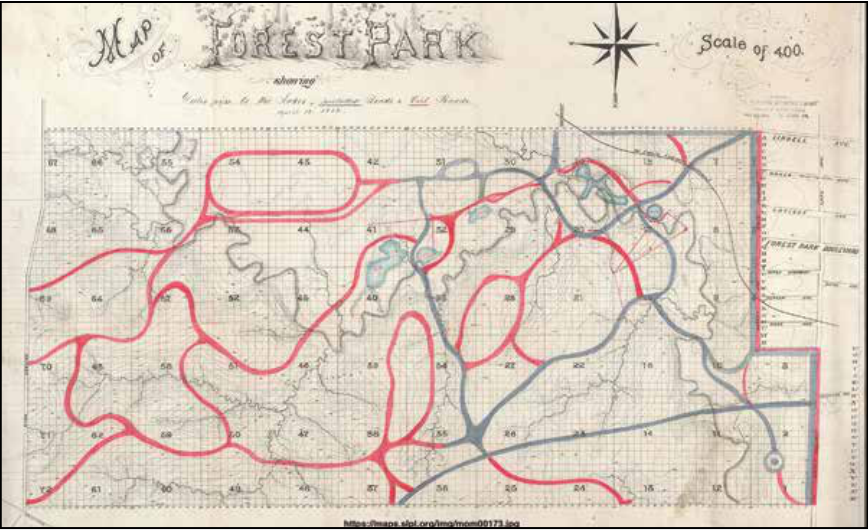
We are lucky to be located next to Forest Park, likely the best US city park. Forest Park has a long history. Plans for the park began in the 1860s and the park first opened in 1876. Citizens and public representatives had realized that the population growth of the city was quickly closing in all the natural areas, and an effort had to be made to preserve some space where “the rich and poor, the merchant and mechanic, the professional man and the day laborer, each with his family and lunch basket, can come and enjoy his own . . . all without stint or hindrance . . . and there will be no notice put up to, ‘Keep off the grass.’” True to its name, Forest Park containsmany natural areas; including-more than 60 acres of mature forest in the southwest corner of the park, dedicated as the Kennedy Forest in the 1960s.
This part of the park alone has more than 3 miles of trails that include seasonal wetlands that support a great variety of birds and frogs.
A benefit of the way this area is maintained is wildlife; old trees are left standing as habitat for wildlife like birds of prey.
Another beautiful natural area is Deer Lake Savannah across from the Muny to the north and east.
This 24 acre area has several miles of trails, which pass through prairie, woodland and wetland areas.
It is a common place to spot large fishing birds, like herons and egrets. At times, however, walkers and wanderers want to get further afield. For this purpose, parks exist on a spectrum from municipal parks to state parks to national parks. Municipal parks tend to focus on recreation that involves equipment and amenities, but often not natural ones. Local parks are very often oriented to the enjoyment of sports and play; state and national parks focus on preserving and protecting areas of unique scenic, historic or natural value. Although Missouri has a respectable number of nationally designated sites that are part of the national park system, most of them exist on the basis of their historic significance. Only the Ozark National Scenic Riverways is established for the value of the natural resources it preserves.
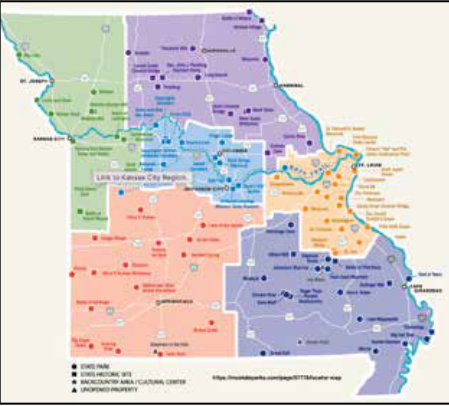
The Missouri state park system makes up for that absence.
The Missouri state parks not only preserve and protect our state’s natural areas for future generations, but also create opportunities for the recreational use of those areas. LIke Forest Park, Missouri’s state parks have been established with the express purpose of conserving and providing access to areas of interest and value. Big Springs is a great example.
It was one of Missouri’s earliest state parks, established in 1924.
It conserves one of the biggest natural springs in the United States. Big Springs has an average daily flow of 286 million gallons of fresh water. By comparison, the Water Division of the City of St. Louis produces an average of 150 million gallons of fresh water every day. Big Springs is no longer part of the Missouri state parks system because it was donated by the citizens of Missouri to the National Park Service in order to establish the Ozark National Scenic Riverways.
However, it still represents an effort by the citizens of Missouri to conserve and provide access to one of the natural wonders of our state.
Some Missouri state parks preserve sites of scenic or historic value, others preserve Missouri’s natural wonders.
In the materials for any state park, visitors find extensive interpretive information carefully constructed to help visitors learn the scientific meaning of what is preserved by the park. Visitors can learn about plant and animal life, geology and most other natural features from experts.
This educational element informs our use of natural resources and provides a long-term benefit to the citizens and the environment.
It comes at a moderate cost, but one that Missouri has always been willing to pay. Since 1984, Missouri’s voters have supported the state park system with an annual sales tax of one tenth of one percent.
This tax is renewed every ten years by voter approval and never has attracted less than a two thirds majority. Missouri voters support our parks.
This sales tax was reapproved last in 2016 by the highest majority ever, with about eighty percent of voters in favor of continuing the tax.
It is recognized by a host of organizations around the state as taxpayer money well spent. Both close by or a few hours away, there are so many places of scenic, historic and natural value that have been conserved for you, so get out and explore our parks!
Original photograph caption
Historical map of Forest Park reproduced with the parks article. Source: maps.slpl.org/Maps/mop 00171.jpg.
Originally published in The Times of Skinker-DeBaliviere, February–March 2023.
Read this article in the original newspaper issue.
Original source: SD_Times2023_02.pdf, printed page(s) 5; PDF page(s) 5.





