此内容暂无简体中文译文,以下为英文原文。
Historical Summer 2022 article. Dates, prices, services and contacts describe the source period; current availability has not been established.
Monarch butterflies are on their way north; it’s time more people paid attention. Many people recognize them but may not know why they are of such great interest to both scientists and wildlife enthusiasts. Although Monarch butterflies are just one kind of butterfly, they are a signature species for many conservation efforts.
This is because the presence of a healthy migration of Monarchs each year is considered an indicator of the ecological health of an area.
In recent years, Monarch populations have had steep and worrisome declines.
To address this problem, conservation efforts are being made to provide them with more of the plants they require.
This is an effort to which you can contribute..
The Eastern Monarch migrates from Mexico to the northern US and Canada in successive generations and then migrates back to Mexico in one single generation. Monarchs can be spotted in our area on their journey north.
The journey often crosses into Canada.
A single monarch makes only part of the journey north; they lay eggs along the journey and their offspring continue the trek.
The Spring migration north requires multiple generations, but the journey south is accomplished by a single generation.. Monarch butterflies have very specific habitat needs–they can only use milkweed for host plants (where they lay their eggs). About four days after being laid, the eggs hatch and the baby caterpillar begins to eat milkweed.
After two weeks, the caterpillar is fully grown and attaches itself to a leaf or stem and forms a chrysalis. Inside the chrysalis, over ten days, the monarch transforms from a caterpillar to a butterfly.
Then the monarch pupa emerges from the chrysalis as a butterfly to feast on other nectar and, except for the last generation, survives only about 2-6 weeks, laying eggs for the next generation. Monarchs go through roughly four generations while migrating north.
The fourth generation lives 8-9 months flying from their summer homes up north to their winter home in Mexico to rest up and start the migration all over again in the spring.
This southern migration also passes through our area. Drastic drops in the number of migrating Monarchs have led to many conservation efforts.
These efforts can be supported by planting in your front or back yards. Although many flowering plants can provide nectar for Monarchs and other butterflies, planting milkweed gives Monarchs an opportunity to breed and increase their numbers. Experts say you don’t need a lot of milkweed plants to attract Monarchs – they have been known to spot a single young plant and lay eggs on it. Swamp or Marsh milkweed is an excellent choice for our area, especially if you have a spot that is often wet, like near a downspout. Swamp milkweed also makes an excellent rain garden plant. Once you get your plants in the ground, check them from time to time for eggs or caterpillars.
It is a treat for kids and adults to witness the changes from tiny caterpillar to chrysalis to butterfly.
When you do get eggs, you can report your sightings on journeynorth.org or use an app like iNaturalist.
There are even Monarch tagging programs, like the one run by Monarchwatch.org that serve scientific research. Monarchwatch has planting guides for butterfly gardens, you can attract a variety of butterflies simply by choosing the right plants. Many local nurseries sell swamp milkweed, but Monarch Watch has an online milkweed market, if plants are sold out locally. Several yards in our neighborhood have already been recognized by Monarch Watch as Monarch Waystation Gardens. Whatever you do, consider planting some milkweed in your yard. That way, you can share your space with Monarchs!
Original photograph caption
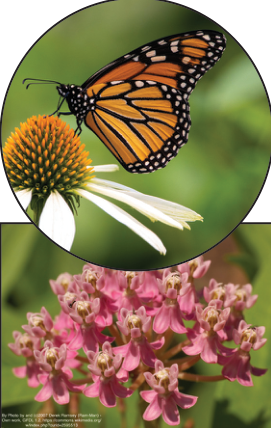
Monarch butterfly and milkweed illustrations.
Originally published in The Times of Skinker-DeBaliviere, Summer 2022.
Read this article in the original newspaper issue.
Original source: SD_Times2022_06.pdf, printed page(s) 5; PDF page(s) 3.





