此内容暂无简体中文译文,以下为英文原文。
Historical November–December 2021 article. Dates, prices, services and contacts describe the source period; current availability has not been established.
Correction: In the last issue of the Times of Skinker DeBaliviere, there was a factual error.
The references to Phosphorus (P) and Potassium (K) were switched throughout the article.
In one place, the text should have read, “Phosphorus is important for root development, flowers and fruit. Potassium is present in every plant cell and plays an active role in moving nutrients within a plant.” A corrected version of the article is available at https://bit.ly/2Z1blsl.
It is fall bulb planting time, so it is time to get some new flower bulbs in the ground. St. Louis has impressive traditions with fall-planted, spring-flowering bulbs going back a way. Perhaps the most memorable are the daffodils along interstates in the city of St. Louis from Operation Brightside; in addition, both Missouri Botanical Gardens and Shaw Nature Reserve have nationally recognized collections and plantings.
The daffodil lawn at Shaw Nature Reserve goes back 80 years and represents the work of an enthusiastic amateur who worked to breed flowers that produced a succession of blooms over a period of months.
There are two main types of flower bulbs that St. Louis gardeners regularly plant, categorized by their planting time: fall bulbs and spring bulbs. Fall bulbs are planted before the onset of cold weather and are winter hardy.
They produce flowers in the spring, the exact flowering time may be different depending on the variety. Gardeners have often planted fall bulbs with this succession in mind, planting a variety of types with different bloom dates to ensure fresh flowers over a longer period. Spring bulbs are planted in the spring and are generally not winter hardy.
These bulbs are dug up and stored over the winter for replanting in the spring. Spring bulbs often flower in the summer or fall. Fall bulbs (spring flowering) include daffodils, crocuses, snowdrops, alliums and heirloom tulips. Spring bulbs (summer and fall flowering) include dahlias, cannas and lilies of the valley.
It is important for all bulbs that you choose spots that get the appropriate amount of sun. Many bulbs need at least 6 hours of sunlight, but because they grow and blossom before trees leaf out, they are sometimes planted in spots that become shaded when trees develop leaves.
This is a common trick with daffodils.
Most bulbs require rich, well-drained soil, so it is often a good practice to add compost when planting. Many bulbs are planted at a depth three times their height. For a two inch tall bulb, that means six inches. Poorly draining soil or over watering bulbs can lead to problems. Bulbs will rot in the ground if overwatered or soil won’t drain well. “Naturalizing” bulbs are often preferred for planting, but check packaging before buying to see whether a variety is “naturalizing.” This only means that the bulb will produce flowers perennially in a spot. Naturalizing bulbs can often be dug up after flowering and divided for planting out.
Some of the countries that have long standing traditions of flower bulb planting, like the Netherlands, where many varieties of flowering bulbs have been cultivated since the 1600s. One interesting tradition is Stinzen lawns. Stinzen lawns are traditional lawns, where a variety of naturalizing, spring flowering bulbs have been planted.
They are planted with careful consideration to bloom time, so that when one type of bulb finishes flowering, the next is beginning. Such plantings might begin with early Spring flowering bulbs like Snowdrops or Hyacinths, progress to Mid-Spring varieties like Daffodils, Fritillaria or mid-season Tulips and end with late Spring flowers like Lilies, Dutch Iris or Alliums. Planting a series of bulbs with a variety of blooming times provides a succession of beautiful flowers. One final point: most bulbs naturalize best when the bulbs and leaves are left to die back, rather than being removed or mowed down. Photosynthesis continues for several weeks (6 weeks to 2 months) after the flower has died, so long as the plant is exposed to light and water.
This will let the plant store energy for the next year; ensuring a vigorous future bloom next year.
Original photograph caption
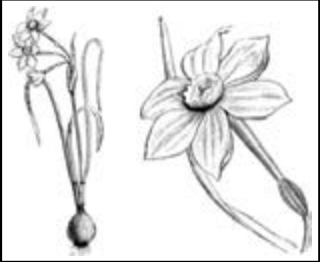
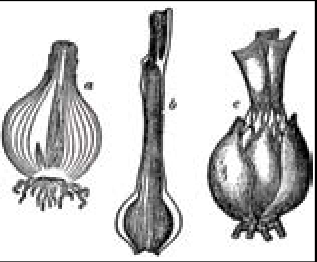
Flower bulb and daffodil illustration.
Originally published in The Times of Skinker-DeBaliviere, November–December 2021.
Read this article in the original newspaper issue.
Original source: SD_Times2021_11.pdf, printed page(s) 5; PDF page(s) 5.





