此内容暂无简体中文译文,以下为英文原文。
Historical September–October 2021 article. Dates, prices, services and contacts describe the source period; current availability has not been established.
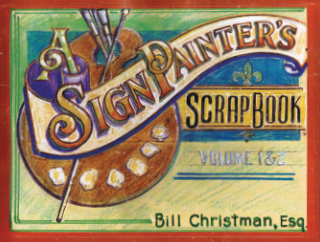
During lockdown, like many families, we spent hours walking around the neighborhood, desperate for a glimpse of something besides the inside of our home. Luckily for the residents of this neighborhood, Skinker Debaliviere is home to the spectacular sculptures of resident artist Bill Christman (6014 of Kingsbury). Every time we walk past, something different would catch our eye: the serene face of the Buddha hovering over the side gate, that jaunty two-story robot high-stepping over the yard, or the glint of light through the colored glass of the New Jerusalem gates. Christman’s 2011 book A Sign Painters Scrapbook, Volume 1 & Volume 2 offers a similarly marvelous visual experience in bound form.
The book celebrates the work of artisans – some professional, some self-taught, their names lost to time – whose work has informed his evolution as an artist. Like Christman’s sculptures, the book evokes both wonder and delight, and it revels in the inventiveness of neglected American roadside attractions (drive-ins, bygone motels, and carnivals).
In the collection, Christman pairs photographs with waggish, insightful commentary; he also incorporates quotations from favorite artists that resonate with the images. Christman’s no snob; while his commentary highlights his deep knowledge of design and design history, it also praises the artistic innovations of anonymous artisans – from the painter of a chubby, grinning Mr. Peanut on a Missouri State Fair sign to a hirsute Big Foot loping across a Route 66 billboard. Readers get an introduction to the greats of American sign-making as well as a crash course in learning how to see some of the underappreciated treasures of Americana surrounding us.
The common theme linking the images and text is an appreciation for the charm of effective sign craft through the decades. Christman pulls images from all over the world, highlighting work from the Czech Republic and Ireland, in particular; primarily, however, he lauds the variety of signs in St. Louis and further south. Think the gaudy chicken-car chimaera advertising Chicken Out in the Loop is an innovation? Christman includes a picture of the chickenshaped truck that once delivered the mysteriously named “Chicken Dinner” chocolate bar around St. Louis (it has a fine set of tail feathers!). Particularly enjoyable to read about are the roadside ice cream stands, liquor shops, and amusement park ride signs; one also discovers the origin of the colossal blue trousers currently in residence outside Joe’s Café (and an excellent directional guide for visitors to the neighborhood. How many twenty-foot-high pairs of trousered legs are there on display in St. Louis? One.) Christman is particularly taken with and knowledgeable about neon signs, and the book introduces readers to several gems.
I was astonished to learn that one of the earliest neon signs in existence resides nearby; this emerald beauty of a sign dating from the 1920s belongs to Daniel Feinberg of Feinberg Real Estate. Throughout the text, Christman draws attention to the complex ways in which neon has been employed in signage – from chasing lights to the rotating wonders of the now-rare Sputnik signs.
In the text, one also learns more about the impressive body of work Christman has created in his diverse career as commercial artist, sign-painter, collector, founder of Christman Studios, and close observer: the street art he crafted with young artists in the 1980s; the iconic typeface he designed for Blueberry Hill; the Cherokee Street statue greeting visitors at the corner of Cherokee and S. Jefferson; the Vintage Vinyl sign featuring Rassan Roland Kirk, the musician who could play three saxes at once; and a wide array of wry “fictitious” signs advertising products and companies he has invented (“Mankind’s Search for Nougat”; Dimwit Brothers Sign Painting).
In an age of computers, Christman notes in his introduction, “the art” of sign-craft has “leached out.” Much of the visual images we see daily are mass-produced, as distant from the hand that made it as our packaged, pre-prepared food is from the ground in which it once grew. Christman’s book is a welcome reminder that artisans still produce vivid, imaginative art, even if one must seek it out in unexpected places.
This Wunderkammer of a book demands reading and re-reading – and it makes one want to pay another visit to Joe’s Café to look again at its splendors.
Original photograph caption
A Sign Painters Scrapbook, Volumes One and Two, by Bill Christman.
Originally published in The Times of Skinker-DeBaliviere, September–October 2021.
Read this article in the original newspaper issue.
Archival transcription note: Printed byline Tim Wookcock variant retained as attribution evidence; Summer editor and biography establish Tim Woodcock spelling.
Original source: SD_Times2021_09.pdf, printed page(s) 7; PDF page(s) 4.





