此内容暂无简体中文译文,以下为英文原文。
Original printed byline: Cecelia Nadal
Historical February–March 2021 article. Dates, prices, services and contacts describe the source period; current availability has not been established.
On January 6 my whole day’s work was disrupted by a mob of seditionists who attempted to take over and destroy America’s Capitol.
It was painful.
I was outraged, glued to the television.
The siege was surreal taking central stage on a day where the highest number of COVID-19 deaths occurred up to that point. Images I was seeing at the Capitol triggered images of our history as one single agonizing story.
An insurgent carrying the confederate flag inside the Capitol of the United States appeared on screen and my mind jumped back to August 2017, in Charlottesville with clashes between white supremacists carrying confederate flags and Black Lives Matter protestors.
The only person to die in Charlottesville was a white woman who supported BLM and was run down by a car driven by a white supremacist.
A videographer filmed a group of insurgents dressed and armed as military men squeezing through the civilian crowd until they joined others in breaking the living barrier of Capitol and DC policeman.
This scene took me back to the 2014 Ferguson protests resulting from the murder of Michael Brown by a Ferguson policeman.
There I saw heavily armed, white, militia men dressed in camouflaged uniforms atop buildings on West Florissant street allegedly protecting business property. No one knew who invited them.
We only knew that the police were not asking them to leave.
The very buildings they “guarded” were suspiciously set on fire.
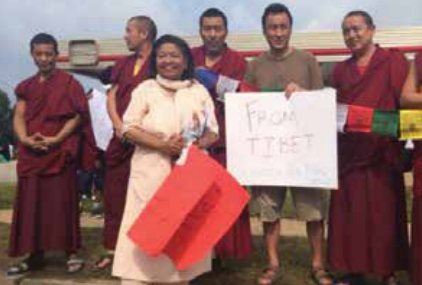
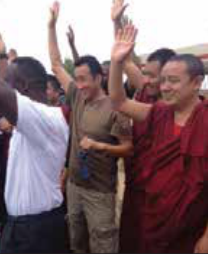
The predominantly white, male crowd at the Capitol that day was so different than the crowds at the Ferguson protests! Men, women, blacks, whites of many faiths were represented including even a group of 8 Tibetan Buddhist monks.
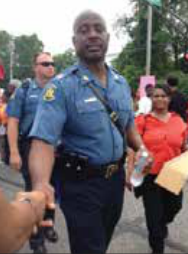
While there were peaceful protests during the day, at night criminal opportunists and rioters came. Peaceful protestors organized to stop the night violence and looting in Ferguson.
They even helped business owners clean up removing broken glass and putting products back on shelves.
I looked hard for intervention in DC at the Capitol, but never saw people try to
stop the mob from hurting police and destroying property.
During a major and violent clash between police and the insurgents at the Capitol, a white woman was shot and killed.
As she fell to the ground many in the mob continued their assault as if crazed. Sadly, she was part of the crowd. At that moment the 1855 hanging of Celia the teenage slave girl in Calloway County, Missouri came to mind. For five long years Celia was brutally raped by her owner until she could take it no more and clubbed him over the head. Twelve angry white men on the jury found her guilty.
I cannot tell you exactly why Celia, a slave, came to mind when the woman at the Capitol was a participant in the mob, however both were victims in different ways!
As reports on the siege wrapped up, I concluded that there were no heroes from the ranks of this all-white mob in Washington DC.
On that ugly day I could not retire for the evening without thinking about ordinary people, white and black, that have fought for democratic principles. Such people entered my stream of consciousness as if to say, “think of us now!” I thought about Andrew Goodman and Michael Schwerner of New York City who joined James Chaney as Mississippi civil rights workers registering African Americans to vote.
The KKK murdered them in 1964.
The only time I smiled that evening was while thinking about Juliette Hampton Morgan, a white socialite and southern belle from Montgomery, Alabama who spoke boldly about the need to oppose white supremacy and didn’t care what her wealthy friends thought! Before closing my eyes from emotional exhaustion with the television turned off, I thought about the bright warm glow that comes from the heroism of ordinary men and women who genuinely care about other citizens and about democracy.
On the other hand, I was reminded on January 6 that only darkness comes from anti-democratic insurgents and white supremacists.
The spirit of democracy is overwhelmingly present when one sees the collaborative actions and unity of men and women who come from all races, walks of life, cultures and faiths.
A week later as we began to get more details about the seditionists, I was struck by Kevin Greeson, one of five people that died at the Capitol.
He was a union vice-president from Alabama who supported Barack Obama and went to his inauguration. Greeson became an ardent supporter of Trump and went to Washington DC on January 6.
He died of a heart attack at the Capitol during the siege. Why the political transformation? Many manufacturers and plants had moved out of the South and Midwest going to foreign countries or closed down due to automation.
As he heard Trump speak, he began to feel that Trump had more business acumen, could help keep jobs in America and open up the plants. Greeson began to embrace Republican politics because of the economy.
There is nothing that shows he was a white supremacist but he was a Fox news follower who eventually started listening exclusively to far right news sources. Reaching out to people like Kevin Greeson is vital to our democracy. Just 12 days later as we celebrated Martin Luther King, I revisited what he had to say about the “beloved community “ after the Montgomery Boycott. “ the end is reconciliation; the end is redemption; the end is the creation of the Beloved Community.
It is this type of spirit and this type of love that can transform opponents into friends.… It is this love which will bring about miracles in the hearts of men.” Dr. King envisioned a beloved community where there was equality in justice, economics, health, and education.
The beloved community would consciously work on insuring this equality because of their genuine love of community. “The aftermath of nonviolence is the creation of the beloved community, while the aftermath of violence is tragic bitterness.” Martin Luther King, Jr., 1957 The inauguration of President Joe Biden and Vice-President Kamala Harris was profoundly inspirational and hopeful. President Biden emphasized that he was there to serve all Americans including those who did not vote for him.
He was passionate about being a President that wants to unite the country and make our democracy stronger.
The youth poet laureate Amanda Gorman left us with this powerful thought: “There is always a light, if only we’re brave enough to see it.
If only we’re brave enough to be it.” The road ahead will not be easy but each of us as neighbors, citizens and leaders can make our democracy stronger by actively helping to create a beloved community.
There is no doubt that history is what gives us depth in our efforts and it is cross-cultural engagement that keeps us honest. So, you are wondering how we can create a beloved community?
In the next issue: “Finding Common Ground.”
Original photograph caption
Photograph accompanying Cecelia Nadal’s Ferguson and Capitol comparison; individual names not captioned.
Originally published in The Times of Skinker-DeBaliviere, February–March 2021.
Read this article in the original newspaper issue.
Original source: SD_Times2021_02.pdf, printed page(s) 3, 4; PDF page(s) 3, 4.





