此内容暂无简体中文译文,以下为英文原文。
Historical February–March 2017 article. Dates, prices, services and contacts describe the source period; current availability has not been established.
Editors Note: Discovered by King Schoenfeld among the voluminous archives of the Post Dispatch now placed online, and digitally enhanced by Marj Weir, the following is a heretofore unknown part of neighborhood history.
The TIMES will continue to endeavor to document and verify the details of our past, wherever they may lead!
In this case, and in part due to space limitations, we have put the full text of this long article on our TIMES website, including the colorful, and indeed sometimes offensive, descriptions of World’s Fair workers from Italy.
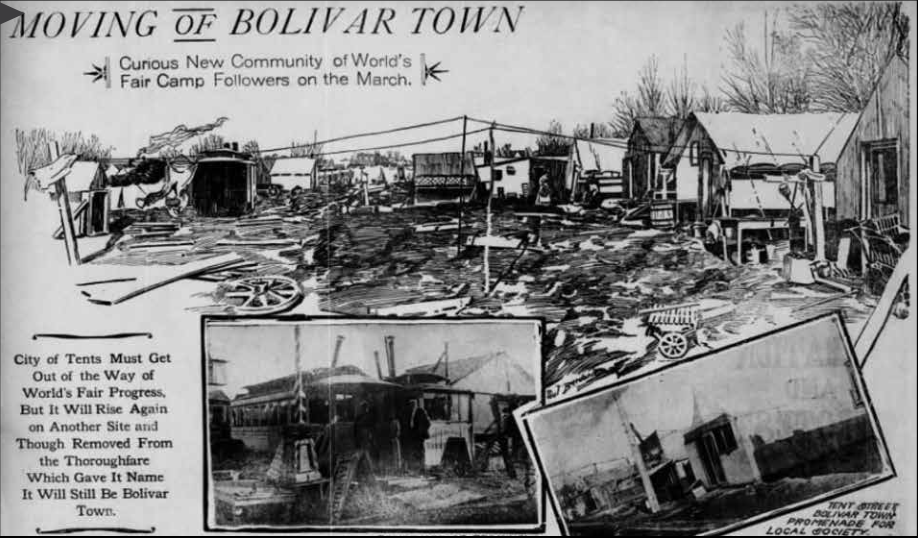
The piece documents in part the prejudices and perceptions of the times, perhaps little different from our own times, with just a change of the ethnicity being described. Go to www.sdtimes.org to read the rest of this interesting tour of DeBaliviere Boulevard. “Moving the Bolivar Town” was published on Sunday, January 3, 1904.
The hegira of Bolivar Town, the new and curious Little Italy of St. Louis, is now under way.
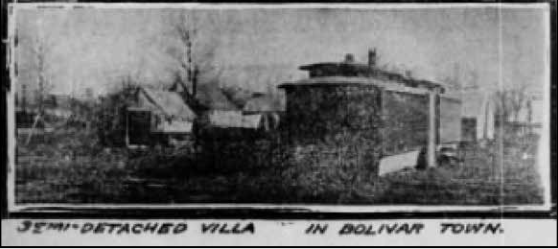
It constitutes a World’s Fair epic. Bolivar Town is the quaint little settlement of worn-out street cars, flapping tents and weatherbeaten frame shanties that stands at the corner of DeBaliviere and Delmar Boulevards, extending south, where the Lindell cars turn into Forest Park on their way to the pavilion near the Palace of Liberal Arts of the World’s Fair.
It owes its name to the fact that “Bolivar” was the nearest approach its speakers could make in the pronunciation of DeBaliviere.
The march of World’s Fair progress has compelled the abandonment of the present site of Bolivar Town.
But it is not the case of the wiping out of a community.
It is, rather, a transference, the removal of the household goods of an entire village from one well-defined location to another—hegira, not extinction. Where Bolivar Town now is, with its entire front facing westward, you will see before many weeks a wide and stately avenue lined with splendid structures.
A mammoth combination hotel and shopping arcade is to greet the eye in the place of the little laundry in a street car that now marks the northern beginning of Bolivar Town.
The $350,000 Criban Clubhouse will arise at the southern extremity at the Bolivar Town of today.
The great Napoleon Bonaparte Hotel, costing $300,000, is to be built just off the southeast edge of Bolivar Town.
It is because of these things that Bolivar Town must move.
The inexorable law of the “survival of the fittest” creates the necessity.
The inhabitants of Bolivar Town, who live after the manner of the patriarchs of old, in tents, are mainly Italian plaster workers employed on the World’s Fair grounds.
They will establish their new canvas town on vacant land about 300 feet east of where they are now. It’s lucky for them they live in temporary structures.
All that is necessary for the removal of such a village is to “Strike Camp” and make a sprinting dash for the next point of settlement. Many of them have already done this. Bolivar Town owes its original foundation to native local demand, but it soon became a foreign colony.
The first “shacks” that went up in this curious settlement were for the accommodation of employees of the St. Louis Transit Co., the motormen and conductors of the division whose offices and car sheds are located on the opposite corner.
It is a busy junction and transfer point.
In that corner and a little eating place in an abandoned street car was the first Bolivar Town structure. Trade was good and soon there was a tiny laundry, followed by a barber shop. Next and enterprising cobbler set up his bench in a corner of one of the ramshackle old cars that had been placed on the veteran retired list.
All this began about three years ago…. And so it has come about that the site of Bolivar Town has been shifted bodily and that the pretty stretch along DeBaliviere avenue which knew the town once will know it no more forever. “Go west, young man,” said Horace Greeley—but the folk of Bolivar Town went east, about 300 feet. And they’re there now until further notice.
Original photograph caption
Moving of Bolivar Town original 1904 newspaper illustration and captions.
Originally published in The Times of Skinker-DeBaliviere, February–March 2017.
Read this article in the original newspaper issue.
Archival transcription note: Editor announces full 1904 article available online; only printed excerpt is supplied here. Locate existing full online version before duplicate or representing excerpt as complete original.
Original source: SD_Times2017_02.pdf, printed page(s) 7; PDF page(s) 7.





