此内容暂无简体中文译文,以下为英文原文。
Historical April–May 2016 article. Dates, prices, services and contacts describe the source period; current availability has not been established.
Twenty years ago this month, the SDCC was created in the SD neighborhood. Funded by the area institutions—WU and the three largest neighborhood churches, St. Roch’s, Grace Methodist, and Delmar Baptist—it was set up to do what neither they nor the Rosedale and Washington Heights groups were prepared to do individually: provide a permanent, paid, fulltime staff to work on any and all problems affecting the neighborhood.
The staff was to furnish, on behalf of these institutions and groups, a continuing daily presence in the neighborhood, which over the years proved to be a more important contribution than any particular problem it was able to solve.
The idea for the SDCC, like so many ideas and projects in the neighborhood, came out of a series of meetings. Lots of meetings. Often held at Grace Methodist Church, the meetings were attended by people who represented the local churches and the neighborhood organizations. Usually in attendance were such people as Dr. Hager of Grace Methodist, Father Griesedieck of St. Roch’s, Dr. Loughhead of Delmar Baptist, Bob Blackburn from Washington University, Jim L’Ecuyer from Rosedale-Skinker (the forerunner of the present Rosedale Neighbors Assn.), and Joe Botz from Washington Heights.
A number of others were present from time to time, but this was the main group.
The topic for discussion was the neighborhood itself. SD in 1965 was beginning to show signs of wear.
Some houses which formerly were well-kept were becoming run-down.
A growing number were vacant and staying vacant for a longer time.
Some apartment buildings were becoming shabby.
The 5700 blocks of McPherson, Kingsbury and
Westminster, running west from DeBaliviere, had a number of these. Their height and close spacing gave them the appearance of the tenements more familiar in certain cities on the East Coast.
These blocks were sometimes called “the canyons” by local people. DeBaliviere Boulevard itself was becoming seedier and the ambience was “late Gaslight Square”.
While the Apollo Theatre was operating as an art house, showing quality foreign films, the Stardust Lounge did steady business as a strip joint, featuring the ecdysiast Evelyn West and her heavily underwritten if not supported bustline.
There were some vacant storefronts on “The Strip” and some fires of suspicious origin. Neighborhood appearance issues weren’t the only things on the minds of the people at the Grace Church meetings. Crimes such as petty theft, burglary, and stealing from automobiles seemed to be on the increase. Street crimes like purse snatching, virtually unheard of years before, began to occur. Then, too, the neighborhood seemed to be getting shortchanged on services from the City for dealing with these problems and political representation seemed dormant if not comatose.
The neighborhood, as it began to integrate, was beset by some of the sleazier tactics of unsavory real estate dealers. People were steered to certain blocks only.
Residents on some blocks were getting scare calls from agents telling them that if they didn’t sell soon they would surely see their investment drop. Federal housing agencies’ programs were being abused by some agents who placed people in houses they could not possibly afford to maintain, since their entire subsidies were being consumed in house payments. Other agents were starting to pull back from doing business in the neighborhood.
The local public schools were overcrowded and rundown. Many neighborhood people felt that the school administration wasn’t sufficiently concerned about local problems.
All of these issues were part of the agendas of those who attended the meetings at Grace Methodist Church. Clearly, some new approach was needed in working on these problems, because they weren’t being solved by the old methods.
But the meetings, as is often the case with such things, usually ended inconclusively.
A number of ideas were proposed, but for a while nothing much happened.
Finally, attorney Richard Hart of the 6000 block of Westminster, proposed that what was needed was some sort of funding to hire a full-time person who would work on problems affecting the neighborhood.
It was this idea which led to the formation of the SDCC.
The concept was that the three churches, Washington University, and the two neighborhood organizations would join together to form a not-for-profit corporation.
The board of directors would consist of one representative from each of these groups (this was to change in later years). Dick Hart filed the incorporation papers and helped write the first by-laws.
The four funding institutions contributed a budget total of about $ 14,000. WU put in $ 5,000 and the three churches put in $ 3000 each.
With this money in place, the Council hired its first executive director, Jim L’Ecuyer, of the 5700 block of DeGiverville. Prior to this, Jim had been president of Rosedale Skinker.
It was Jim who opened the Council’s first office in space donated by Delmar Baptist on the second floor of a building at 5858A Delmar. Thus established, the Council needed to define itself to the neighborhood, to pick its goals, and to select the problems on which it was going to work.
Some in the area totally misunderstood the Council. Jim L’Ecuyer remembers, “They wanted me immediately, within two or three weeks, to stop the trend of integration in the neighborhood.” The Council, itself integrated from the beginning, was determined to proceed in the opposite direction. “We were going to promote integration at any cost, I mean integration was going to work here, or it wouldn’t work at all,” L’Ecuyer said.
The Council embarked upon a period of trying things, experimenting with approaches, seeing what would work in helping the neighborhood.
In so doing, it began to establish, through its director, a permanent daily presence in the neighborhood, which proved to be vital in years to come.
In coming together in the Council, the neighborhood groups and institutions could talk frankly and freely among themselves and could present a united front to outside groups, city agencies, and federal agencies when needed.
In the fall of 1970, Jim L’Ecuyer resigned as executive director after nearly five years of strenuous efforts on the Council’s behalf.
The Council turned to Calvin B. Stuart in January, 1971, to be its new director. Cal Stuart…had been the Council’s president and a representative from Rosedale…By this time the Council was in the office most familiar to neighborhood people at 6008 Kingsbury.
It had moved from a storefront at 404 DeBaliviere which it occupied after being burned out of 433 DeBaliviere in March, 1970. Housing problems in the area became a major focus of the Council.
While the Council in the period of the early 1970s withdrew from direct real estate management, it did not pull back from dealing with real estate problems in the neighborhood.
On certain blocks a deadly sequence threatened certain houses and apartments.
It was foreclosure followed by abandonment, followed by demolition.
It was desirable to head off the sequence entirely, but it was absolutely essential to stop it before step three. Foreclosures in that period were usually started by one of the federal agencies having to do with housing: HUD, FHA, VA. Banks rarely foreclosed because they rarely made loans in the first place. Remembers Stuart, “The HUD policy for foreclosures, nationally, was to tear them down, that they were uninhabitable, not worth a dime, and better cleared.” This policy, if left to operate in the area would have devastated some blocks. Working with newly elected Alderman John G. Roach, Stuart and the Council sought to fend off demolitions. Roach approached HUD with the idea that if they would stop tearing down buildings, the Council would get the buildings rehabbed, and then find buyers and find loans for the buyers.
The marketing would be done through the Residential Service.
This was all enormously difficult and timeconsuming in the early 70’s, but little by little it was accomplished. Stuart recalled that, not counting the “triangle” redevelopment area, the neighborhood only lost three houses to HUD demolition. At one time, said Cal Stuart, “There were twelve houses in the 5800 and 5900 blocks of Waterman almost gone!”… The Council was always working on every aspect of neighborhood life.
It was the Council which obtained Community Development Block Grant funds through CDA to build the Four Corners project at Kingsbury and Des Peres in 1976.
It was the Council which obtained funding to start the Community School at Hamilton School, and at one time or another helped THE PAPER and the People’s Clinic with volunteers and money, encouraged Grace and Peace Fellowship to come into the neighborhood and worked with the churches on their summer programs.
All of this work and activity over the years did pay off, and in many ways.
It attracted many people to the area who found that there was a genuine sense of neighborhood here that didn’t seem to exist elsewhere in the City or County.
It resulted in property values moving upward from the trough they had been in the early 70’s, slowly at first, but then more rapidly later.
It gave the neighborhood a good reputation far beyond its borders and throughout city government.
It made us proud of ourselves. About the time the Council was being planned (mid 60’s), someone at Washington University’s School of Architecture predicted that the Skinker-DeBaliviere neighborhood would be abandoned and demolished by 1970.
He was wildly, spectacularly wrong.
He was wrong because he didn’t pay attention to the kind of people who stayed here in those early days and to the kind of people who joined them.
He didn’t note their ability to organize a Council, for which there was no model, and to make it work.
The Council, ultimately, was the people, and the people have made all the difference.
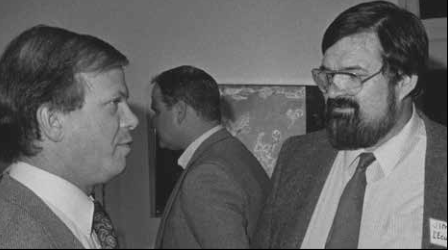
Original photograph caption
Ken Cohen and Jim L’Ecuyer; photograph accompanying the 2016 reprint, date not independently established.
Originally published in The Times of Skinker-DeBaliviere, April–May 2016.
Read this article in the original newspaper issue.
Original source: SD_Times2016_04.pdf, printed page(s) 1, 6; PDF page(s) 1, 6.





