此内容暂无简体中文译文,以下为英文原文。
Historical Summer 2014 article. Dates, prices, services and contacts describe the source period; current availability has not been established.
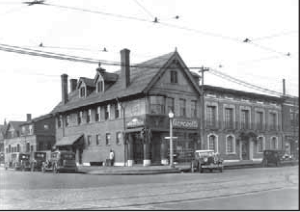
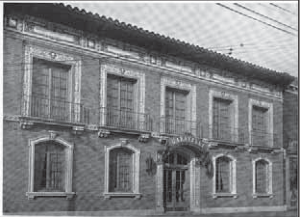
The corner of DeBaliviere and DeGiverville is (for now) a plain old strip mall, but for more than seventy years it held a magnificent German-style building that housed an Italian man’s American Dream. Garavelli’s was one of the jewels of the DeBaliviere Strip. Joe Garavelli came to the US from Italy in 1901 at the tender age of 17 to join his brothers in NYC.
His father was a government official in Bassignana in Northern Italy. “I got so homesick I couldn’t stand it, so I told my brothers they had better send me back home.
They did,” he told Post-Dispatch writer Dickson Terry in 1964. “Before he boarded the ship, he stopped in Macy’s and bought a new hat, a handsome felt of dark blue. ‘When I got back to Italy, my friends all laughed at me,’ he said. ‘They wanted to know why had I come back?
I told them I had just gone to America to buy myself a new hat.'” He returned to the US in 1903 and became a citizen in 1909 while working at Cafferata’s Cafe, just north of DeBaliviere on Delmar.
He soon began to scout locations for his own restaurant and tavern.
He found just the spot at the corner of DeBaliviere and DeGiverville, and the owner of the land was none other than the Anheuser-Busch family.
The brewery actually built the original Garavelli’s for his business in 1914 (see the traditional stork on its chimney nest?), and they promoted it relentlessly in their Bevo Tattler Magazine for the brewery trade. Of course, this was during the time that the Anti-Saloon League was promoting prohibition, and it took Joe three long years to gain the support of the neighborhood to even sell beer.
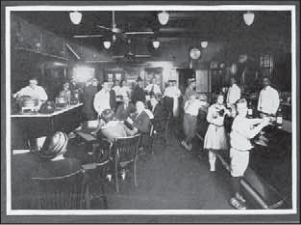
He recounted in later interviews how he survived by making sandwiches for the “motormen” who saw the place from the streetcars and started coming in. By the time Prohibition was a reality across the country in 1919, Joe Garavelli’s tavern had become famous for its food.
The AnheuserBusch brewery also made “near-beer” and soft drinks, and they continued to advertise his success. One article is entitled The Kind of Dealers You’d Like to Have: “We tell you the story as an inspiration …” Another magazine article described how a Chicago restaurant came to be: “Before opening Hinky Dink’s old stand as a modern soft drink and eating house, Signor Toffenetti came to St. Louis and inspected Joe Garavelli’s celebrated soft drink place at DeBaliviere and DeGiverville Avenues.
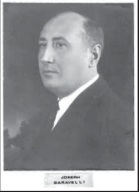
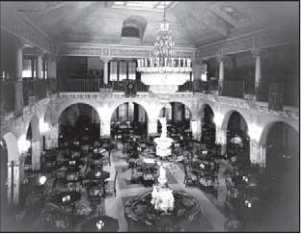
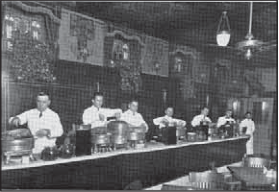
He returned to Chicago and adapted a number of Garavelli’s ideas to his own business. Garavelli’s was the first restaurant to offer curb service, with “seven waiters in white jackets taking care of the automobile trade at the curb.” In 1926, Joe Garavelli built a magnificent Mediterranean-style “dining room” just north of the original tavern. “With its marble walls, its crystal chandelier, and its marble fountain,… Garavelli’s became an institution,” said the Post-Dispatch. Many of these pictures are in an amazing leatherbound collection by photographer C. Trefs, circa 1930, and preserved by the Missouri History Museum.
They include the formal portrait of Garavelli himself we’ve shown here.
During Prohibition, which lasted until 1933, and throughout the Great Depression, Garavelli’s survived and thrived, with Joe greeting everyone with “Hello, my friend.” During the worst years of the depression, “Joe never turned down a man because he was broke. Word of this got around, and when the depression was at its worst there was a steady stream of the hard-up to Joe’s back door, all of whom received a sort of box lunch Joe had devised to meet the situation.
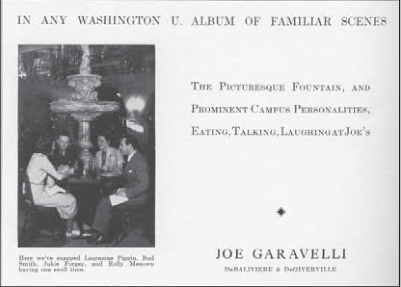
He handed out as many as 150 box lunches a day…the WPA workers in Forest Park and other places in the West End had reason to be grateful to Joe, too. Every day a WPA truck pulled up to the back door with orders for sandwiches and pie, orders Garavelli filled at reduced prices–10 cents for a big sandwich and 10cents for a man-sized slab of pie.” The restaurant was clearly a popular hangout for students at Washington University, seen in this ad in the WU yearbook in 1930.
He even donated $ 10,000 to buy a collection of rare books there.
The donation stayed anonymous until WU asked permission to add new bookplates in 1944.
In 1941, Joe Garavelli retired and sold his beloved business to August Sabadell, the catering manager of the Chase Hotel, but Joe stayed on.
In 1952, the business was again sold, this time to baseball great Stan Musial and his partner “Biggie” Garagnani, who said “we are aware that it is a St. Louis landmark, and we’re going to do the right thing by it.” Their plans never materialized, but instead Byron Tompras leased the property, and, for the next 18 years, he continued many of the Garavelli’s traditions, including Joe himself, who lived nearby on Pershing and came to the restaurant nearly every day. Joe Garavelli died in 1968; the area itself was in decline, with the Stardust and other dubious businesses accelerating the downhill slide. Tompras left in 1973 and shortly after, “the death knell for a St. Louis landmark was sounded”..when the contents were sold at public auction…the 84 foot bar was knocked down for $ 70.” For more than a decade, the building remained abandoned and suffered inexcusable decay.
In the mid 1980’s, a restoration project was announced, amid the deservedly heralded redevelopment of DeBaliviere Place by the Pantheon Corporation, but by July of 1987, they had sold the property to Mestman-Restnik Development, who applied for a demolition permit. Many neighbors protested as the Heritage and Urban Design Commission debated and finally approved demolition of the historic buildings.
The May, 1987, issue of the TIMES gave the details, with heartbreaking photos by King Schoenfeld.
But by July, all the Post-Dispatch could do was cover the demolition. Rita Cohen, who lived next door during the 20’s, recalled the wonders of this great restaurant and how she sat and watched the grand “touring cars” that parked on DeBaliviere.
The beautiful restaurant made DeBaliviere a famous destination.
The Garavelli fountain was sold and moved in 1955 to the Ladue home of businessman Sid Salomon, Jr., and donated to the City of St. Louis in 1973 by then-owner Morton Zalk. Southwest Bank helped sponsor the installation of the fountain at the KingshighwayVandeventer intersection.
It now graces the entrance of the St. Louis Public Library Branch at that location.
The magnificent chandelier sold at auction in 1974 for just over $ 5,250.
Original photograph caption
Here they are — men, women and children — all Joe’s friends.
Originally published in The Times of Skinker-DeBaliviere, Summer 2014.
Read this article in the original newspaper issue.
Archival transcription note: Article describes July 1987 development disposition but says May 1987 Times covered details before July demolition; exact sequence not independently resolved.
Original source: SD_Times2014_06.pdf, printed page(s) 8; PDF page(s) 8.





