此内容暂无简体中文译文,以下为英文原文。

Historical November–December 1999 article. Dates, prices, services and contacts describe the source period; current availability has not been established.
Publication of this new book could hardly be more timely.
The recent loss of accreditation of the St. Louis Public Schools has put an end to hope that conditions might have improved on their own over the past few years. CITY SCHOOLS AND CITY POLITICS: Institutions and Leadership in Pittsburgh, Boston, and St. Louis, by John Portz, Lana Stein, and Robin R. Jones, was published this fall by the University Press of Kansas. Portz is an associate professor at Northeastern University; Jones is coordinator of Community Initiative at the University of South Florida; Stein is associate professor of political science at the University of Missouri St. Louis.
In the book, Stein, who also serves as editor of THE TIMES OF SKINKER-DE BALIVIERE, worked with university colleagues to describe and analyze three cities with similar political and social backgrounds and which have many school system problems in cornMon.
The authors have written a fascinating account of how history and political structure have led to very different responses to the public school crisis, with very different levels of success.
The book uses some statistics, in a restrained and effective way, to show how they arrive at the conclusion that St. Louis places third in almost every way among the three cities analyzed. Of particular interest to me are the descriptions of the historic, structural barriers, which make transformation of the St. Louis Public Schools difficult.
The “cartel-like governing entities” are described, and the striking similarities of St. Louis’ political structure and its school system structure are explored. Observing that the bureaucracy of the St. Louis Public Schools mirrors the City government’s “machine tradition” (p. 113), Stein notes that most City politicians have traditionally been Catholic and attended archdiocesan schools and operate from that framework, whereas most administrators in the St. Louis Public Schools went to public schools themselves, and, indeed, most attended Harris-Stowe. Therefore, the associations and informal connections, as well as the frame of reference, remains politically separate.
In addition, the barriers within the school system are formidable. For example, the top-heavy administration and inbred personnel system is documented carefully.
In 1995, of the top 10 administrators, 3 had been with the system more than 40 years, 3 more than 30 years.
The remaining 4 had all been there at least 24 years. “Seven of the top officials had not held an educational job anywhere else.” (p.122) In addition, there is the dominance throughout the system of alumnae from Harris-Stowe College. Indeed, Superintendent Hammonds (who just this month was awarded a 4-year extension) was the first top administrator hired from outside the system. And although Hammonds was not uncontroversial in his past job, here he has worked slowly, with apparent emphasis on the desegregation Issues, not educational reform. “Institutional inertia” is another well documented topic in the chapter about St. Louis.
A striking example is the way in which a retiring teacher calculates retirement pay at a higher rate if the teacher retires at the beginning of the school year, rather than at the end. “The result each fall is that a significant number of classes lose their teachers just as the new year starts”. (p. 119) The rigidity of the organization is explored in many such interesting ways. Also, the book’s analysis of the desegregation program is very thought-provoking.
The author’s lack of enthusiasm for magnet schools is in clear contrast to the concept of “institutional quality education”, defined as having a goal of quality education for all. Whereas the magnet schools have been successful. for those lucky enough to attend them, even limited successes in Pittsburgh and Boston have had the goal of reforming education quality for everyone in the system.
In St. Louis, by contrast, resolving desegregation has been the main focus. Outside of the internal issues are the equally important failures of the organized corporate body Civic Progress and the City Government to effect change. Unlike counterparts in Boston and Pittsburgh, in St. Louis, Civic Progress has no staff and is too highly linked to changes in the business climate toward non-local ownership of major corporations. “Civic Progress has not played a major role in shaping the debate on educational reform in St. Louis.”(p. 146).
This major failure is reflected in the lack of city government input as well.
In Boston, where a major instrument of change was granting the mayor appointive power over school committees—and recognizing that, unlike St. Louis, Boston has a strong mayor form of government—a new leadership opportunity was created that has increased civic capacity and led to some reforms there.
In St. Louis, the courts took over, and the mayor said he had too much on his plate. Civic Progress offers big-screen ‘TVs as incentives to come to school (and still 25% of the students are absent the first week).
In ranking the three cities for school reform, St. Louis is last again.
As the academic reviewers note, this is a “first-rate book … with appeal to a wide audience” (Barbara Ferman).
While all three authors have written clearly and well about their cities, it is naturally St. Louis we find most compelling. Though I—like most St. Louisans I know—frequently feel that I must not have the “big picture” in my own knowledge of the schools, after reading this book, I felt my doubts confirmed and expanded. Truly, whether the St. Louis Public Schools can be successfully reformed remains a very big question, Since the state’s action on reaccreditation, we as a community have finally begun to acknowledge the urgency of the issue.
This book points out many possible approaches to reform, and the many obstacles we have structured around us. Will we even try to do anything?
Original photograph caption
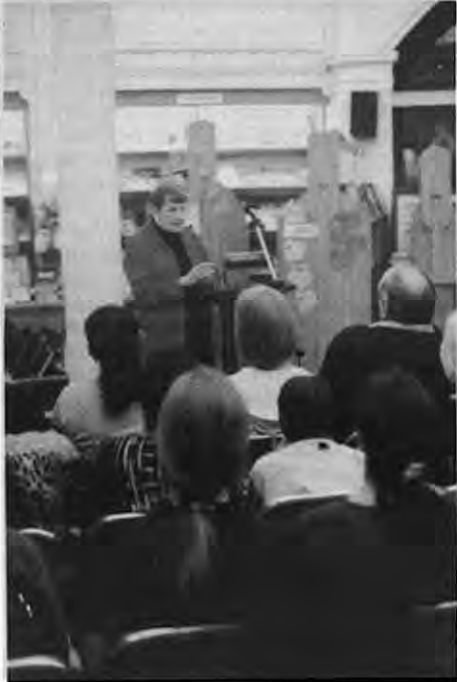
Lana Stein at book discussion. Page photos credited to King Schoenfeld.

Originally published in The Times of Skinker-DeBaliviere, November–December 1999.
Read this article in the original newspaper issue.
Original source: SD_Times1999_11.pdf, printed page(s) 4; PDF page(s) 4.





