此内容暂无简体中文译文,以下为英文原文。
Historical December 1984 report or notice. Original dates, prices and contacts describe the source period; current availability has not been established.
The walls of the Stella Maris Child Center reflect the joy and delight of the children it serves. Brightly painted school buses have a child’s stick-figure face in each window.
And posters report the children’s answers to such questions as “How does a car move?” One three-year-old replied “the brakes make the car move” and another “the computers make it work.” When asked “What is Thanksgiving,” one pre-schooler said: “Candy, chicken.
We thank you for cake.” But the children are not the only ones enjoying themselves. Their parents are too. Paula Repetto, who started threeyear-old Reeve at the Center last May, is impressed with its warmth, the caliber of the teachers, and the quality of the program. “I think its a great place.” she says.
The Center’s staff is just as pleased.
Last year, they faced a difficult transitional period when they moved five blocks from Union Boulevard to new quarters at the southeast corner of Delmar and DeBaliviere, in a beautiful 1928 structure remodeled by Pantheon Corporation. “Now we’re at a stabilizing stage,” says Dennis Shaughnessy, director for the past seven years, whose background includes counselling, psychology, and personnel management. “The excitement of our relocation and building a new program from the ground up is over. We’ve made tremendously rapid growth.
Now we’d like to maintain the quality of things we’ve developed.” With an enrollment of 133 children, from infants to kindergartners, the Center is virtually at capacity. Only a couple of places are currently available in the oldest group, he says.
There are also a thriving before and after school programs.
One of the greatest strengths of the Center is its diversity.
As they had expected, some 35 percent of the children come from the Pershing-DeBaliviere Redevelopment Area: expanding those boundaries one block north of Delmar encompasses 60 percent of the students.
But in the infant-toddler group especially, the children come from a wide area, some seven or eight zip codes in all. “I think we go out of our way to represent the neighborhood mix as it really is: culturally, racially, socio-economically,” says Shaughnessy. “I had no idea so many immigrants lived in this area.
We serve their children, too.
He quickly credits the success of the Center to his “super-qualified staff,” headed by nine supervisory teachers with degrees in early childhood education and related fields.
They have entered into a cooperative arrangement with nearly every college in the area to use students of early childhood education as part-time trainees.
Altogether, including the able kitchen staff which prepares the children’s hot meals, there are fifty staff members.
This kind of quality care costs money and the non-profit, United Way-supported center has a half million dollar annual budget.
With the help of a growing Friends organization, they are also working actively to retire a $30,000 debt incurred as part of the move.
A fund raiser this summer brought in $2,500, a schoolwide raffle is now underway, and another event next spring is currently being planned.
The center’s tuition is based on a sliding scale and ranges from $34 to $76 per week, depending upon family size and income as well as the child’s age (the younger the child, the more expensive the care). State Title XX funds pay the bulk of the tuition for families whose income falls below the minimum level on the center’s scale: $11,500 for a two-person family. Parents, in turn, often comment on the quality of the program, noting that their pre-schoolers have developed surprising language and pre-reading skills.
But there is also a strong arts and crafts component, illustrated by the fish with crepepaper tails hanging in the two-year-old room.
The children take frequent field trips, too, in a van donated to the Center a year ago by the Variety Club.
The center, which celebrated its 40th anniversary last year, was staffed by nuns during World War II to serve the children of women working in defense plants. (The name “Stella Maris” is Latin for star of the sea.) In its early days, the six-day-a-week program cost families an average of $3 per week. Today, the center looks ahead to its future.
This summer, they hope to add a summer program for school-age children up to age ten, with field trips and swimming.
They will also expand their before and after school programs. “We are supplying really top quality care, in the face of the tendency to treat children as units to be processed,” says Shaughnessy. “It’s very satisfying.” (If you would care to donate good quality used items—or new ones—to the center, here is a list of some things they need: Playground equipment: wheeled toys and wagons; cots, sheets, and towels; books: table toys; dress-up things.)
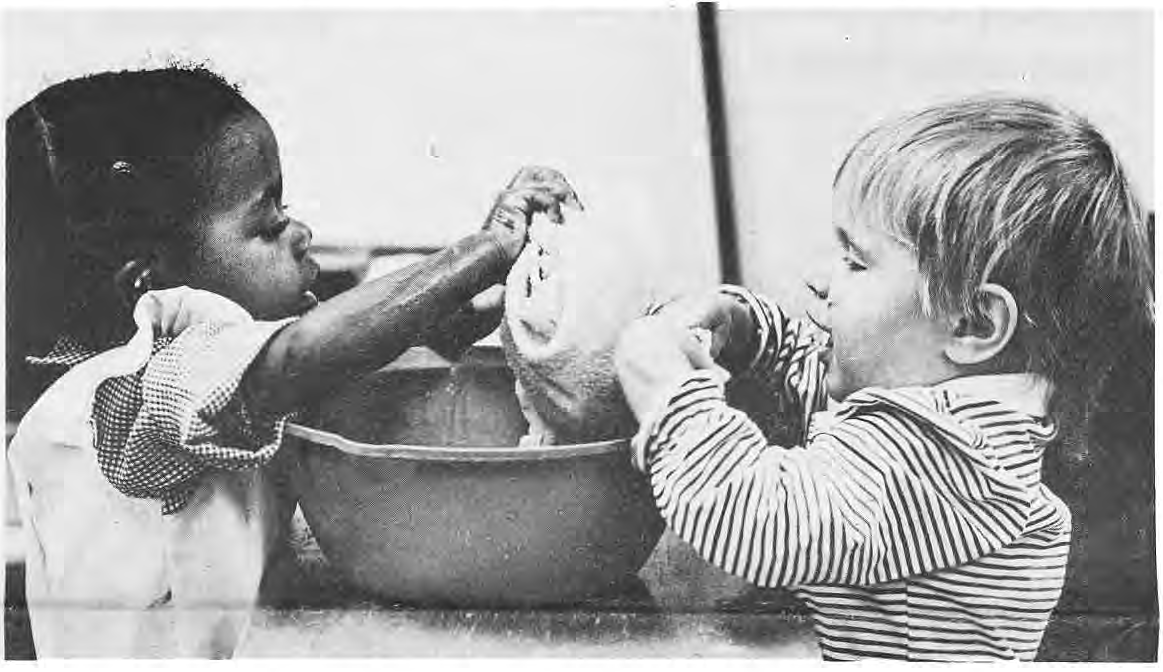
Original photograph caption
Children at Stella Maris Child Center. The Times of Skinker-DeBaliviere, December 1984, page 1. Photographer and children not individually identified in the source.
Originally published in The Times of Skinker-DeBaliviere, December 1984.
Read this article in the original newspaper issue.
Original source: SD_Times1984_12.pdf, printed page(s) 1, 8; PDF page(s) 1, 8.
