Historical December 1997 article. Dates, prices, services and contacts describe the source period; current availability has not been established.
In a time when even the residents of my sprawling hometown of Oklahoma City are opting to cloister themselves in “gated communities,” Rosedale is brimming with neighborliness. One example is a joint effort between the Frank Driscole and Joe Gruneisen families to turn their respective back yards into what I call “Driscole-Gruneisen Park.” This is the story of the Driscole (east) side of the fence. Frank and Flossie Driscole comprise a kind of Voneguttian “duprass,” a “world of two,” a couple so close and tight-knit and compatible that it seems when one speaks, the other is speaking. Born “in the Twenties,” they celebrated their 50th wedding anniversary on October 5, 1997.
They left the flowers on the altar of Second Presbyterian Church in order to share the occasion, and headed off on a month long road trip in their vintage BMW, a sojourn typical of their youthful approach to life and general vim and vigor.
In 1960, the Driscoles moved to an apartment at 6187 Pershing. Two years later, they bought 6155 Washington where they have been ensconced ever since.
The Driscoles moved to Rosedale from a house in Collinsville surrounded by “wide open” land. “We realized we were not outdoor people,” said Frank in a recent interview. Flossie adds, “We couldn’t tell the flowers from the weeds.” They were looking for an urban setting where they could live their principles, a primary one being “the world oughta be Integrated.” As newspaper people from Arkansas, “We feel the pulse of where we are,” they say.
They liked what they saw in “Rosedale-Skinker.” They recognized that the neighborhood had good leadership and “the strongest neighborhood association in the City at that time.
We felt it was solid and could survive anything ” So, in a time of white flight, the Driscoles deliberately chose an area in transition, moved in and planted themselves for the duration. Borrowing an attitude they attribute to Suzanne Hart, Joyce Littlefield, Jane Davenport, George Walker and others , they summed up their feeling this way: “We don’t care who lives here. It’s how they live here.” While they were not really quite prepared for what they experienced next, they agree that they grew from it, almost immeasurably.
The Driscoles say, “While Rosedale slept, real estate speculators took advantage of a new HUD program designed to offer subsidized home ownership to low Income families.” The character of the neighborhood changed almost overnight as people with no concept of home ownership or maintenance, some of whom did not even realize they were actually buying a house, moved to the 6100 block of Washington.
The Driscoles “used the laws available to prevent unsanitary conditions.” Then they spent time with little kids on their front porch.
They planted a barberry hedge to protect the yard and worked with other families, black and white, “to stabilize this thing.” (When this writer moved next door to the Driscoles in 1979, Flossie was still on her mission.
She appeared at my home while I unpacked boxes and informed me that this was an integrated neighborhood with its problems basically solved, and she warned me to be mindful of my behaviors and attitudes.) The Driscoles consider they have never been victimized in the Rosedale neighborhood. Once a case of oil was taken from, and recently new guttering was pillaged off their garage, but nothing more “We have the greatest neighborhood going,” says Flossie. “We wish everyone here would stay.” She notes that Bruce Shipman mows their lawn, and Joe Gruneisen, who has a key to their garage, has had the snow shoveled from their back walk before they even wake up. Frank and Flossie have cat sat for this writer numerous times and everyone makes sure everyone else’s paper is on the porch. “F” and “F” have impacted all the communities in which they have become involved.
This is especially true in work and worship.
They are both elders at Second Presbyterian Church where they have belonged “since the early ’50s… Frank is an ordained deacon and has served on the Board of Trustees.
They are proud of Second and its tradition of making tough decisions during times of change. Notably, during the Civil War, the members of Second took a position against slavery. One hundred years later, in the 1960’s, there was a move afoot to flee from Second’s urban location at the corner of Taylor and Westminster Flossie and Frank were part of the prevailing vote to remain in the neighborhood. At issue was a move all the way to DeBaliviere and Lindell.
The Driscoles worked together most of their professional lives.
They came to the St. Louis area in 1948 to run “state of the art” printing equipment for Max Hill.
When Frank joined the Star Times (and then the Post Dispatch). Floss decided to stay home and become a housewife.
After about three months, Floss gave up a fantasy that did not fit and went back to work.
In the end, “F and F” retired from their own company, Academia Typographers, where they did typesetting for textbooks and journals.
They employed twelve people who were given a great deal of autonomy.
Each worker had their own key and could name their own hours so long as they did not impinge upon the next person’s getting their job done without delay.
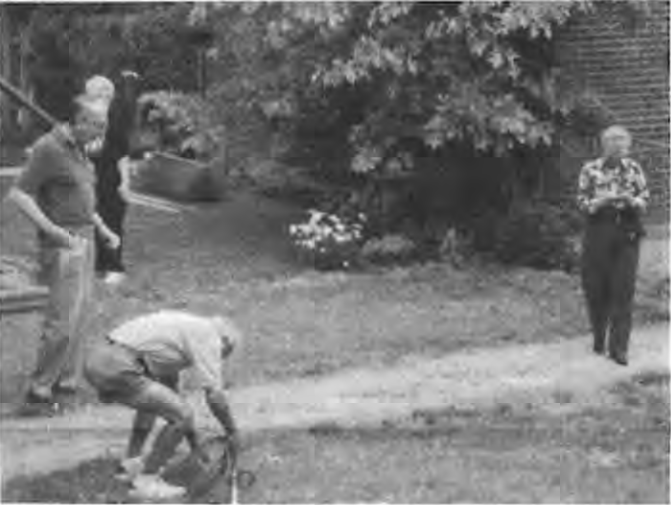
It was, then, the Driscoles’ attitudes of community involvement, commitment, and responsibility, their dedication to principle, and their creative approach to everything that lead them to respond favorably when Nancy Gruneisen “just floated a balloon over the fence” and posed the idea that if the fence came down, the Gruneisen children could play In the yard, Nancy could garden, and Joe would mow the lawn. Frank immediately suggested that the Driscole concrete parking pad could be used for the children’s wading pool, and the move was on.
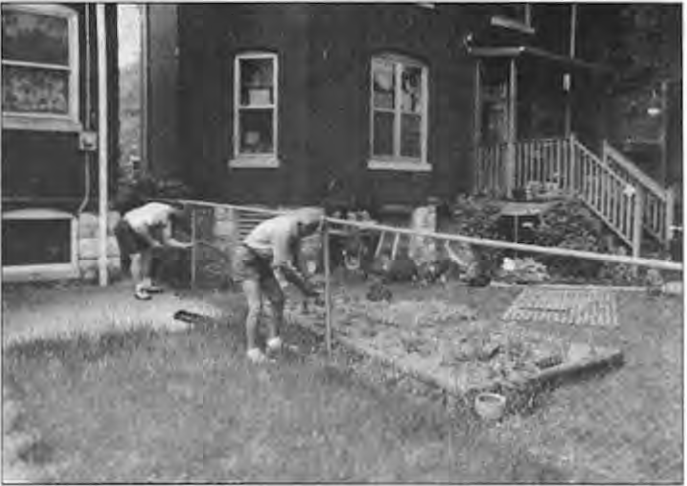
On Memorial Day, Nancy’s father and mother came for a visit and helped Joe take down the fence and put up an attractive wooden gate. DriscoleGruneisen Park was born. Immediately three children under the age of five were frolicking in their plastic vehicles down the Driscole sidewalk, playing basketball by the Driscole backdoor and adding the tinkling sounds of laughter and young life to the world and experience of Flossie and Frank, who had given themselves the opportunity of being grandparents without ever having been parents.
In late summer, Nancy orchestrated a neighborhood picnic in the joint yard, and many residents of Washington were treated to an evening of the sharing taking place on our street.
In mid-fall, Joe trimmed his oak tree, moved his garden to the Driscole side, put away the children’s toys, raked the leaves and put the scene to bed for the winter.
While Joe Gruneisen and his father-in-law meticulously rolled the fencing last May, and stored it lest there be a need to return the boundaries per Robert Frost’s theory of “good fences good neighbors make,” for now there is a new and open situation on Washington that is open, lively, heart-warming, and worth our all taking note.
Original photograph caption
Joe Gruneisen and his father-in-law take down the fence. Photographer not credited.
Originally published in The Times of Skinker-DeBaliviere, December 1997.
Read this article in the original newspaper issue.
Original source: SD_Times1997_12.pdf, printed page(s) 5; PDF page(s) 5.