Historical December 1991 article. Dates, prices, services and contacts describe the source period; current availability has not been established.
A collection of rare Union and Confederate battle flags herald the Missouri Historical Society’s expansion to additional quarters in late 1991.
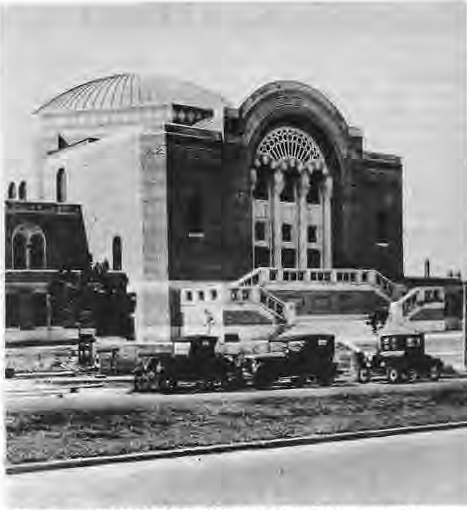
The flags, some up to five feet long, are among thousands of artifacts including rare books and documents, art works, historical costumes and 1904 World’s Fair memorabilia – to find a new home at the Society’s recently completed library and Collections Center at 225 South Skinker Blvd. “The move from the Jefferson Memorial Building now under way will take four months.” said Dr. Robert R. Archibald, president of the Missouri Historical Society. “It’s the biggest operation in the Society’s 125-year history. We’ll transport more than 2 million books and documents and 80,000 artifacts from our collections.” Scheduled to open on Monday, December 9, the library services will be housed in the renovated United Hebrew temple.
The Collections Center, a 58,000 square-foot addition to the south of the library, will hold the Civil War flags, paintings, historical costumes and museum artifacts not on exhibit at the History Museum in the Jefferson Memorial Building in Forest Park, also operated by the Missouri Historical Society.
The Greco-Byzantine style library will house more than 70,000 cataloged books, pamphlets and periodicals. Under its ornate 40-foot dome, researchers will find information about the commerce on the Missouri and Mississippi Rivers, St Louis neighborhoods, the exploration and settlement of the Louisiana Territory and a host of other subjects.
They will have access to St. Louis newspapers dating back to 1808, city directories, French and Spanish colonial records and 17th and 18th century maps.
The archival collections, which may be accessed by a card catalog in the same space, contain William Clark’s elkskin journal from his expedition with Meriwether Lewis, papers that belonged to the Chouteau family, to David R. Francis, who served as U.S. ambassador to czarist Russia, writer Kate Chopin, poet Sara Teasdale, educator Susan Blow and former President Thomas Jefferson. Researchers may request family papers as well as government, military and business records dating from the period of French colonization of the Mississippi Valley. Strengths are Western exploration, the fur trade, the Mexican War, river history and the Plains Indians.
Also on hand will be more than 430,000 images, including photos, prints, videotapes and motion picture film, presenting a nearly complete pictorial history of St. Louis in the last century. Works of photographers Emil Boehl and W. R. Persons, historic posters, lithographs, and engravings are included in the pictorial history collection.
The Collections Center will provide state-of-the-art conservation facilities for the thousands of artifacts not on display at the History Museum. “Since only about five percent of our holdings are used in exhibits at one time, collections stored in the Center represent the bulk of the materials we have been preserving since 1866,” said Archibald. “As such, they require a large investment in care and attention.” Housed in the four-level structure, the Civil War flags, delicate because they were made of silk, will be protected in acid-free tissue and laid flat on oversize shelves. Nearby, antique quilts will be carefully wrapped on rollers to avoid fold marks. Other special storage facilities will protect fragile items such as prehistoric Native American pottery, china, antique silver, furniture, firefighting and riverboat memorabilia, guns and swords, men’s and women’s hats, and items donated by Charles A. and Anne Morrow Lindbergh. Humidity maintained at a constant 50 percent and a temperature of 68 degrees will retard deterioration of the collections. Archibald said the building will have a holding room for artifacts just acquired. “When appropriate, new acquisitions will be placed in our walk-in freezer – a more efficient and ecologically sound method of making sure insects, mildew and mold spores don’t become part of the collections,” says Archibald.
He adds that researchers will be able to examine artifacts under staff supervision in special reference rooms. “We will be able to serve students, teachers, historians, members of the media and other residents of the region.” Generations of St. Louisans have visited the History Museum in the Jefferson Memorial Building, operated by the Missouri Historical Society, where, until now, most of the collections have been either exhibited or stored.
The familiar Charles A. Lindbergh flying suit and trophies. the bright red 19thcentury firefighting pumper and hose cart, and the impressive pilot house of the Golden Eagle steamboat continue to grace its galleries.
The museum remains open to the public Tuesday through Sunday, 9:30 a.m. through 5 p.m., and there is no admission charge.
The Missouri Historical Society was founded in 1866, after the Civil War, to collect, preserve, exhibit and interpret materials that reflect the history and culture of the St. Louis area, state of Missouri, Louisiana Purchase Territory and the American West.
The Jefferson Memorial Building, located on the site of the main entrance to the 1904 World’s Fair, was opened in 1913.
The new library building was acquired and renovated in part with public funds from the History Museum Sub-district, approved in 1987 by voters in St. Louis City and County.
The $9.3 million construction project makes the Library and Collections Center, along with the Jefferson Memorial Building, one of the nation’s leading facilities for historical research, conservation and exhibits. “One of the Confederate flags in our collections may have led Pickett’s charge at Gettysburg,” said Archibald. ‘Although our move is not quite so dramatic, it has required just as much strategic planning. teamwork, energy and spirit.”
Original photograph caption
The former United Hebrew Temple in 1927. Photograph by W. C. Persons, from the collections of the Missouri Historical Society.
Originally published in The Times of Skinker-DeBaliviere, December 1991.
Read this article in the original newspaper issue.
Original source: SD_Times1991_12.pdf, printed page(s) 5; PDF page(s) 5.
