Historical essay by Ray Breun, November 1982. Dates, genealogy, land transactions and historical interpretations are preserved as the author’s period account and require independent verification before factual reuse.
When Bill Russell arrived in St. Louis in February, 1804, the population of the village was barely 900.
He tried merchandising and working for a living, but found land speculation much more profitable.
He talked his two brothers, James and Joseph, into settling in St. Louis. Russell Boulevard was named for Bill Russell.
His country land was located just south of the Soulard property and was known as Crystal Springs Farm. Comprised of 76 acres, it was adjacent to the Mississippi River.
The Russell mansion overlooked the river.
The street from the Russell mansion west toward the Oak Hill area is what we now call Russell Boulevard. Bill Russell also laid out a city in Arkan – sas known as Little Rock.
When the vote was taken by the Arkansas legislature concerning where to locate the state capitol, Little Rock and Cadron were the two contenders.
The senate was for Little Rock.
Some of the representatives, after buying land in Little Rock from St. Louis land owners, realized the wisdom of voting for Little Rock, and thus the Russell city was made the capitol of Arkansas. Bill Russell was the father of Alton, Illinois, in addition to his Little Rock connections.
But the Arkansas story typifies the sort of speculative style typical of the times. James Russell emulated his brother, Bill, and bought a large estate owned by Henry Shaw just south of St. Louis, adjacent to Tower Grove, called Oak Hill. Jim Russell was in the process of selling it off in 1820 when he discovered a seam of coal on his land.
He stayed in town and eventually found clay under the coal.
The combination of coal mining and clay mining grew into the Parker-Russell Firebrick Works of Oak Hill. Oak Hill’s boundaries were Kingshighway, Custine, Arsenal and Tholozan Streets. Comprising 432 acres, the Russell homestead is now a series of subdivisions, and most residents are unaware of the mining history of the area.
It became a part of St. Louis in 1855, when the city expanded to what is now Grand Avenue.
One of the sons of James and Lucy Russell was Charles Silas Russell.
He Settled into the mining and brick business with ease.
He married Elizabeth Mead, the daughter of a silversmith with no mean artistic talent.
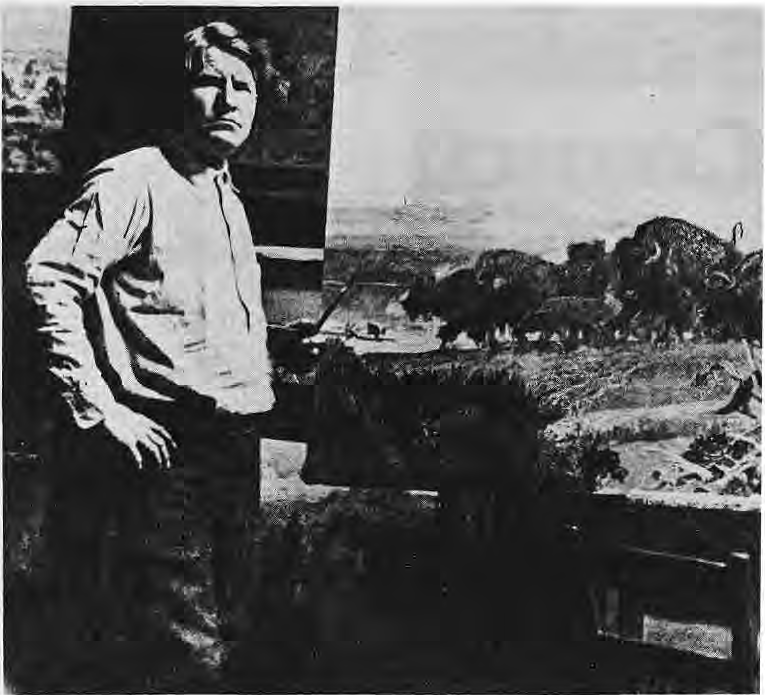
The offspring of these generations of Russels (the individual most of us will recognize), was the third son of Charles Silas Russell and Elizabeth Mead Russell: Charles Marion Russell. Charles M. Russell is the most famous descendent of the Russells of Oak Hill.
The work of this famous and beloved painter and sculptor in bronze came of a love for the life of the Plains he saw passing away even in his lifetime.
Original photograph caption
Charles M. Russell in his Great Falls, Montana, studio circa 1920. Courtesy Charles M. Russell Museum, Great Falls, MT. Original caption, The Neighborhood Paper, November 1982, page 8.
Originally published in The Neighborhood Paper, November 1982.
Read this article in the original newspaper issue.
Archival transcription note: Dates, genealogy, land transactions and accounts of Little Rock and Oak Hill are the author’s 1982 historical narrative and require independent verification before factual reuse.
Original source: SD_Times1982_11.pdf, printed page(s) 8; PDF page(s) 8.
