Historical interpretive essay by Ray Breun, September 1982. Its claims about slavery, auctions, the tunnel and barred rooms at the Old Courthouse are preserved as the author’s period argument and require independent verification before factual reuse.
Those of us who fancy ourselves custodians of history must now and again unburden ourselves of our conceits and discuss what didn’t happen as well as what did.
Some have defined history as a trick played on the past by the present—and in many respects that is true. Let me give you three examples of what I mean from the “history” of the Old Courthouse.
In the basement of the east wing of the Old Courthouse are rooms with bars on the doors.
A number of books about St. Louis speak of the jail in the basement of the building, and many people are certain that slaves were held behind the bars in the rooms in that east wing basement.
The fact is those bars were installed late in 1866, fully a year after the Civil War was over—fully a year after slavery was removed by force of arms from the United States.
In addition, those rooms were designated the storeroom of the clerk of the court and held the records of the court until the Missouri Historical Society began to use them as storage for their collection late in the 1860s.
In other words, the bars were on the doors to keep people out, not in.
Yet people come to the building regularly looking for the bars which show where slaves were kept in jail. Such a story is as much an artifact of history as what actually happened.
In the basement of the north wing of the Old Courthouse is the entrance to a tunnel going from that location under Fourth Street to the Pierce Building across the street.
The myth is that slaves escaping from the east wing of the Old Courthouse escaped through that tunnel to freedom.
We already know there was no jail in the east wing.
The tunnel from the Old Courthouse was built in the late 1870s, and in it was a conveyor built to take books to the legal library of the court housed across the street.
The tunnel currently ends in the middle of the street and the conveyor has been removed.
But it was a tunnel only a book could use as an escape, particularly since it was constructed long after the Civil War. Nevertheless, visitors to the Old Courthouse insist there is a tunnel slaves used when escaping from the clutches of the jailors in the basement of the building. Such a story is again an artifact as much as the tunnel is, and many of those who believe in the story cannot be persuaded otherwise, despite documentary evidence.
The third story from the mythic past of the Old Courthouse concerns the auctioning of the slaves held in the jail in the basement who could not manage to escape in the tunnel. Regular slave auctions were held on the Old Courthouse steps—so says the storyteller.
There is a painting in the collection of the Missouri Historical Society from the era of the Dred Scott case before the Civil War showing slaves being sold on the steps of the Old Courthouse. Surely, given the evidence of the jail, the tunnel and the painting, slaves must have been sold at auction on the steps.
In fact, the only non-court related business of a commercial nature ever associated with the Old Courthouse was a pottery concern (brick selling), which was in the basement of the north wing during the time when City Hall operated that entire wing, and then for only a period of less than two years.
No public sales of any commercial kind other than brick sales ever happened at the Old Courthouse.
The painting is a political statement, akin to the cartoon seen in newspapers today and is a product of the abolitionist movement before the War Between the States. Settlements of court cases often ended with the euphemism, “to be sold on the Courthouse steps.” Such settlements happen today. Property is auctioned in settlement of court cases, and before the Civil War such settlements would have included purchases of people.
But the Old Courthouse steps were never a slave auction site.
The Lynch slave pens, the largest such operation in St. Louis, were located south of Sixth and Clark Streets in the vicinity of what is part of the Busch Stadium complex.
But the property settlements exercised.”on the Courthouse steps” were legal transactions, not commercial ventures in human flesh. Three stories intertwine to make a mythic scenario which is believed by a great number of people in St. Louis.
Because it is believed so strongly by so many people, the Old Courthouse is often used as an example of the horror of slavery. Slavery was not just.
The Old Courthouse was the temple of justice for most of the West for much of the nineteenth century.
In a way it is fitting to use it to show the injustice of slavery—even if for the wrong reasons.
In this case history is a trick played on the present by the present.
Obviously the past had nothing to do with much of what we call history.
The historian’s task, then, is to separate not only fact from fiction but present from past and present from present.
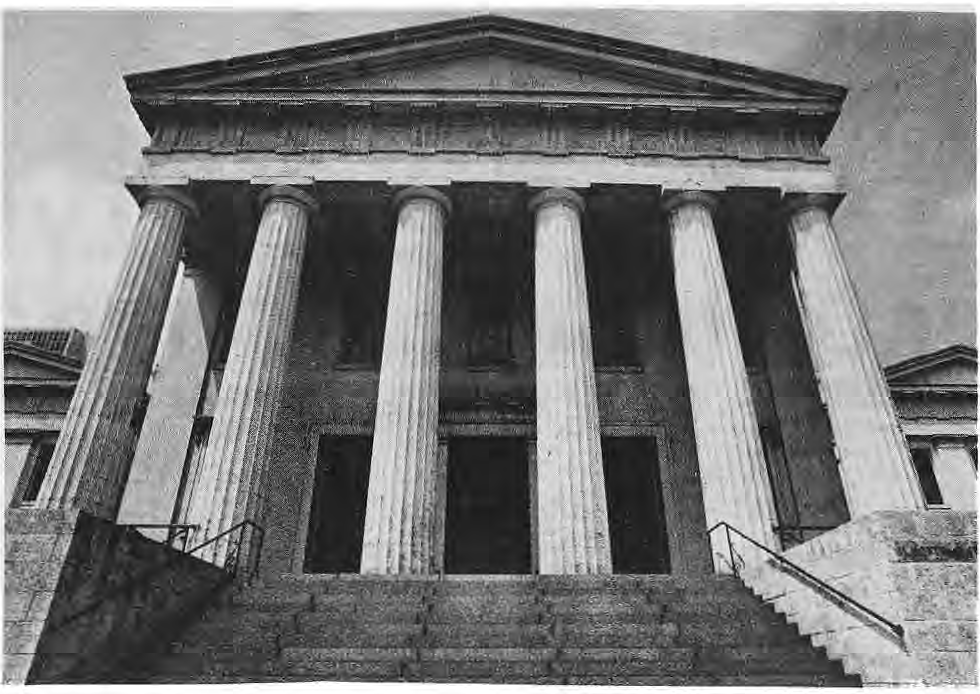
Original photograph caption
The Old Courthouse. Original photograph accompanying Ray Breun’s historical essay. The Neighborhood Paper, September 1982, page 8. Photographer not credited.
Originally published in The Neighborhood Paper, September 1982.
Read this article in the original newspaper issue.
Archival transcription note: The author’s categorical claims about slave sales at the Old Courthouse, the purpose of its tunnel and barred rooms, and the interpretation of the painting require independent verification. Preserve this as a dated 1982 interpretive essay rather than silently treating it as a verified modern historical account.
Original source: SD_Times1982_09.pdf, printed page(s) 8; PDF page(s) 8.
