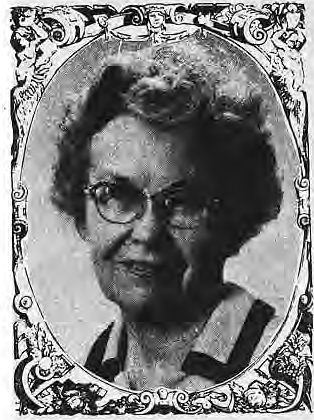
Long-awaited by those of us who knew it was in the works, Avis Carlson’s new book, In The Fullness Of Time, rewards the wait admirably. Now available at Paul’s Books and elsewhere, the book is sure to be a success, for it explores a difficult topic with new insight and describes old age with wonderful liveliness.
In writing, as in talking, Mrs. Carlson’s unique humor and personality reach out and stimulate the reader—into thinking and feeling, and sometimes laughing. For those of us who know Mrs. Carlson, there is, naturally, a special interest in seeing her accomplishment. Thre is also much of value in this book that is difficult if not impossible to find elsewhere.
For one thing, almost everything written about the subject of aging has been done by younger people, often those who are still middle-aged and in dread of what is to come. As Mrs. Carlson says, “Somebody needs to write from the inside about the experience of aging.” Well, Someone surely has.
On one level, it is a resource book, for it details the many programs of organizations doing work with and for the elderly. It gives specific suggestions on what the `just-about-to-be-old’ person can do to develop the skills necessary to have a new life or to recognize and take advantage of what he already knows and is interested in. As such, it will be a vaulable “how-to” aid for many people who need to recognize both what they’re worth as well as how to go about formulating and then realizing their own goals.
Moreover, Mrs. Carlson tackles a formidable discussion of the numerous fears of and myths about old age with such head-on forcefulness that one begins to feel, with her, that, “We have a right to feel somewhat apprehensive about aging. But it is simply absurd to spend thirty years either denying it will come or quaking at the thought of it.” Her treatment of the “common strategies” for dealing with one’s own old age (e.g. denying it, joking about it, giving up, etc.) is clear, articulate, constantly detailed with specific examples. It is apparent even to one in her 30’s that yes, there’s my aunt, my grandmother, maybe me in thrity more years. Instead of seeing the old as the pitiful anonymous, one sees individuals, and most of them don’t seem pitiful. Indeed, there is a later description of some individuals who remained respected, interesting, and useful while bedfast and nearly immobile—except inside themselves.
To me, the most important aspect of the book is this repeated emphasis on what Mrs. Carlson calls the “battle for self-respect,” for this is a battle that continues throughout life and is immediately applicable to anyone, at any age level. Indeed, as she points out, it is essential to work at developing and maintaining one’s self-esteem all through life, in part because when one becomes old, he will have many more outside, often societal, pressures working against it. Even if one has so far avoided thinking about getting old, he can hardly avoid the fears that crowd in on all of us at one time or another of not being worthy of esteem. At-home mothers who feel the present crisis of maintaining their feelings of self-worth despite not being ‘liberated’ working women can certainly identify with the needs, the fears, and also many of the solutions presented in this book. However, until I read this book, I hadn’t really understood or felt that this battle for self-respect goes on forever. One of the many heady thoughts: “And while this is happening to me, I shall have to respect and like myself as I am then—and do it in the face of a society that says I am becoming progressively more useless and burdensome.”
Truly, whether facing old age now or many years hence, Mrs. Carlson’s book forces one, in a most pleasantly readable way, to consider what he needs to be working on right now. We who are young enough to avoid this subject a while longer are quite lucky, for we will read the book because we know the writer. One can hardly escape accepting its thesis, because we know she is living proof that it is possible that, “Barring serious senility we can continue to grow right to the end… The great majority of us have a choice: we can become pains-in-the-neck or we can move on into a new phase of life that has opportunities of its own.”
You may not believe it until you read
IN THE FULLNESS OF TIME, but once you have, you’re going to feel differently about elderly people.
You may also feel a bit guiltier and a lot lazier. For a book about growing old to make you feel energetic is quite an accomplishment. To feel, in addition, that it is really possible to continue to the end-despite the “betrayal of the body”— feeling that energy and excitement about living is really a most encouraging perception.
IN THE FULLNESS OF TIME HENRY REGNERY COMPANY, 1977, 195 pp.
Original photograph caption
Avis Carlson. The Paper, June 1977, page 4. Photographer not credited.
Originally published in The Paper, June 1977.
Read this article in the original newspaper issue.
Archival transcription note: Printed Thre, vaulable and thrity retained.
Original source: SD_Times1977_06.pdf, printed page(s) 4; PDF page(s) 4.
