Historical April–May 2010 article. Dates, prices, services and contacts describe the source period; current availability has not been established.
No one can doubt that our neighborhood is filled with talented, accomplished people. Being part of Washington University’s “extended family” is one of the reasons that is true. Eric Mumford, a professor of Architecture at Washington University and a resident with his family on the 6100 block of Westminster, is a prime example. Already a published author of works on architecture and design, he has recently written the central essay for “Climatron 50, A Celebration of 50 years,” published by the Missouri Botanical Garden.
The book traces the history of the Buckminster Fuller-inspired geodesic dome structure from its original conception by Frtiz Warmot Went through its design by Mackey and Murphy and renovations completed in 1990.
In addition to Mumford’s essay, the book contains a wealth of pictures from the past and present, plus a section of 3D pictures complete with the required 3D paper glasses! Few, if any, other examples exist of a geodesic dome used for greenhouse purposes.
When asked whether he thought the form supported the function, he said, “As a place where constant light was real important, it works really well. Geodesic domes, I think, Fuller originally [considered] as a housing concept, as something that could be quickly put together and mass produced. It’s never really worked that well as that … Fuller built one for himself like that in Carbondale. It’s a wooden dome, but the second floor is odd. It’s hard to use it.
I think for this kind of a function [the Climatron], it works really well. Mumford is both an architect and an architectural historian. “My focus has always been on modern architecture and the ideas of modern architects, really as an academic focus… My work grows out of that. I’d never really worked on Fuller before, so it was interesting to me to learn about Fuller and see how his ideas played out. I’m also interested in buildings from that era that actually weren’t failures, like the Arch and the Climatron and the Priory Chapel.” As an architectural accomplishment, Mumford says it is not well-known outside St. Louis. “I had never heard of it before I came here.” In the architectural world, the Arch is what St. Louis is known for, he indicated. Asked about how long the Climatron could be expected to remain a viable structure, Mumford said that with the appropriate regular maintenance, it could last another 50 to 60 years. Among his numerous publications are “Modern Architecture in St. Louis: Washington University and Postwar American Architecture, 1948-1973,” “Josep Lluis Sert: The Architect of Urban Design, 1953-1969,” “Defining Urban Design: CIAM Architects and the Formation of a Discipline, 1969.” “Climatron 50” is available at the Garden Shop at the Missouri Botanical Garden, at some local bookstores, and at Amazon.com for $19.95.
Original photograph caption
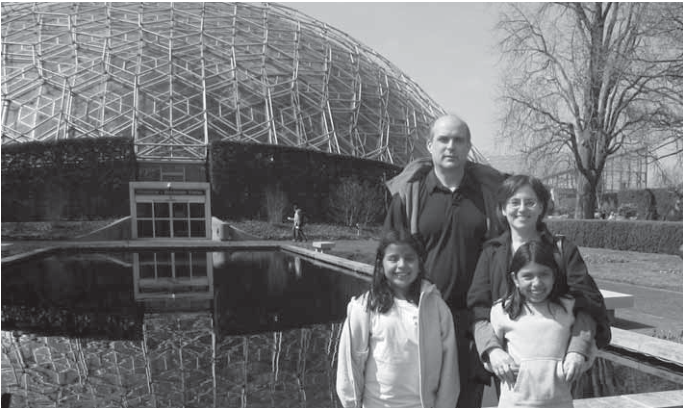
Eric Mumford with wife Devora Tulcensky and daughters Anna and Sophia. Photographer not credited.
Originally published in The Times of Skinker-DeBaliviere, April–May 2010.
Read this article in the original newspaper issue.
Archival transcription note: Printed Frtiz Warmot Went and book date 1969 in Defining Urban Design title retained, not silently corrected.
Original source: SD_Times2010_04.pdf, printed page(s) 7; PDF page(s) 7.





