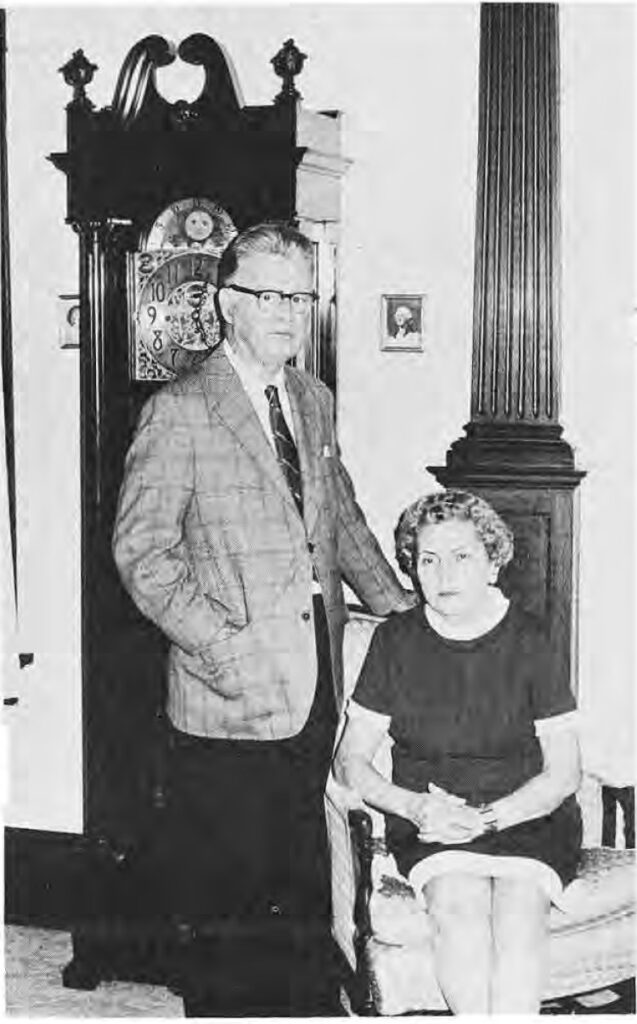
When you talk about urban changes and the Skinker-DeBaliviere area with Mr. and Mrs. Bill Walsh (properly Mr. and Mrs. William D.), you are apt to get a smile and a question, “Which changes?” The smiles are second nature and the question a sincere inquiry into your interest. It’s just that after fifty-two years in the neighborhood they recall changes and developments that most of us would have to go to a library to find out about.
“We moved into a house on DeGiverville in 1918 and loved the convenience of street cars, churches and shops.” Mrs. Walsh adds, “We still enjoy the convenience.” When they needed more space to house a growing family, they moved into Parkview in 1925 and are still there today. “St. Roch’s had finished the church and school then, so we decided to stay right in the area we knew and liked.”
It was a happy choice for all concerned. Outgoing, interested in others, with deep convictions about sharing their good fortune, Mr. and Mrs. Walsh launched in to civic, neighborhood and parish activities in the formative years of the area. “Young people may laugh and not quite believe it, but the biggest improvement in this neighborhood was the building of DesPeres Avenue over the old River Des Peres. You know, it used to be an open creek, smelly and buggy, with the streets running across bridges. This is a much nicer place to live with that water running underground.” An active walker, Mr. Walsh has covered this neighborhood on foot many, many times.
During his long residence in the area, Mr. Walsh has had a distinguished career as a St. Louis businessman. He ran the Walsh Motor Company, then became associated with Easton-Taylor Trust, then Mississippi Valley Trust, and when he retired some years ago he was a vice-president of Mercantile Trust Company.
At this same time he managed what amounted to a second career in charitable and social welfare work. He has been treasurer of Catholic Charities of St. Louis for forty years and still performs this job. He served on the board of directors of United Charities, beginning with work in St. Roch’s chapter of the St. Vincent DePaul Society, a lay organization devoted to helping the poor and the troubled Mr. Walsh got involved in this group’s city-wide efforts and served as its treasurer for years.
“Since there are many government programs in these fields now, our work today is basically supplemental. I think I liked it best when it was simple, direct and personal. I remember the men, most of them gone now, who personally visited families needing help at Christmas. We seldom had anyone that needy around Skinker-DeBaliviere then, but there were always families around town who needed help in bad times.”
Mrs. Walsh remembered bad times with a touch of humor. “During the depression the Rock Island Railroad still ran down Millbrook, and the trains slowed down at Skinker. The hoboes would hop off and make the rounds of the neighborhood. We housewives used to search that corner trying to find whatever signal other hoboes left to spread the word that this was a good neighborhood to eat in. We never did find out how those men knew where to go.
“It sounds strange now, but none of us ever thought of being afraid. Times were bad, and if you had enough food, you just naturally fixed a plate for anyone who turned up on your doorstep.”
During the depression years and after, the five Walsh children, Bill, Jr., Bob, Rosemary, Pat and Jim went to school at St. Roch’s, then on to high school and college. Mrs. Walsh now had her hands full of Mothers’ Club, Sewing Guild, Boy Scouts, Girl Scouts, high school and college booster groups. “The schools needed a lot of help then, but we also made friends and had a lot of fun while we worked for the schools.”
Mr. Walsh continued his career in banking and his second career in charitable work, serving on the board and as an officer of the National Conference of Catholic Charities. He got interested in the work of the USO and devoted time to their efforts. In 1949 his church recognized his thirty years of service when Pope Pius XII named him to the order of the Knights of St. Gregory for his service to his fellowmen. In 1961 the board of governors of the USO presented him with the highest award given to non-military personnel.
He took the treasurer’s job for the Greater St. Louis Community Chest, and served on the board of the National Catholic Community Service Club in St. Louis. He served three terms as president of the TB Society. He has retired from his business career but continues active with the TB Society and Catholic Charities.
At home, too, retirement is active. With twenty-nine grandchildren and fourteen great-grandchildren, a birthday, a graduation or a wedding is always looming up. They also have a built in pipeline to younger generations. Up-to-date and always interested in what’s going on among young people around the parish and the neighborhood, it’s hard to see them and believe they have lived here for fifty-two years.
Both Mr. and Mrs. Walsh (BillandMarie, in one word, to their friends) are noticeably silent about their careers in community service. They allow as how they’ve been associated with this work or that, but for details of their years of service, you have to look elsewhere. They would be polite, but embarrassed, if you suggested that their example has led a lot of young and not-so-young people into active charitable and community service. Perhaps we should say not only led younger people, but occasionally shoved them into service, since the Walshes preach and practice the idea that young people have to pitch in and take over “from us old duffers.”
With all their wealth of experience behind them, they are far more apt to listen than to speak at neighborhood meetings, learning what the problems are and what possible solutions might be.
After fifty-two years, they still like the convenience and the privacy of Parkview and in the midst of their family and organizational activities, take a keen interest in what’s going on around the neighborhood.
Originally published in The Paper, October 1970.
Read this article in the original newspaper issue.
Original source: SD_Times1970_10.pdf, printed page(s) 6.