此内容暂无简体中文译文,以下为英文原文。
Historical April 1981 report or notice. Original dates, prices and contacts describe the source period; current availability has not been established.
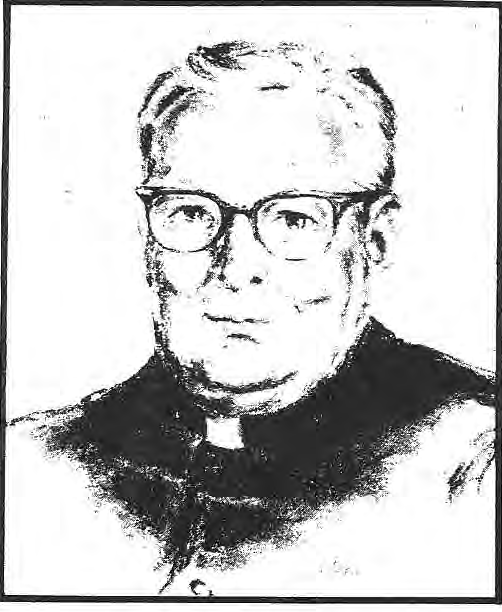
Monsignor Robert Peet is about to retire from St. Roch’s. He’ll say his official final Mass at 1 p.m. on Sunday, April 12th, in the gymnasium he built. And as has been added so often during his almost twenty years at St. Roch’s, “All are welcome” and “Refreshments will be served after the Liturgy”.
With those two phrases, endless patience, a rare capacity for listening, and constant kindliness, Father Peet has been an unobtrusive but dominant force in the revitalization of the Skinker-DeBaliviere area.
When he arrived in May of 1962, the “smart money” people at real estate companies, lending institutions, and insurance firms were writing off this neighborhood.
At the same time the changes arising from Vatican II were going into effect in the Catholic Church, so many felt double uncertainty and frustration.
One of Father Peet’s first announcements was that St. Roch’s would build a new school building which would include the long-needed gymnasium.
This enabled the sixty St. Roch’s children attending other schools to return to St. Roch’s in 1964, and made space available for other local students.
Father also got acquainted with the ministers at other area churches.
In the spring of 1963 he scheduled an Interfaith Conversation at which all were not only welcome but sought after.
The men of St. Roch’s went door to door personally inviting every resident to come. Almost 500 people turned out; some 25% to 40% were not St. Roch’s parishioners.
Naturally, refreshments followed.
When the changes of Vatican II came to the parish level, Father Peet began with small, informal meetings block by block.
After a series of Operational Renewal meetings in 1965, a parish-wide meeting recommended setting up a permanent parish assembly as a forum and as a source of advice for the pastor.
Naturally, after the meeting, there was the Liturgy and supper.
Father Peet encouraged the development of the Assembly of the People of St. Roch’s, which has met twice a year since 1966.
The constitution of this Assembly became a model for many other parishes, as did the by-laws for the St. Roch’s School Board.
When people complained to Father Peet about red-lining and other practices threatening the neighborhood, his first advice was always to invite people into the area so they could see what we had here.
He became a Skinker-DeBaliviere booster among his many friends throughout St. Louis.
He backed the start of the Skinker-DeBaliviere Community Council, and in 1969 the Archdiocese of St. Louis granted SDCC $10,000 for some of its projects.
From the pulpit and in his daily life, Father preached that “you have to be a neighbor to have a neighbor.” He welcomed everyone to St. Roch’s, visited throughout the neighborhood, lent the use of parish buildings, and encouraged people to get together and invite others. Card parties, sports events, musicals, luncheons, dinners of every type and description, coffees, rummage sales, art and craft displays, anything that got people working together filled the St. Roch’s calendar.
Father Peet’s congenial attitude led to the annual joint Thanksgiving Day service with Grace Methodist Church, and to joint prayer services with Trinity Episcopal Church.
He brought back the ancient custom of blessing new mothers, and later took on the unpredictable ceremony of blessing the dogs of the neighborhood.
Little by little, Father Peet’s neighborly attitude, his lively pride in his people and their neighbors spread through Skinker-DeBaliviere.
As John Roach put it recently, Father Peet created an atmosphere for us, an atmosphere in which good things could happen, and did happen.
When Phil Lucier’s tragic death threatened his newly-formed West End Townhouses, Inc., Father Peet helped arrange to hold the redevelopment corporation in trust at St. Roch’s so the work could continue. Later both the Archdiocese and Washington University extended an impressive line of credit to assist West End Townhouses in rehabilitating area apartment buildings.
Even though St. Roch’s has long since ceased being predominantly Irish, if it ever was, Father Peet has made the annual St. Patrick’s’ dinner a combination bash and reunion for friends and former parishioners — which is proper for a boy born in 1903 in St. Mark’s Parish, on Academy Avenue, which was predominantly Irish at the time.
He attended St. Mark’s Grade School, then the Preparatory Seminary, then Kenrick Seminary and was ordained in 1934.
His first assignment was to St. Michael’s, 2200 North Eleventh Street, and he has been a city priest for all but the 7 years he spent at St. Luke’s in Richmond Heights.
From St. Luke’s he went to St. Patrick’s downtown, where he helped run Father Dempsey’s Charities.
Along with his pastoral work at St. Roch’s, the Liturgy, the baptisms, weddings, and funerals, Father Peet has served on the Archdiocesan Commissions on Ecumenism, Human Rights, and the Sacred Liturgy.
He took part in the Archdiocesan Council of Priests and was dean of the North Side Deanery.
The Archdiocese recognized his remarkable career by naming him a Monsignor in 1971, the occasion for another celebration at which all were welcome and refreshments served.
An illness in 1974 left him with limited locomotion, but he has managed to continue not only his duties, but his congenial visits in the neighborhood, his devotion to music from grand opera to musicals, his enthusiasm for sports, and his bridge games.
He will remain a “city slicker” in retirement, moving to Regina Cleri House at 4540 Lindell.
All will be welcome and refreshments will be in order.
Original photograph caption
Monsignor Robert Peet. The Paper, April 1981, page 5. Photographer not credited.
Originally published in The Paper, April 1981.
Read this article in the original newspaper issue.
Original source: SD_Times1981_04.pdf, printed page(s) 5; PDF page(s) 5.
