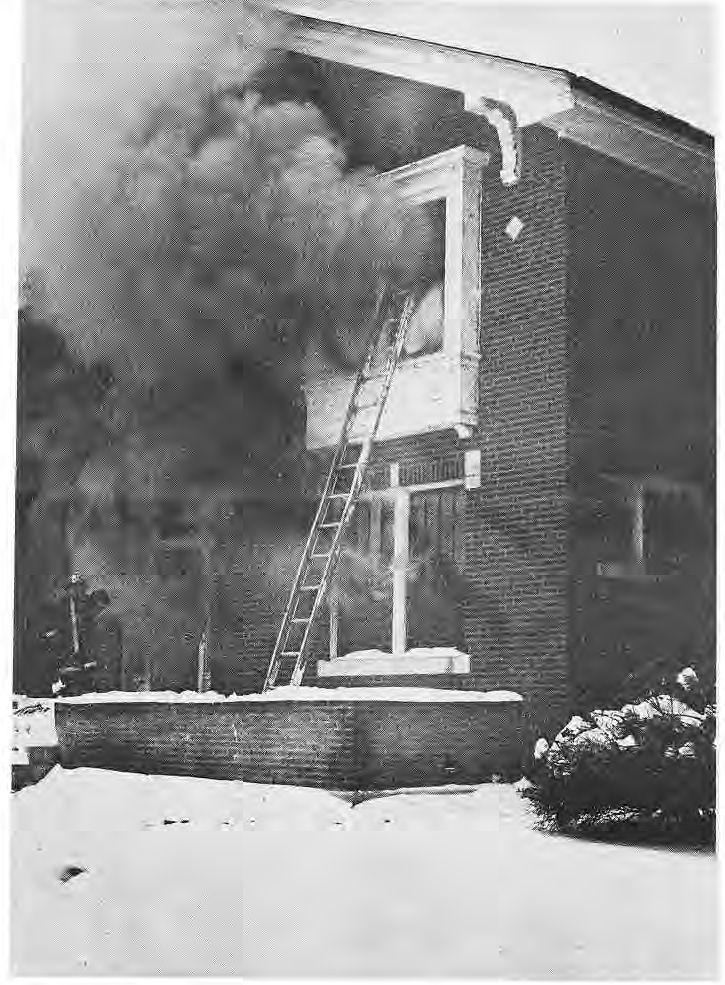
First of a historical March 1977 series by Jo Ann Vatcha, Marj Weir and Chris Lange. Original methods, including obsolete materials, are reproduced as period reporting, not current fire-prevention or building guidance.
In minutes the yellow gray smoke billowing softly from the chimney and attic vents darkened and began to stream from every window crack from basement to roof. The firemen, eager to ventilate the house before entering, started the systematic smashing of each window with their ladders. Taking a deep breath of fresh air, the choked fire coughed out its hoard of black smoke and began to blaze in earnest. It was a sobering sight, forcing witnesses to consider their own vulnerability.
Several times in recent months people in our neighborhood have suffered major fires, pointing up to the rest of us the need for constant vigilance. Our large old homes present some special fire-prevention and escape problems. Wiring is often out-dated, furnaces are, frequently antique, and abundant wood millwork and flooring is available as fuel. In addition, most homes have two, if not three floors from which it might be necessary to escape. Taking precautions to reduce the risk of fire and planning for escape in the event of a fire are essential.
Our focus in this first installment of a series on house fires is on the period before the first flame breaks out, the period in which one can take prevention measures and make escape plans.
###
REDUCING YOUR RISKS
###
Understanding the causes of fire:
The causes of the vast majority of home fires are: accumulated paper and rubbish, defective and misused electrical or heating equipment, and the number one cause, careless smoking.
Trash, old clothing and furniture, excessive amounts of paper and magazines should be discarded, not stored. These things ignite quickly and a huge fire can result from a simple spark dropped onto such materials. The possibility of spontaneous combustion also makes it important to guard against the excessive accumulation of paper and rubbish. Spontaneous combustion occurs when a flammable material (e.g. the oil or paint in old, soaked rags) gradually unites with oxygen from the air. Eventually, enough heat accumulates to set the material on fire.
Defective heating and electrical equipment are also common sources of fire. Have your heating equipment checked regularly to avoid, as much as possible, the dangers associated with furnaces. With a faulty pilot system, escaping gas could travel to a source of heat, such as the flame of a hot water heater. Pilot lights, fuel lines, wiring, flue and chimney, the controls on the equipment — all must be maintained properly if you are to be sure of the safety of such equipment. Smoke pipe sections should be sealed with asbestos cement. And all heating units except electrical ones must be properly vented to the outside.
Electrical fires may result from frayed wires, cords exposed to excess wear (e.g. cords run under carpeting) or hung over nails, radiators, or any place where the insulation could wear off.
Improperly used fuse boxes cause many fires. Never put a penny or any other conducting material under a burned-out fuse. Too much current could enter the circuit, overheat the wires, cause a fire to start. Proper size fuses must also be used to avoid overloading a circuit.
Another frequent cause of home fires is the misused space heater. These appliances must be used with the utmost care. They should be mounted on a fireproof base, e.g. slate, ceramic tile, concrete, and extreme care must be taken to avoid the exposure of flammable materials to the heat from the unit. Examples are: curtains blowing too near the heater may catch fire; carpet under them can ignite, clothing may catch on fire if too near the heater. Children must never be allowed too near these appliances.
###
FIREPROOFING YOUR HOME
A periodic check of your home may reveal many overlooked danger spots. Use the checklist below to remind yourself of the areas of your house that may need improving. It won’t take long to correct these conditions, and the time you spend “fireproofing” your house may be crucial to reducing your family’s chances of having a fire.
###
START WITH YOUR BASEMENT
1. Eliminate excessive quantities of newspapers and magazines, lumber scraps, sawdust, rags, unused clothing.
2. Limit the quantity of paints and solvents. Put those you must keep in a well-ventilated spot (e.g. open basement shelves), not in a closed cabinet. If you have no adequately ventilated place, consider installing an air duct to the outside.
Paints — water based latex paint is not flammable, but other paints are, so check the ingredients and precautions on the cans and act on those warnings.
Solvents — all solvents — turpentine, varnoline, alcohol, etc. — should be limited in quantity to one pint and should be stored in metal or plastic containers so that the danger of dropping a glass container is eliminated. Spreading fluid can ignite very easily and spread to encompass an entire basement quickly. Think of what could happen if the fumes spread to reach the flame of a hot water heater (or even a cigarette).
3. Check your furnace, or have it checked for problems with the pilot lights, fuel lines, wiring, flue and chimney, the controls, Make sure pipes are properly sealed.
4. Check to see if you have any frayed electrical cords or any cords hanging over nails.
5. Check the fuse box. Make sure everyone in the home old enough to change a fuse knows the dangers of misused fuses.
###
THE KITCHEN
1. Move any flammables away from the stove. This includes curtains, pot holders, towels, matches, etc.
2. Store matches in a fireproof container away from the stove.
3. Keep fans and filters clean and free of accumulated grease.
4. If you have cabinets above the stove, don’t put the cookies there. Children may be tempted to climb up on the stove to reach favorite snacks.
5. Keep a coffee can for the emptying of ash trays.
###
ALL OVER THE HOUSE
1. Make sure you have and use a screen on the fireplace to keep the sparks away from carpets, etc.
2. Check electrical outlets to make sure none are overloaded. Check cords to be certain none are worn out.
3. As you go through your house looking for danger spots, consider escape routes and fire-fighting equipment appropriate to each space. Thinking of these before a fire could well save lives.
Grim though it may seem, making an escape plan and training the entire family in it use can make a life-and-death difference in a fire. Because each family is different, an escape plan must be tailormade to suit it. For example, special provisions must be made for an infant, toddler, invalid, handicapped or aged person in the family. Each house also presents different escape problems and possibilities. It is important for each family to its own unique situation and to make such plans (and changes in their living arrangements) as seem appropriate. In doing so, remember these facts:
1. You need two escape routes. Hallways and stairways are often blocked by heat and smoke, so you need alternate exits from every room in the house. This means a window you can get out of — by climbing out on a roof, down a ladder, or by dropping to the ground.
2. Fire spreads fast, so get out of the house fast. Don’t stop for anything — except to help someone. Smoke can kill you; in fact, smoke and deadly gases kill 80 per cent of all fire victims. Battling a big blaze by yourself is usually futile and dangerous.
3. If smoke is heavy, crouch as you hurry along. Try to cover your nose and mouth with a towel or pillow.
4. Meet outside at a prearranged spot to count noses and make sure all family members are accounted for.
5. Consider whether you have installed bars over windows from which you might need to escape.
Original photograph caption
House-fire photograph accompanying Learn Not to Burn. The Paper, March 1977, page 4. Address and photographer not credited.
Originally published in The Paper, March 1977.
Read this article in the original newspaper issue.
Archival transcription note: Printed incomplete sentence “It is important for each family to its own unique situation” retained, not supplied with invented verb.
Original source: SD_Times1977_03.pdf, printed page(s) 4; PDF page(s) 4.


