April 1976 Historic District Supplement: a contemporary explanation of the proposed district, not a statement of current regulations.
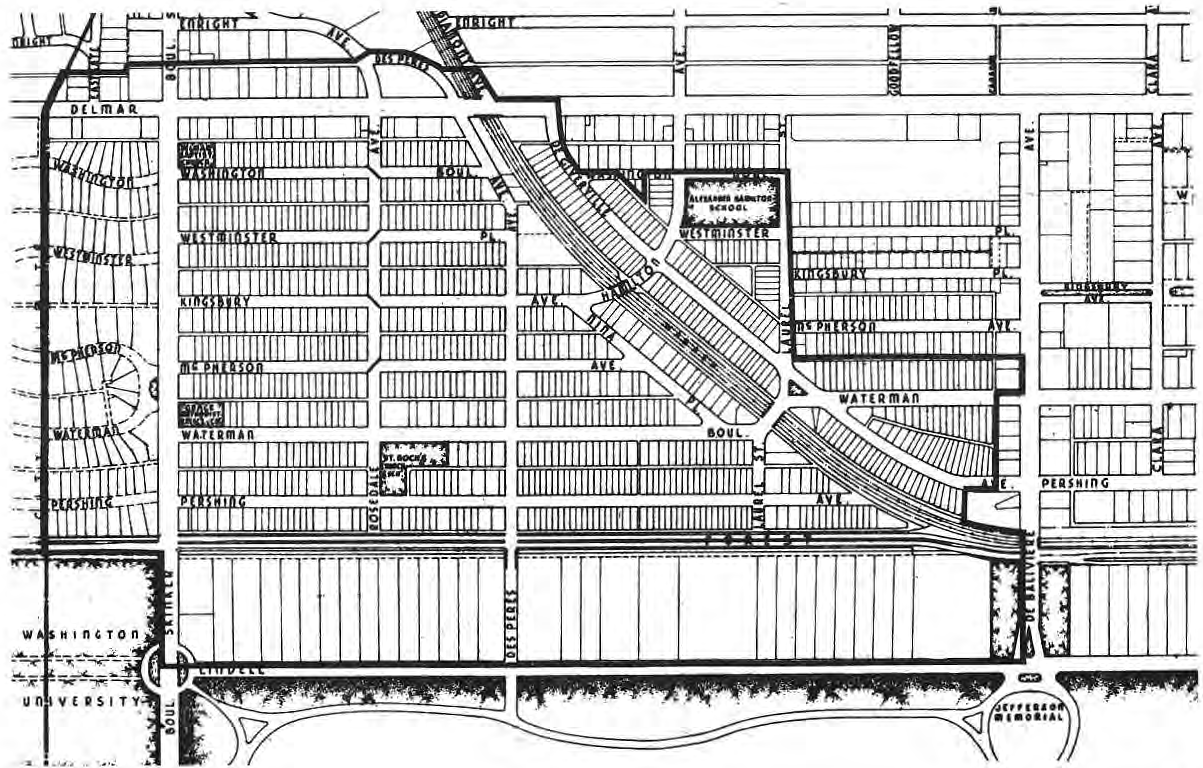
An Historic District in St. Louis is an area of the City which is recognized as something special. This area may be special because the architecture of the entire area is special, or it may be special because it was planned as a unit long ago and to the present day has remained a unit that looks much as it did originally. The last case is our reason for possible designation as an Historic District. We (the Parkview-Rosedale/ Washington Heights-Catlin Tract area) were originally developed as a whole by one company—The Parkview Realty and Improvement Company–with slightly different plans for each of three tracts within the whole. Although Parkview Realty’s plans were not carried beyond the point of grading the entire area at one time, enough of the company’s directors became directors and shareholders in the realty and development companies which followed to ensure that the original plans were mostly carried out. Thus, the entire area outlined on the map was basically built between 1905 and 1925. Architecturally, it is a whole neighborhood of middleto-upper class residences and shops carefully controlled to fit together while providing an entire range of units for residential needs and wants.
The location within the City (and now also in relation to the County) has always been good, and because of this the area has continually attracted new residents who have maintained their homes and been active within the community. Inspection of the proposed Historic District area, block by block, will demonstrate that one very seldom comes upon a building whose design looks “out of place”. It is this “look” we are proposing to preserve.
Keeping the “look” of the neighborhood is what an Historic District is intended to do. We, the residents, will adopt a set of appearance standards for the commercial and residential areas which will apply only to the fronts of the buildings unless other parts of a building are visible from a street (such as houses on corner lots). To make these standards apply to all the buildings within an Historic District, the City (in the form of the Board of Aldermen) enacts a zoning ordinance which is superimposed upon existing zones and which contains the appearance standards we have decided we want. Once the area becomes a legal Historic District, no structure may be built or torn down, nor any change made to the front of a building, until our ordinance is consulted to see that the plans fit the standards we have set. No one person can tell any other person what he can do to his/her building, but we all will be telling each other what we can and cannot do to our buildings. It is a community decision, to preserve and protect–and enhance–the value of our buildings and our entire neighborhood. New buildings will have to be compatible with neighboring historical buildings. Alterations to existing buildings will have to recognize the original architectural features of the building front and be compatible with the fronts of adjacent buildings.
Besides the appearance standards, the ordinance will contain a “restoration and new development plan.” This is most effective when the Historic District is large and includes commercial or multifamily zones either within it or at its edges, as ours does. The District may encourage or prohibit certain commercial activities, make recommendations regarding traffic patterns, transportation, redevelopment, parks and recreational facilities, and may request changes in existing zoning. This plan may also express goals for long-range planning. Again, the community makes all these decisions as to what it wants or doesn’t want, and once this is squared with planning by the City we have determined what we want to be and how we want to look. For us this is a golden opportunity, because the Community Development Agency is currently doing long-range planning for our area of the City and we can feed our ideas into their planning.
The Historic District ordinance we agree upon’ will be reviewed by the Community Development Agency and then presented to the Board of Aldermen, who will hold their own public hearing on it. When it is passed, the regulations will go into effect. No one can be made to alter something already done to the front of his/her building which does not fit the standards in the ordinance.
The enforcement of Historic District appearance standards is accomplished when a building permit is going through the application process. The Landmarks and Urban Design Commission reviews all permit applications in light of the Historic District ordinance, to ensure that nothing is planned which is contrary to our standards. IF it is “clean”, the building permit is issued. Having the ordinance available for use during the planning stage will reduce any conflicts to a very low level. By consulting the Landmarks and Urban Design Commission to get their meeting dates, a building permit could be applied for, reviewed, and then issued in a very short time, allowing property owners to get the job done with a minimum of delay. If, however, someone is planning to do something to his/her building front after the community has made its decisions on appearance standards, but before the ordinance is passed, he or she is encouraged to consult the standards and do the work in compliance with the new standards. That kind of action would help the Historic District off to a running start and be appreciated by the entire neighborhood!
Original photograph caption
Map accompanying the proposed Historic District. The Paper, April 1976, page 5. Cartographer not credited.
Originally published in The Paper, April 1976.
Read this article in the original newspaper issue.
Original source: SD_Times1976_04.pdf, printed page(s) 5; PDF page(s) 5.
