Historical April–May 2006 article. Dates, prices, services and contacts describe the source period; current availability has not been established.
Last May, as my family and I prepared to leave for a year in Berlin, Germany, my days were consumed with the twin tasks of readying our house for tenants and trying to cram everything we would need into five oversize suitcases.
As I stuffed most of our worldly possessions into bags and boxes, I would occasionally think about Jo Ann Vatcha’s request that I write as a ‘foreign correspondent’ to the Times.
The idea intrigued me, but I wondered, how different could things really be? What would people find interesting about our lives over here?
After our arrival, I forgot these questions as we adjusted to our new lives.
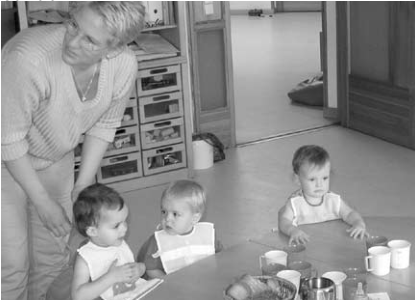
I attended language school full-time while my husband Warren, on sabbatical from Webster, worked on a history manuscript, and our daughter Eve got started in German day care, or ‘Kita’.
We moved into the Friedenau neighborhood in southern Berlin, on a quiet tree-lined street of fivestory apartment houses.
Some buildings, like ours, dated back to the turn of the century, and others were clearly post-World War II replacements (Berlin was 70% destroyed by bombs). Our flat turned out to be lovely, with 12-foot frescoed ceilings, massive solid wood doors and hardwood floors.
It came IKEA-furnished and outfitted with crib and high chair, a welcome perk in a country where unfurnished apartments often require the tenant to bring not only furniture but also their own kitchen cabinets, fridge and clothes washer.
There were no closets, but there was a balcony off our bedroom and wireless DSL. Our introduction to German day care began as many things in this country do, with a bureaucratic encounter.
After much struggle over papers and their proper stamps at the local Youth Agency, Eve was able to begin at the Kita in late July.
The first two weeks of school consisted of an ‘acclimatization period’ during which Warren accompanied her there for about two hours per day, gradually leaving the room for brief periods. Only after the teacher was sure she had made the adjustment was she allowed to stay for alone for lunch and nap time. Eve’s teacher, Uli, has been at her Kita for many years, as have the majority of the staff.
In Germany, being a day care worker is a formal career path, and jobs have better benefits than most American day care workers received.
Also notable is that about 90% of the cost of the care is paid for by the government, making good day care truly affordable for all. Eve’s classroom was very international, with children from Turkey, Jamaica, Austria and Argentina.
We were the only Americans there.
The kita itself was well-designed for children, with a wooden bridge connecting the classrooms to the expansive sand playlot, and the building is set right next to the community gardens.
We were initially taken aback at the breakfasts, which often include Nutella and chocolate milk, but the lunches are home-cooked and worthy of a discrimi-nating palate – a recent lunch included cauliflower with hollan-daise sauce and there is a vegetarian meal once per week.
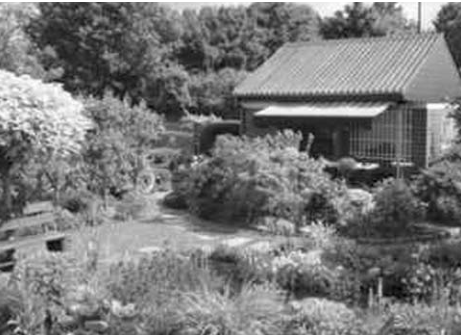
As summer wore on we missed our yard and garden, and took long walks in the nearby gardens to console ourselves. Known as ‘schraebergaerten’ in German, these gardens are a bit like community gardens in the States, but the parcels are bigger and are fenced off from each other.
Each lot has a simple multi-purpose structure on it, kind of a cross between a garden shed and a summer cabin. Technically you are not allowed to live in the sheds, but many people spend all their waking hours there on weekends in the warm months – gardening, preparing meals, visiting with family and friends, or just relaxing.
The garden tradition extends back for at least a century, but became especially popular after 1945, when food was in such shortage that people were forced to grow their own. Even the Tiergarten, the Forest Park of Berlin (without the golf courses) was temporarily converted to feed the city.
In the fall I began working as a visiting fellow at the German Institute for Urban Studies, where I did research on the temporary use of vacant land in Berlin and Leipzig, another city that was part of the former East German Republic.
I spoke with city plan-ners and community activists grappling with the physical manifestations of population loss.
They are turning vacant land into an opportunity by encouraging artists, entrepreneurs and environ-mentalists to transform on a tem-porary basis empty space into art, sports venues, markets, gardens and other uses that attract people to an area and help stabilize it. Local govern-ment helps by providing tax subsidies and technical sup-port. Surely this was the city planning equivalent of turn-ing lemons into lemonade.
As winter arrived we bundled up against the cold, stoicly awaiting for the sun to emerge through grey skies every week or so.
We listened with envy to reports of 60º days from friends back home. And not only did the weather turn cold. Giving up on jogging after snows turned the sidewalks into sheets of ice, I joined a health club, where on one of my first visits I was scolded by a woman for getting the floor ‘too wet’ (I had just come from the pool). Cold weather really brings out the unfriendliness in people here, I reasoned.
But there was at least one bright spot in winter. Every year around this time, the city of Berlin gets a wake-up call from the late-winter doldrums with the start of the international Berlin film festival, or Berlinale. Luminaries such as Spike Lee and George Clooney descend along with hordes of lesser-known film industry big shots clad in black turtlenecks. You can pick these people out from a distance because they always have a cell phone glued to their ears and can be overheard discussing casting sce-narios in unmodulated Amerikan-isch, as the Germans call our English.
It has been fun to see so many of my fellow countrymen making a scene and feeling the city caught up in the glamour of Hollywood. Although Germans may not be as friendly as Americans, at least not in winter, once you make a friend here, it is for life.
We could not have survived without the help of several wonderful old friends from my husband’s student days who provided gear, advice, and support on many occasions. Yet I also think of our wonderful neighbors and friends at home who mailed us things we forgot and reassured us that our house was still standing after a month of resident Muni actors.
We are particularly grateful to Faith Sandler and Michael Holahan and their kids Claire and Pete, who not only are hosting our cat for the year, but also took care of everything from supervising itinerant gardeners to removing dead tree branches from our roof. Our tenants Mikel and Virginia have also been great. By the time you read this, spring will be in full bloom in St. Louis, while back in Berlin we’ll still be trying to keep warm.
But we’re not complaining. Spending a year abroad involves giving up some things, like the comfort of your own home, in return for gaining other things, like a new language, and in our case, even a new baby (coming to theaters near you in late August). Viele Gruesse aus Berlin (Greetings from Berlin), and see you this summer!
Original photograph caption
A nearby schraebergaerten.
Originally published in The Times of Skinker-DeBaliviere, April–May 2006.
Read this article in the original newspaper issue.
Original source: SD_Times2006_04.pdf, printed page(s) 5; PDF page(s) 5.
