Historical May 1992 article. Dates, prices, services and contacts describe the source period; current availability has not been established.
Irish lace and linens, silk, wool and taffeta, fashioned into garments at the turn of the century and now fitted onto more than 30 small-waisted mannequins, will grace the east wing of the Jefferson Memorial Building in the Missouri Historical Society’s new exhibition, ”From Carriage Trade to ReadyMade: St. Louis Clothing Designers, 1880-1920?
The historical clothing, created by ten St. Louis designers, will be on view at the History Museum in Forest Park from May 9 through the end of 1992.
The exhibit will be open Tuesdays through Sunday, 9:30 am. to 5 p.m. Admission is free.
The work of well-known dressmakers such as the Slater Sisters (Mary and Grace) and tailors such as Girolamo Giuseffi, Samuel Harbison and Ferdinand Svoboda will be included, along with early examples of ready-made items of apparel, all from the collections of the Missouri Historical Society.
This is the History Museum’s major exhibition for 1992 and is the first to examine regional designs of St. Louis. Sharon Fivel, the Missouri Historical Society’s Bascom curator, spent two years researching this exhibit, organizing it and writing the catalog- She began by looking at the inventory of the. MHS costumes collections to identify clothing with labels of dressmakers or ladies’ tailors.
She then went through the collections, examining more than 100 dresses, suits, jackets and capes to find labels that had not been noted on the inventory.
The most significant of these discoveries was a Giuseffi riding habit from the late 1880s, one of the first pieces he designed in St. Louis. “From this list, we narrowed the selection of garments to those made by ten representative dressmakers,” she says. “From Giuseffi we have eight garments that range from walking suits to evening gowns.
On the Cummings label, ca. 1907-10, there are three lingerie dresses, worn to outdoor galas and informal evening parties, all embroidered and trimmed with lace or eyelet. “We are also showing suits, coats and capes, complete with accessories.
The period mannequins were designed to show the garment as if it were fitted over a properly corseted figure,” says Fivel. Photos Courtesy of Missouri Historical Society
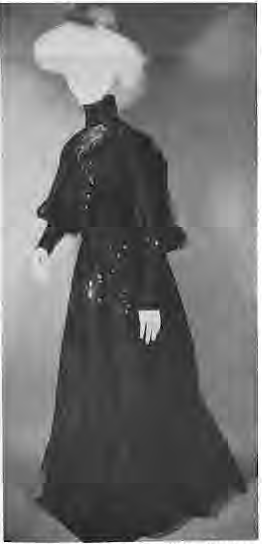
Black taffeta reception toilette, e. 1904, with bishop sleeves, full skirt, heavily embellished with cut steelbeads,sequins, braid and lace insertions. Designer, Girolamo Giuseffi, St. Louis.
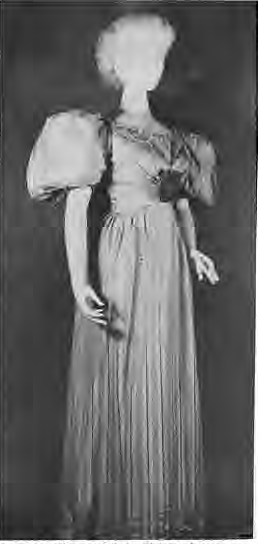
Lavendar and cream striped taffeta evening gown, c. 1892, Illustrates the short-waisted effect described as the “Josephine” or “Empress.”
Original photograph caption
Black taffeta reception toilette, c.1904, bishop sleeves, cut steel beads, sequins, braid, lace insertions; designer Girolamo Giuseffi, St. Louis. Courtesy Missouri Historical Society.
Originally published in The Times of Skinker-DeBaliviere, May 1992.
Read this article in the original newspaper issue.
Original source: SD_Times1992_05.pdf, printed page(s) 3; PDF page(s) 3.
