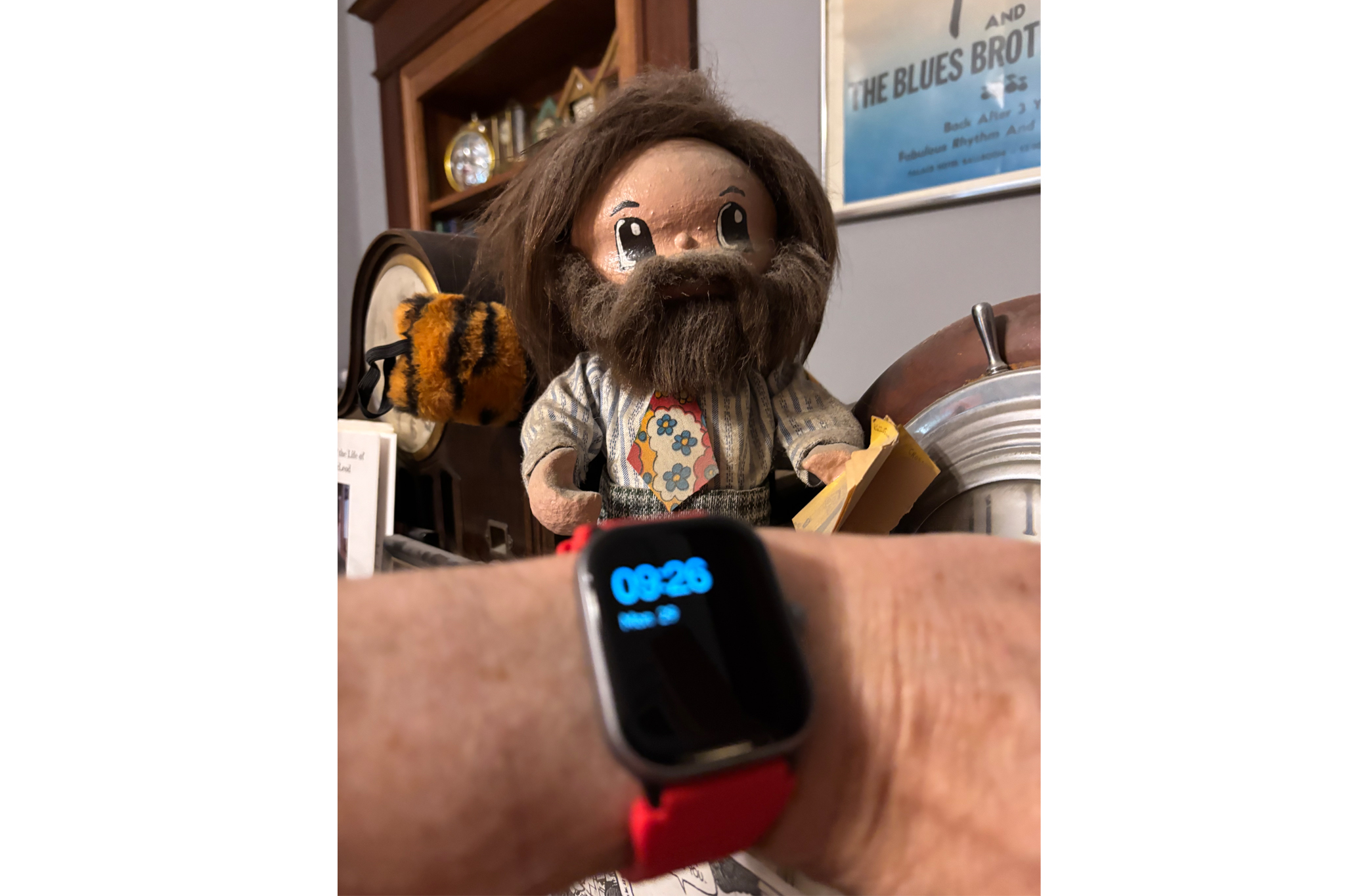
My wise readers (a redundant term) will recall my frustrations with technology, specifically the apoplexy caused when I purchased a new Spade Health4 watch. It was fine except that I had trouble setting, charging, and reading it, and the directions were written in dyslexic. “I’m lost in my watch,” I wrote. But good news, a bit over a year later I have mastered this puppy. My smartwatch is my friend (much more so than the Spectrum television recording function which I do not know how to use). Thanks to this smart watch and its now semi-smart owner, I can monitor how many steps I have taken, my heart rate, my activity level, my sleep patterns, and the temperature. Plus its lit screen allows me to see the time when I am tossing and turning in bed prior to my too many trips to the bathroom throughout the night. I could use my smartwatch for sending and receiving texts and phone calls, but I don’t want to push my luck.
Smartwatches, wearables, are actually pretty common. I just learned that “40 percent of Americans were using some type of wearable and that ownership was higher among younger, healthier and more fitness-minded consumers.” That made me feel pretty good because I don’t fall into any of these categories. It’s nice to be among the trend-setters.
And if this isn’t enough, I read about how AI will be infused into smart watches, making them even smarter. That makes sense because AI is an invisible tsunami. It is stocking grocery store shelves, driving cars, writing essays, and creating movies. This might sound scary but it’s already here. Siri comes to family picnics and Alexa is in the bedroom. GPS is my co-pilot even though she mispronounces many St. Louis street names. AI is already a part of our life and that’s fine. After all, it’s hard to argue with decisions being made with intelligence. Just think, if intelligence determined elections, Gore, Clinton, and Harris would have been our presidents. No Iraq war, forget January 6, and people in Greenland aren’t worried about an invasion.
The wearable article discussed how smart watches can already monitor how many calories you’ve consumed, take your blood pressure, and check your V02 rate. Forget telemedicine, telewatch is going to rule the day and make all of those medical degrees obsolete, Further, as exciting as wearables are today, their potential is much, much greater.
Tomorrow’s smart watch will discern the size of and flow within your digestive track as food moves through your body. Yep, no more colonoscopies. It will monitor your eating and cholesterol rate and send a small buzz to your wrist to alert you to stop eating rich foods – right now. Your nervous system will be accessed by your watch so it will speed up or slow down your breathing as the environment warrants. Your wearable will flag atrial fibrillation and send the necessary impulses to get your ticker ticking on time.
But there’s more. The wearable of the near future will be infused with AI that goes beyond reading your biological measures. It will be able to read your conscious and unconscious brain waves. AI will be part of your brain. Or maybe it’s vice-versa?
When was the last time that you were trapped in a boring conversation and had to work to appear interested. Yesterday, right? Well, the AI wearable will infer this from reading your brainwaves and it will not only shoot a microvolt into your spinal column to keep you awake and standing straight, it will draw from the content of your brain – just like Chat GPT pulls from letters, books, articles, and encyclopedias – and send your comments through your brain and to your tongue.
That’s right, you will be chatting with someone while thinking about the Cards’ last loss or your next vacation, but your mouth will be saying relevant and insightful comments. They will be the kinds of comments that you could make if you were fully attentive and spent hours reading and researching, so your words would be accurate and insightful and reflect your values. Yep, your wearable will do it for you.
Of course, the person to whom you are speaking will find your words meaningful and have no idea that your mind is really in London or riding a roller coaster. But that’s OK because when he offers a comparable clever and relevant response, his mind might be in Paris or playing the guitar.
So enjoy visiting your family doctor and conversing with friends while you can because wearables talking to wearables is just around the corner.