Historical September–October 2025 article. Dates, prices, services and contacts describe the source period; current availability has not been established.
There is still a lot of work to do to repair tornado damage, but one thing to definitely include on the list is replacing lost trees. Damage to buildings will be long-lasting, but the loss of trees can also be severe and even longer-lasting.
This loss can affect both ecosystems and community systems.
The new views to a hot summer sun along many of our streets are a stark testament to the beauty and function of trees. Trees are important for our urban ecosystems; without trees and their shade, our soil dries out faster, leading to fewer plants, hard soil, and erosion. Since so many birds, insects, and animals shelter in our trees, the loss of tree canopy contributes to the loss of wildlife. And since large trees are so effective at drinking up water, their loss can contribute to increased stormwater runoff, an important concern in a historically flood-prone community like ours.
The loss of trees and shade is not only a blow to our ecosystem, it has consequences for our community. Loss of shade from trees is strongly associated with the urban heat island effect. Urban heat islands form because the building and road materials that form urban areas retain more heat.
According to Climate Central, St. Louis already suffers from 7 degrees more heat than the surrounding areas.
This heat island has other impacts as well. That 7-degree difference causes increased energy use for air conditioning, costing our communities money. Because it is less comfortable being outside, parks, yards, and public spaces become less inviting.
In addition to adding beauty, good shade trees are a sound investment in our neighborhood and our city.
There are also important things to consider when planting trees, so that the investment pays off.
The most obvious is that you must choose the right tree for the spot. That means paying attention to how big and how fast trees will grow, being aware of utility lines above and below, and how the future growth may affect them.
To maintain a stable tree canopy, it is a good idea to have a mix of faster- and slower-growing trees. Planting deciduous trees is also a good idea, because they will provide shade in the summer, but in the winter cold, the lack of leaves allows the sun to warm your house more. Because trees are an investment, it is wise to consider some other factors too.
It is very important to have a care plan. Depending on placement and maturity, trees may need to be staked and protected from weed trimmers and mowers. Mulching around trees is very good for them, but take care to keep mulch 3-5 inches away from where the trunk enters the ground. Mulch too close to the tree creates an environment that is harmful to the tree. Ideally, trees benefit from having mulch all the way to the edge of their canopy, but for many areas of our yards, this is just not feasible. New trees need a watering plan. Newly planted trees should be watered daily for at least several weeks.
This can taper off to two to three times per week for the rest of their first year in the new location. Even trees that have been in the ground for more than a year might need water, particularly if we have an especially hot, dry summer.
In general, the larger the tree, the more water it requires.
There are many great choices for species.
The City of St. Louis maintains a list of trees that they plant as replacement trees in the tree lawn. Other tree species are an option, but it is very important to look up how much space will be available as the tree grows and the tree canopy spreads. Oaks are not a fast-growing species in general, but they are a good investment.
They have great canopies, are tough, grow tall enough to shade our houses, and have strong wood, so there are fewer falling branches. Sycamores grow more quickly and also have beautiful canopies.
Some people don’t like their messiness, but their bark-shedding trunks and dappled shade are charms to others. Tulip poplars grow fast, have wonderful flowers, and good resistance to urban issues. For a tough tree that can survive the worst conditions, many choose the hackberry. It’s not flashy, but it’s reliable.
A choice that is interesting but uncommon in our neighborhood is the basswood. Basswoods make great shade trees with a thick canopy, can be long-lived like oaks, but grow relatively faster. Oaks outgrow them eventually, but just by a little bit, but basswoods survive well in tough condition, and best of all, they have great flowers.
They blossom in summer with bunches of flowers that attract many pollinators, especially bees.
They are considered a “bee” tree, and honey from basswood trees is highly prized. Whatever kind of tree you choose to plant, you will be doing our neighborhood a favor when you plant a tree.
We and future St. Louisans will all benefit from the new trees that grow.
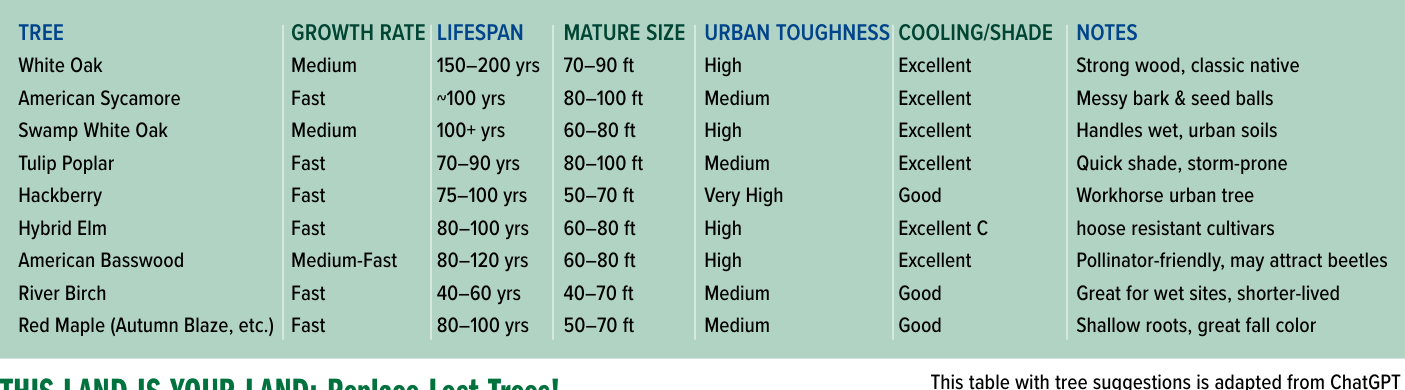
TREE GROWTH RATE LIFESPAN MATURE SIZE URBAN TOUGHNESS COOLING/SHADE NOTES White Oak Medium 150–200 yrs 70–90 ft High Excellent Strong wood, classic native American Sycamore Fast ~100 yrs 80–100 ft Medium Excellent Messy bark & seed balls Swamp White Oak Medium 100+ yrs 60–80 ft High Excellent Handles wet, urban soils Tulip Poplar Fast 70–90 yrs 80–100 ft Medium Excellent Quick shade, storm-prone Hackberry Fast 75–100 yrs 50–70 ft Very High Good Workhorse urban tree Hybrid Elm Fast 80–100 yrs 60–80 ft High Excellent C hoose resistant cultivars American Basswood Medium-Fast 80–120 yrs 60–80 ft High Excellent Pollinator-friendly, may attract beetles River Birch Fast 40–60 yrs 40–70 ft Medium Good Great for wet sites, shorter-lived Red Maple (Autumn Blaze, etc.) Fast 80–100 yrs 50–70 ft Medium Good Shallow roots, great fall color This table with tree suggestions is adapted from ChatGPT
Original photograph caption
Original nine species tree comparison table, explicitly adapted from Chat GPT.
Originally published in The Times of Skinker-DeBaliviere, September–October 2025.
Read this article in the original newspaper issue.
Archival transcription note: Tree table explicitly adapted from Chat GPT; not independently verified arboricultural observations. Hybrid Elm Excellent C ho ose extraction repaired to Excellent and Choose after image comparison.
Original source: SD_Times2025_09.pdf, printed page(s) 6; PDF page(s) 6.





