Historical Summer 2025 article. Dates, prices, services and contacts describe the source period; current availability has not been established.
Our yards and gardens become a little sadder in June and July compared to Spring’s fresh beginnings.
The weeds grow faster than our plants, trying to overshadow or choke them. Insects descend, some just there for pollen and nectar, but many others to chew leaves or sip sap.
While there are sprays and powders you can buy to combat them, one cheap and effective tool you may not have considered is companion plants. Companion plants can help with many garden problems – they can help keep down the weeds, control pests, encourage pollination, and attract beneficial insects, but each companion plant only plays specific roles; the relationship is not necessarily mutually beneficial.
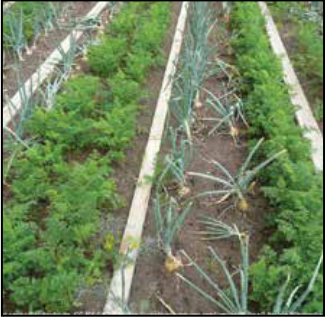
A perfect example is planting carrots with onions.
The scent of onions is known to deter insect pests that prey upon carrots, but carrots don’t deter pests on onions.
It is not always a two-way street, and this can make for more complexity in planning what to plant where. Experienced gardeners choose companion plants for their ability to deter pests, like the onion example above.
A common companion for tomatoes is basil. Basil’s strong scent can deter pests with a smell they don’t like, so putting basil around tomatoes can keep pests from attacking them. Companion plants may also attract pests away from targets.
In farming, this is called trap cropping.
In this strategy, a bed or area of the companion plant is planted near the main crop to attract pests away.
This is a common reason why people grow dill around tomatoes.
In Missouri, tomato hornworms are a significant pest, but when they emerge from the soil in May and June, the dill can attract them more than the tomatoes, allowing you to pick them off before they start on the tomatoes. Your dill may not end up great, but it is a resilient plant, and better the dill gets chewed up than the tomatoes.
Some plants also attract beneficial insects that prey upon pests. Borage is a good example of that. Borage not only attracts pollinators, but also parasitic wasps and hoverflies.
These don’t bother people, but prey on insects like the cutworms and aphids that damage plants.
This makes borage useful in several ways. Relative plant heights can also be useful when choosing companion plants. Tall plants can shade smaller plants when Missouri’s summer sun is harsh.
Some gardeners alternate rows of corn and lettuce because the larger corn plants shade and cool the lettuce and visually hide it from potential pests.
Some companion plants are chosen for their fertilization benefits. Beans are one example of a plant that fixes nitrogen in the soil, so growing beans nearby can help fertilize some heavy nitrogen feeders, like pumpkins and cucumbers. Companion plant interactions are not all positive. Certain companion plants can also have negative effects. Sunflowers are a good example of a plant that releases chemicals into the soil that can harm several common garden plants like potatoes and beans, so it is important not to grow them together. Because plant relationships are a complex web, a little research may be necessary to learn what will help your plants the most. One good chart is available from the Old Farmer’s Almanac (https://www.almanac.com/sites/default/files/webform/pdf/companion-planting-chart.pdf).
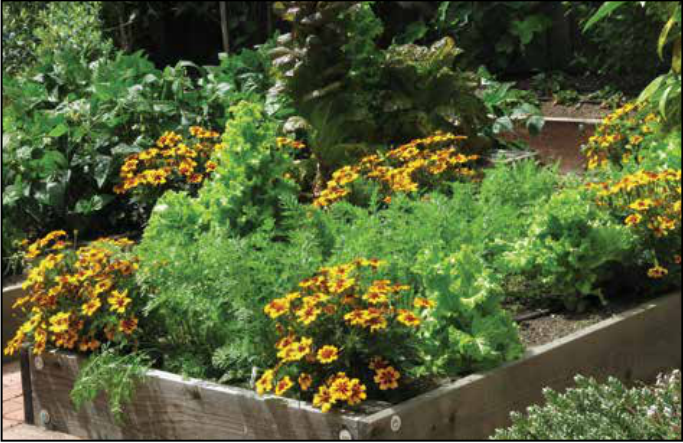
This chart lists common companion plants for many garden crops and outlines how they help. One common garden companion plant that is easy to grow and benefits many crops is marigolds. Marigold leaves have a smell that deters several pests; they attract wasps and hoverflies, which kill pest bugs, and the flowers attract pollinators, helping your plants thrive.
They are easy to grow, hardy, and have colorful blossoms. Consider growing some this summer to give your garden a boost!
Original photograph caption
Karotten Zwiebeln.
Originally published in The Times of Skinker-DeBaliviere, Summer 2025.
Read this article in the original newspaper issue.
Original source: SD_Times2025_06.pdf, printed page(s) 5; PDF page(s) 5.





