Historical February–March 2024 article. Dates, prices, services and contacts describe the source period; current availability has not been established.
Are you missing a good BLT yet?
I am.
Now is the time to get ready for the best BLTs of your life. Late winter and early spring is a great time to get a jump on planning your garden. One way to get ready for growing season is to start your own plants indoors. And the plants you start yourself are better than the ones you can buy at a big-box store or nursery.
It is not difficult or expensive. You will have a wider choice of plant varieties, you can cheaply grow more plants of whatever kind you want, and you will know what has been added to the soil to help the plant grow.
The process of raising a seed to a vegetable on your table or a flower in your vase is rewarding. Seeds are easy to come by, and you can choose seeds from local companies, which offer plants accustomed to our local weather patterns and temperatures. Among the best of the many regional-local garden seed companies is Baker Creek. Baker Creek seeds are available at nurseries and garden stores in our area, including OK Hatchery in downtown Kirkwood. Make sure to read the seed packet before starting. You should note two things: what the seed needs to germinate, and what it needs to grow.
It is important to start seeds in the right conditions for that plant. Seeds germinate with the correct soil, light, heat and humidity conditions, so monitoring and controlling these factors can prevent problems. Soil is the first factor to consider.
It is possible to germinate seeds in many different kinds of soil, but often a sterile, soilless mix is best. Seed starting mix is available at many stores, but it is also easily and cheaply made at home.
The most common mix is one part peat moss or coco coir, one part vermiculite, and one part perlite.
These three ingredients are cheap if bought separately and mixed at home. Coco coir is an industrial by-product of coconut harvesting, and, unlike peat moss, it is a renewable resource, so it is more sustainable. Whatever mix you choose, remember that it should stay damp, drain excess water, and be fine-textured, so that roots and stems can develop easily. Seed packages often include details that help success – for example, the number of days between planting and germination and the recommended planting depth.
The number of days until germination is especially important if you are planting several types of vegetables or flowers at the same time. Because some seeds germinate quickly and others not, you may think that some failed to germinate just because they didn’t all sprout at the same time.
A rule of thumb for planting depth is that seeds should be planted at a depth that is twice their diameter. Really, what this means is that small seeds can be pressed onto the surface of the potting soil and covered with a thin layer of additional soil mix. Bigger seeds are planted deeper. Bright light is important. Seedlings become leggy without bright light, so many people use either their sunniest window sill or a plant light close to the surface of the soil. Before seeds germinate and sprout, it is often essential to maintain humidity, so having a tray with a clear, plastic cover is helpful, although a cleaned plastic salad container works fine too.
Some people also use a plant heating mat to guarantee a consistent soil temperature until seeds germinate. Keep the soil or the tray damp, but not so wet that you could squeeze water out. Once the tiny plants start appearing, wait until most have emerged before removing the cover.
When plants have two or more leaves, any cover can be removed. Keep any light source as close to the plants as possible.
Some people use a fan or brush their plants softty to help strengthen the stems.
This is important because seedlings grown indoors are more tender than those grown outside.
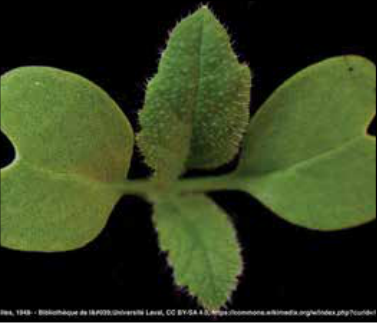
After the first leaves (often called seed leaves), plants will start developing “true” leaves.
These leaves can be differently shaped than seed leaves and often resemble young versions of adult leaves.
When there are two or three true leaves, transplant the seedlings into bigger containers, especially if you started with small pots.
This gives the plants a chance to develop more roots.
This is called “potting up.” Some people even pot up plants several times before planting them out in the garden. Once the plant has two or three additional sets of true leaves, get them ready to move outside by “hardening them off.” This means taking them outside for increasing lengths of time. At first just a few hours in a protected location, but gradually increase the time and find increasingly sunny locations.
The date a plant should be planted in the garden can vary by the kind of plant. Seed St. Louis, the organization that sponsored our community gardens, has a great planting calendar (https://seedstl.org/wp-content/uploads/2023/01/2023_SSTL_Planting-Calendar_001-1-3.pdf).
When you plant them outside, it is very important to “water them in.” Water them well at planting time and for several weeks until they are established.
In no time, you’ll be enjoying the flowers and vegetables you started this year, and – trust me on this – your care and effort will make them look and taste better to you than what you have been used to. And you can feed yourself and your family with the true fruits of your love and labor – what a gift!
Original photograph caption
Seedling with first and true leaves.
Originally published in The Times of Skinker-DeBaliviere, February–March 2024.
Read this article in the original newspaper issue.
Original source: SD_Times2024_02.pdf, printed page(s) 4; PDF page(s) 4.





