Historical September–October 2023 article. Dates, prices, services and contacts describe the source period; current availability has not been established.
We need more trees.
They are important for us, for wildlife, and for our environment. Many people don’t know how important trees are important for urban areas, but they truly are.
They add nature to an engineered landscape; they have colors, shapes, textures that soften the hard lines and sharp colors of cities. Scientific study tells us that trees can improve our emotional and physical well-being. Exercising or even just being among trees reduces anxiety and depression and can even reduce high blood pressure. One medical study showed that hospital patients in rooms with a view of trees have shorter average stays after operations.
The presence of trees isn’t just important for people. Trees provide habitat for wildlife. Birds, bees, bats, beetles and many other creatures take refuge and make their homes in trees.
These animals benefit us directly in many ways.
The songbirds living in the maple outside your house help control insect populations.
The bats that live there do as well. Bees love our old oak trees because of the nectar and pollen they provide. Trees provide economic benefit. People stay longer to shop on tree-lined streets, apartments rent more quickly in wooded areas, and healthy, large trees add to house values. Trees reduce street maintenance costs by protecting pavement from the sun.
They save energy.
The trees shading your house reduce cooling costs and their wind protection helps control heating costs.
These savings can amount to as much as 30 percent of cooling costs and 20 percent of heating costs, if the trees are well-placed, according to the US Forest Service.
Most important, however, is the effect trees have on our environment. Trees improve water and soil conditions. Leaf canopies reduce soil erosion by lowering rain impact. Tree root systems take up water, cutting down stormwater runoff that leads to flooding. Trees have a profound effect on urban temperature.
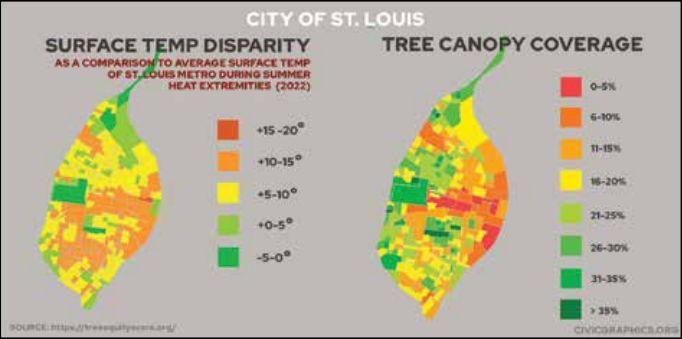
According to a recent article by Mike McCubbin in NEXTSTL.com (https://nextstl.com/2023/08/reforesting-stl-in-the-era-of-climate-change/), St. Louis city has temperatures an average of 7 degrees higher because of the Urban Heat Island effect, which can be moderated by an improved tree canopy.
An increase in canopy coverage of 6 or 7 percent would lower that heat island effect to safer levels, saving lives and money. Since trees grow slowly, planting them as soon as possible is important. Fall is a great time to plant new trees. Picking the right tree and location can help trees thrive, so it is good to do a little research.
The City of St. Louis Forestry Division has a good information on street trees, including important requirements for planting in the the tree lawn (https://www.stlouis-mo.gov/government/departments/parks/ forestry/documents/upload/Street-Tree-Information1.pdf). Forest ReLeaf sells Missouri native tree species in October and November. Planting native species is smart. Native plants are adapted to local soil and climate, so they are more likely to survive planting.
They are also better habitat or food sources for local wildlife, like native birds.
There are several things to pay attention to when planting. Check the needs of the fully-grown tree against the planned location to determine whether your site is appropriate.
A tree in the wrong spot can stress and weaken it.
If you are focused on filling a specific location, evaluate its soil and sun conditions and then choose a tree that will thrive in that spot. Make sure the hole you dig is large enough. One rule of thumb is that the hole you dig should be at least two to three times as big as the pot. Take care with the roots.
The root collar where the main stem meets the roots should be just at soil level.
In general, you want to avoid doing much with the roots, but if the tree is root-bound, where the roots have started to circle the pot, it is helpful to gently untangle them, and make sure they extend down.
Finally, mulch around it and water regularly to help the newly planted tree rebound quickly from transplanting.
When he was young, my son planted a seedling in this way in the tree lawn in front of our house.
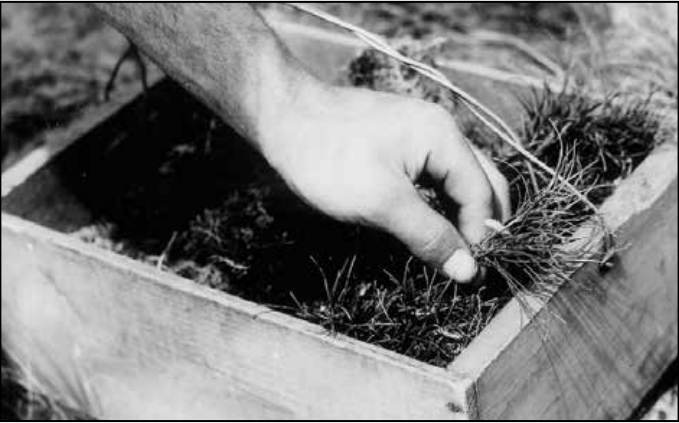
It was a bare-root, oak seeding, not even the thickness of a pencil. Somehow, the seedling survived neighborhood kids, lawn mowers, curbside parking – to become a beautiful oak tree. Now, it shades our porch during hot summers, and keeps the streetlight out of our bedrooms in the middle of the night.
If you plant a sapling this fall, you can watch that gift grow and mature into a beautiful, useful tree.
If you want to give a gift to watch for years and benefit future generations, try one of these ideas: Ask the city to plant a tree in your tree lawn (free!) via the Citizen’s Service bureau (314622-4800) or https://www.stlouis-mo.gov/ government/departments/parks/forestry/trees/report-tree-problems.cfm 1. Order a tree from Forest ReLeaf (https://moreleaf.org/releaf-sales-program/) and follow the instructions for planting above. 2. Go to your local nursery, talk to them about suitable trees, and purchase and plant a tree for your yard.
Original photograph caption
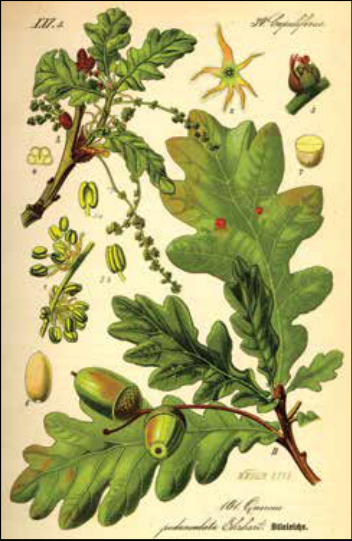
Historical oak botanical illustration.
Originally published in The Times of Skinker-DeBaliviere, September–October 2023.
Read this article in the original newspaper issue.
Archival transcription note: Printed important trees are important and in the the tree lawn duplicated words retained.
Original source: SD_Times2023_09.pdf, printed page(s) 4; PDF page(s) 4.





