Historical September–October 2023 article. Dates, prices, services and contacts describe the source period; current availability has not been established.
Our neighborhood would be directly affected if a proposed ordinance relating to short-term rentals is approved by the St. Louis Board of Aldermen. For the benefit of anyone who’s been asleep the past decade, “short-term rentals” are 30 days or less (“STR”), aka Airbnb. Virtually all of Skinker-DeBaliviere is zoned residential; specifically, “single-family dwelling” and “two-family dwelling.” This doesn’t include STRs because they aren’t residential, but the proposed ordinance would allow them anywhere and everywhere in the city, including districts zoned for residential use. STRs do not belong in residential districts because they provide lodging, not housing.
This activity constitutes a business: (a) operators and travelers connect on an internet platform, (b) they agree to certain terms, including payment, (c) the operator pays a fee to the platform (often Airbnb, a billiondollar global company) for advertising and other services, and (d) the operator or platform pays hotel/ motel tax.
As a business model, STRs are mini-hotels.
They should be called “short-term lodging” and treated as a business and located in commercial districts like hotels. STRs impact neighborhoods because they convert housing to lodging.
We lose our most important asset: a NEIGHBOR — a homeowner or long-term tenant.
In 91% of listings, our neighbor is replaced by an off-site investor and a stream of transient visitors with no stake in the community. Schools are affected. Neighbors have children, and the children attend school. For every house converted to STR, our school enrollment declines and we lose tax dollars. Housing is affected.
The STR business model removes housing from the market.
We all know what happens when supply is reduced: prices go up.
In this case, homeowners and long-term tenants will find it more difficult to locate affordable housing.
As of August, the Transportation and Commerce Committee of the Board of Aldermen has held two public hearings. Homeowners from across the city described how STRs undermine the quality and character of our neighborhoods. No one wants to live next door to a mini-hotel.
A better approach would be to foster STRs in mixed-use districts where under-utilized dwelling units are available on the second and third floors of stores along streets such as Cherokee, Grand and Delmar.
This would allow the city to locate STRs where they would yield the greatest benefits, not where they would do the greatest harm.
In addition to zoning, the proposed ordinance — Board Bills 33 and 34 – would require hosts to obtain an annual business permit, subject to regulations and penalties. Only individuals would be eligible to operate STRs, with a limit of four permits per person.
The bills are sponsored by Ald. Bret Narayan, 4th Ward, which includes Hi-Pointe and other neighborhoods south of Forest Park.
The proposed ordinance is 31 pages of zoning and regulatory components. It’s complex and doesn’t come with an operator’s manual.
The above is my analysis.
The Board of Aldermen is in recess until September.
In the meantime, neighbors may provide comments to our 10th Ward Alderwoman, Shameem Clark-Hubbard (clark-hubbards@stlouis-mo.gov). Or contact me (marvin@nodiffcalaw.com).
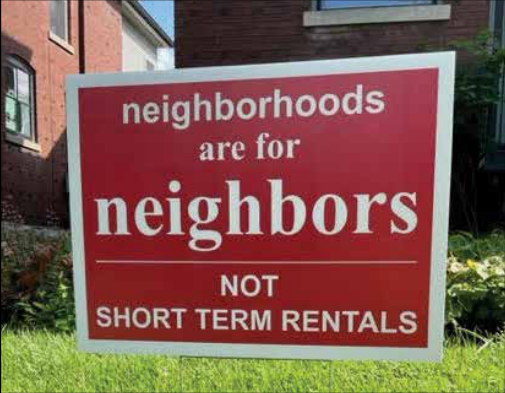
Original photograph caption
Neighborhoods are for neighbors, not short term rentals sign.
Originally published in The Times of Skinker-DeBaliviere, September–October 2023.
Read this article in the original newspaper issue.
Original source: SD_Times2023_09.pdf, printed page(s) 6; PDF page(s) 6.





