Historical Summer 2023 article. Dates, prices, services and contacts describe the source period; current availability has not been established.
Summer can be a time when gardens and lawns look less groomed and managed, and many neighbors often resort to the kinds of weed killer preparations that you can find in a large array of sizes, strengths and formulations that can be difficult to understand.
It is difficult to decide how to control the unwanted plants, when they seem to be taking over our lawns and garden beds.
This is not a new problem. Over two thousand years ago, Latin Poet Horace wrote, “You can chase nature away with a pitchfork, but she always comes back.” Plants in the wrong place have been bothering humans since we planted fields and gardens.
They bother us for good reason, because the unwanted plants can outcompete, overshadow or strangle plants that we want to grow. So we have to control them.
To solve the problem we tend to look for quick solutions, like herbicides claiming to kill hundreds of weed varieties in just a few hours. Solutions like that seem to work for a year, but never carry over to the next.
The flower bed or patch of grass that we treat one year is just as weedy the next, and if you look closely at the labels, you will see all kinds of warnings. Those warnings, regulated by the EPA, are intended to show the toxicity to humans. Although some herbicides only have the caution label (the lowest level of toxicity to humans), they still may be very unhealthy for pets.
The cumulative effects of herbicide use can also be worrisome. Although pesticides may not be directly toxic to animals, they can often have problematic health effects.
A good example is glyphosate and its effect on bees. Although it isn’t poisonous, it does affect bees’ immunity to disease, resulting in an increased likelihood of disease among bee colonies. You can, however, use some common strategies for lawns and gardens that don’t involve spraying herbicides. Mowing high is often used for lawns.
Most unwanted plants tend to grow close to the ground. Letting the grass grow higher will often let the grass overshadow the unwanted plants. Shorter grass heights allow seeds of unwanted plants to get the sunlight they need for germination. Adding layers of mulch, like wood chips, hay or leaf litter, is effective in areas where you don’t have grass, like garden beds or around trees. Any unplanted area is likely to grow unwanted plants, and these plants often quickly spread seed to other areas, like a lawn.
A layer of mulch three inches or more can prevent the weed seeds already on the soil from germinating, and keep new weed seeds from coming into contact with the soil, giving them little chance to germinate. Mulch also keeps water in the soil, so it can help the plants that you do want. Hand digging weeds, especially at the right time, can help.
It is an old piece of farm and garden wisdom to “pull wet and hoe dry.” In other words, it is better to dig out weeds when the soil is wet, because it is much easier to get the entire root system, reducing the chance that the plant can regrow. Pulling them when they are younger is important too.
This is especially important in places where there are fewer wanted plants, like in flower beds.
There are many great hand weeding tools available at any hardware or garden stores for less than the price of a bottle of herbicide, and the weeding tools will last you many many growing seasons.
The weed killer will not.
A final strategy that may help many is that it can be just fine to let it be.
It is not unhealthy for grass lawns to have a mixture of plants. Plant diversity can help the health of your soil, the pollinator populations, and the wildlife that manages to survive in our urban neighborhood.
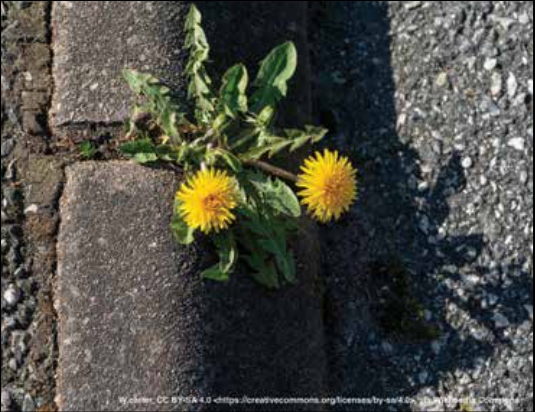
Some clover, a dandelion, or a few violets doesn’t make it look worse, it makes it look better.
It is unlikely that you will be successful in preventing them all, so spend time reducing your weeds, but remember the poet’s observation that no matter how you chase nature away – herbicides or pitchforks – she will always come back.
Original photograph caption
Dandelions growing between paving stones.
Originally published in The Times of Skinker-DeBaliviere, Summer 2023.
Read this article in the original newspaper issue.
Original source: SD_Times2023_06.pdf, printed page(s) 4; PDF page(s) 4.





