Historical September–October 2021 article. Dates, prices, services and contacts describe the source period; current availability has not been established.
Fertilizers are any organic or synthetic material used to supply plant nutrients to plants. Humans have a long history of adding things to soil to help plants produce successfully. For thousands of years, this meant applying manure and compost, but also could include things like fish by-products or blood meal.
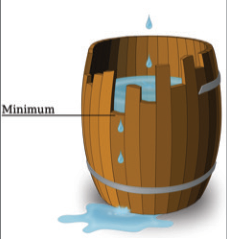
In the 1800s, scientists first described the “Law of the Minimum” or Liebig’s Law.
This is simply that adding plant nutrients does not necessarily help plants. Rather, plant growth and success is limited by the least abundant nutrient.
The barrel illustration is common for this law.
If you imagine that each stave of the barrel is a specific plant nutrient, like nitrogen (N), potassium (P) or phosphorus (K), the plant’s success is not determined by the amount of each nutrient, but the amount of the most limited nutrient. Nitrogen, potassium and phosphorus (N-P-K) are the three most important plant nutrients. Nitrogen contributes to leaf development, and plays a major role in photosynthesis. Potassium is important for root development, flowers and fruit. Phosphorus is present in every plant cell and plays an active role in moving nutrients within a plant. Plants may have fertilization needs that differ by species, so fertilizers are often specific to plants or families of plants.
If you purchase any fertilizer at a garden store, you will always see a series of three numbers connected by dashes.
These three numbers represent the percentage by volume of Nitrogen, Potassium and Phosphorus (N-P-K). For example, 20-10- 10 fertilizer (commonly used for grass) has twice the concentration of Nitrogen, compared to Potassium and Phosphorus. Because overfertilization can also hurt plants and cause environmental damage, it is a good idea to pay attention to these numbers.
Most fertilizers are formulated for specific plants and application methods, making it important to read the labels and instructions.
There has been an explosive growth in global population that corresponds closely to the rise of chemical fertilization of food crops. Soon after the Law of the Minimum was recognized, agricultural science found that certain chemical compounds had a more immediate effect on plants than traditional fertilizers like compost and manure.
This has led to the “Green Revolution,” which means higher crop production on less land than ever before.
It has also had some unintended consequences.
A significant amount of the nitrogen in chemical fertilizers is not taken up by plants, and leaches through the ground water into our water table, streams and rivers.
This leaching has had negative consequences for land; money wasted, damaged soil health, acidification.
It also has had negative consequences for water systems, like excessive algae in river and lake water that kills other vegetation or smothers animal life. Scientists have detected large “dead zones” in many places that they attribute to fertilizer run-off. Excessive use of chemical fertilizers is currently more common in urban areas than in rural, agricultural ones.
To combat this problem, many garden and lawn experts highly recommend using compost and natural fertilizers.
They are easy to use and help the soil in ways that chemical fertilizers do not.
The greatest drawback is that positive results are not visible as quickly.
The most common way to naturally fertilize lawns is top dressing. Top dressing is easy and combined with aerating and overseeding, produces nice, healthy lawns. Top dressing is when you spread fertilizer out in a thin layer on the growing surface around your plants. You should top dress your lawn two times a year; once just before leaves fall and once in the spring before your lawn greens up. Spread ¼ to ½ inch of organic fertilizer like compost or manure and rake it in. That’s it. You can use a wide variety of natural fertilizer products.
Most animal manure products are now treated so that they have little or no manure smell. Even a product like cotton burr compost will work, and will benefit your lawn in a variety of ways that chemical fertilizers will not – it will support the microorganisms that make healthy soil, avoid leaching of excess nitrogen into the water table (saving your money), and reduce soil compaction. So fertilize right!
Archival correction published in the November–December 2021 issue, page 5: The authors state that phosphorus (P) and potassium (K) were switched throughout this article. Their correction reads: “Phosphorus is important for root development, flowers and fruit. Potassium is present in every plant cell and plays an active role in moving nutrients within a plant.” They direct readers to a corrected version at https://bit.ly/2Z1blsl. The original September–October wording above is preserved.
Original photograph caption
Law of the Minimum barrel illustration.
Originally published in The Times of Skinker-DeBaliviere, September–October 2021.
Read this article in the original newspaper issue.
Archival transcription note: Source reverses potassium and phosphorus symbols and N P K ordering, and describes percentage by volume; retain as historical printed text rather than silently correcting scientific claims.
Original source: SD_Times2021_09.pdf, printed page(s) 4; PDF page(s) 3.





