Historical Summer 2021 article. Dates, prices, services and contacts describe the source period; current availability has not been established.
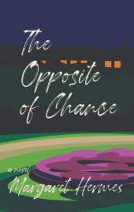
The novel by longtime Skinker-DeBaliviere resident Margaret Hermes, The Opposite of Chance, came out in March – and it’s a book that has been several decades in the making.
As the acknowledgements section of the book explains, the first drafts were written in Ireland in the early 1980s – and with some of those earliest drafts literally being “penned” before the advent of widespread personal computers.
Most of the book was written on this side of the Atlantic, however, and some sections have been published elsewhere as short stories.
The story in a nutshell: Betsy, a 30-something librarian reassessing her life shortly after a divorce, sets out on a trip to Europe, making friends easily, and savoring life rather than rushing through a “grand tour” type itinerary of the continent.
She never seems to feel especially homesick for Milwaukee but, with this being a fish out of water tale, it is also inevitable that she will make her way back to the Midwest. Along the way there are many flirtations – some of the men are charming, others are sleazy, and the line between the two is rarely entirely clear; sometimes the attention Betsy receives is unwanted, sometimes it is encouraged.
It is not until the final section of book, which is set in Dublin, Ireland, that Betsy seems to find a true connection. Much of the book follows a rather unusual repeating pattern – one chapter showing the protagonist exploring a new locale as a tourist, leading to an entanglement of one kind or the other, and then a subsequent chapter in which an illuminating back story of the newly introduced character is revealed.
In this context, we meet Donata, the daughter of a sketchy hotel owner;
the family of Kassim, who is returning to Montreal after a pilgrimage to Mecca and who encounters Betsy in the airport; Brian and Colin, entertaining bickering best friends in Northern Ireland. (Brian recently crossed paths with Betsy in the grimy French port of Le Havre and describes her as “ancient” but “brilliant for all that.”) Many of these chapters are successful and satisfying as discrete short stories (and indeed were published in that way in various literary journals) and yet they also work when stitched together to into an episodic whole, exploring the theme of how little people really learn of one another in chance encounters. Hermes writes vividly about being a stranger in a strange land, with language often being a barrier that is too high to climb, despite the human impulse to connect across cultures.
In France, we are told that the American visitor with poor pronunciation “requested a taxi driver to take her to the train station [gare] and he replied that there was no war [guerre] in France” and in fact she had missed World War II by four decades.
In the section in Florence, Hermes wittily notes that in Italian, if you don’t know the language, everything sounds like a food stuff. And even in Ireland, where English is spoken, the colorful Irish idioms cause much confusion – mostly of a benign nature – to the American visitor. Whether you are able to travel or not this summer, The Opposite of Chance makes for an enjoyable read, both as a novel and a compendium of short stories, and as well as an evocation of Europe in the 1980s.
With Hermes, it is a rare talent with have in our midst.
The Opposite of Chance is published by Delphinium Books. Tim Woodcock worked at the West End Word newspaper from 2002-2009 and currently teaches English and journalism at St. Louis Priory School.
Original photograph caption
The Opposite of Chance by Margaret Hermes.
Originally published in The Times of Skinker-DeBaliviere, Summer 2021.
Read this article in the original newspaper issue.
Archival transcription note: Printed byline Tim Wookcock differs from editor introduction and end biography Tim Woodcock; mapping evidence retained, no new Wookcock profile recommended.
Original source: SD_Times2021_06.pdf, printed page(s) 3, 7; PDF page(s) 2, 4.





