
Historical November–December 2020 article. Dates, prices, services and contacts describe the source period; current availability has not been established.
The west side of DeBaliviere between DeGiverville and Waterman is now a vast vacant lot, soon to be under construction for the Expo at Forest Park, apartments, commercial spaces and Metro Bus parking. For many years, before the unremarkable 80’s strip mall, there were Garavelli’s, the Stardust, Apollo Art Theatre, and Talayna’s, all subjects of past TIMES profiles. More than 112 businesses were listed in City Directories between the World’s Fair in 1904 and the late 60’s in a long block of restaurants and shops between DeGiverville on the south and Waterman on the north. Famed St. Louis restaurateur Al Baker was at Sorrento’s Restaurant at the far north end of this block, before moving to Clayton Road. Upstairs were smaller businesses, including a modest, but important photo studio.
In 1971, when I needed a passport photo for our long-planned trip to India, I put one year-old Chanaya in the stroller and walked down Waterman from Nina Place to meet Duane Coe, a tiny woman who took our photograph from under an old-fashioned camera with a black cloak. Years later, when working on our neighborhood history at the Missouri History Library, I took the opportunity to look up that photographer and found a 1930 Roosevelt High School yearbook listing for Duane Coe, who wrote, “It is greater to be small and shine than to be great and cast a shadow.” My memory of the tiny photographer was correct!
Her studio at 339 DeBaliviere was first listed in 1938, so she was there for more than 40 years.
But there was even more important news to find.
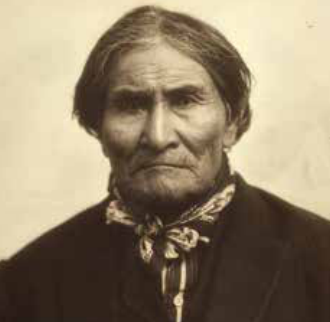
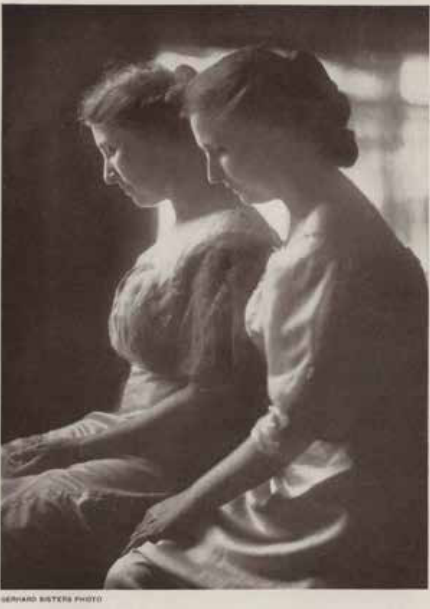
During the previous 30 years, from 1903 to 1936, the studio was occupied by a trail-blazing pair of sisters, Emme and Mayme Gerhard, who took some of most iconic photographs at the 1904 Worlds Fair, including a series of photographs of native Americans who were “exhibits” at the fair.
As described in the profile of the sisters in the Library of Congress, “Some of the Gerhard’s images from the Exposition seem to have been made in their studio, away from the ‘controlled chaos’ of the outdoor displays on the Fair’s Midway. One of those is a portrait of Geronimo that contains an accidental ‘portrait’ of the photographer at work.
It is reflected in Geronimo’s eye and was discovered in 2009 when the Library’s photo conservator realized someone was looking back at her as she worked.
The ‘portrait’ shows a woman wearing a white shirtwaist blouse with a dark skirt, the uniform of ‘the New Woman’ of the 1890’s and early 1900’s.
The phrase New Woman referred to feminists.’” Later work included photographs of women in the suffrage movement, as well as weddings and other events, with both natural and artificial lighting. Both sisters were active in many professional organizations and gained enough economic independence to travel.
They had at least two other studios in St. Louis. Both were married and continued to work together.
In 1936, the Post Dispatch noted that Emme Gerhard was closing her studio on DeBaliviere to devote herself to painting at an art colony in Mexico.
When you visit the Missouri History Museum on Lindell and DeBaliviere, take time to visit the World’s Fair Exhibit, where you will find some of the Gerhard sisters’ photographs displayed. It’s not often that one has the opportunity to delve into neighborhood history and find feminist icons, as well as links to the worlds fair and indigenous people. For more details, explore the MOHIS website, and the Library of Congress under Women Photojournalists.
They have more than 100 of the wonderful photographs taken by the Gerhard Sisters, many of them right here on DeBaliviere.
Original photograph caption
Vacant De Baliviere development site.
Originally published in The Times of Skinker-DeBaliviere, November–December 2020.
Read this article in the original newspaper issue.
Original source: SD_Times2020_11.pdf, printed page(s) 7; PDF page(s) 7.





