Original printed byline: Mark Banaszak; Katrina Stierholz
Historical Summer 2020 article. Dates, prices, services and contacts describe the source period; current availability has not been established.
Spring and early Summer can be difficult times to find space in Yard Waste dumpsters. Lawns grow fast and may need to be mowed as much as twice a week, because of the mild temperatures and wet weather. Cool weather and plenty of rain are perfect growing conditions for the types of grasses many residents have in their lawns.
With such great weather and more mowing, homeowners have piles of grass clippings and want a way to manage them. Homeowners typically put their grass clippings in the waste stream, but there are better ways to handle them—better for your yard and for the environment.
In communities with no yard waste stream, grass clippings go to the landfill, and can represent up to 50% of the total collected waste during the greener parts of the year. You could put your grass clippings in a yard waste dumpster.
The City of St Louis is fortunate to have yard waste collection; however, keeping your grass clippings is a smarter idea. One common concern about grass clippings left on the lawn is that they will contribute to thatch. Not true! Clippings left on the lawn do not contribute to thatch if lawns are mowed dry and regularly. Thatch is caused by decomposing roots and underground stems, not grass leaves.
If you mow your lawn wet, however, the clippings can keep air and moisture from the growing grass and harm it.
If you wait too long to mow, your mower may not be able to chop up grass sufficiently. Longer grass clippings can also mat on the surface, hurting growing grass.
In fact, not only do grass clippings decompose quickly, they are good fertilizer for lawns. Keeping grass clippings on lawns can supply as much as ¼ of a lawn’s nitrogen needs, and doing so over a longer period of time, supports slow, continued growth. Grass clippings are a valuable natural source of nitrogen for plants.
Some gardeners also use grass clippings as mulch. Although not as attractive as wood chip mulch, mulch made of grass clippings protects plants from excessive heat and keeps water from evaporating too quickly from soil, which helps plants survive the hotter part of St. Louis summers.
It is important to note that grass clippings that have been recently treated with broadleaf herbicides are not safe for other plants. Grass clippings make an excellent addition to home compost.
They can be layered with kitchen waste in home compost piles.
They compost quickly and carry many of the fungi, bacteria, and insects that accelerate the composting process. Clippings can even be used to make compost tea, a common organic gardening liquid fertilizer. Mow your lawn regularly when the grass is dry, and keep the clippings on the grass. That’s how you can work smarter, not harder, this summer and enjoy your beautiful yard.
Original photograph caption
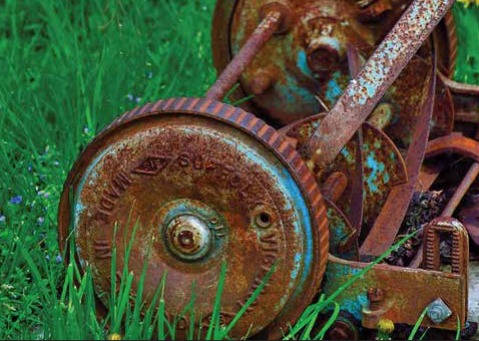
Lawn mower accompanying grass clipping article.
Originally published in The Times of Skinker-DeBaliviere, Summer 2020.
Read this article in the original newspaper issue.
Original source: SD_Times2020_06.pdf, printed page(s) 3; PDF page(s) 3.





