Historical November–December 2017 article. Dates, prices, services and contacts describe the source period; current availability has not been established.
In late July, I stood with my family on a windswept hill near Crow Agency, Montana.
A granite monument, engraved with 263 names, stands on the summit. Just below that, a fence encloses a number of stone markers.
The markers have no bodies underneath them.
The U.S. Army buried those bodies elsewhere, mostly underneath the monument at the crown of the hill. Rather than graves, white stones mark the places where the men of the U.S. 7th Cavalry fell. Red stones mark the places where Native Americans died. Almost all of the cavalrymen in that section of the battlefield died on the summit; a few stones mark where the Sioux and Cheyenne warriors hunted down the last of the soldiers as they tried to escape.
Most of the markers identify only that a member of the 7th Cavalry fell on that spot on June 25, 1875. By the time the Army returned to the site, the bodies could not all be identified.
Some list actual names, mostly those of officers, but one name stands out: G.A. Custer. Less than three weeks later, my oldest son Charlie and I visited the 9/11 Museum and Memorial in Manhattan.
We walked a staircase adjacent to the Survivors’ Stairs, down which hundreds escaped death on that bright September morning sixteen years ago.
We moved along a hallway covered with pictures of each of the 2,983 victims killed by the terrorists on 9/11/2001 and in the World Trade Center bombing eight years earlier.
In all of the portraits that I remember, the person is smiling, doubtlessly unaware that the photograph would be used for such a grave purpose.
I saw enormous beams of two-inch thick steel twisted like so much tinfoil from the impact of the highjacked planes.
I saw images of Missing Person flyers, some handwritten, some typeset, and all heart-breaking.
On the island of Manhattan, I listened to voicemails left by people who knew they were going to die, trying to pass along one last message to a husband, or a wife, or a parent. Seventeen hundred miles away, a screen shows an interview of a grandson of a victorious Sioux warrior.
The warrior once told his grandson that the saddest thing he saw that day was a cavalryman killing his own horse to use the body as a barrier: that cavalryman knew that he would not live to see the sunset.
These two places, 1,700 miles apart, are places of power, tragedy, and grief. Both mark the clash of civilizations. Little Bighorn, and the federal government’s response to it, shaped the American West so completely that it is useless to speculate what might have happened if Custer had acted with either more skill or with some compassion. 9/11 altered the substance of Western Civilization and likely continues to alter it in ways we probably cannot even imagine. Both places demand that we remember as a nation.
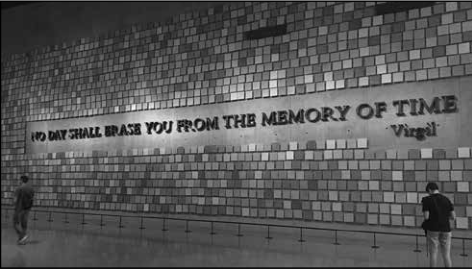
The 9/11 Museum devotes an entire wall, maybe 150 feet or so, to a single piece of artwork.
The piece features hundreds of water-colored panels, all different shades of blue, intended to represent how different individuals might remember the color of the sky that day.
They surround a quote taken from Virgil’s Aeneid, “No day shall erase you from the memory of time.” The artist forged the letters of the quote from steel recovered from Ground Zero.
A widow of a man taken on 9/11 gives us the gift of her thoughts.
As you hear her words, you see them projected on a wall.
She remembers that as terrible as that day was, she had not wanted it to end, because that was the last day her husband had lived.
Another loved one shares her thoughts in the audio of an 11-minute film.
The film features time-lapsed imagery of the seven-year raising of Freedom Tower.
The woman states that the pain of her loss never goes away.
She speculates that perhaps it never should. “Hold you sorrow gently,” she says.
After two insufficient hours, we left the museum and travelled back uptown to catch the show for which we had earlier bought tickets: Groundhog Day.
As we rode the subway, I grimaced and silently chided myself for planning on a light-hearted comedy after such an emotionally grueling experience.
It did not seem appropriate.
But I eventually realized that in a completely unexpected way, it made sense.
The main character of the show is condemned to repeat one day in his life again and again until he can learn to appreciate and live fully in the present. Until he does, he is always looking to tomorrow, yearning to be free of today.
We can only forge a better tomorrow with the tools and materials that we have today.
We cannot value or understand what we have today unless we remember our past.
As we left the show, we walked by a hotel window.
I did not know which one specifically, but I remember that it faced Times Square.
In that hotel room 21 years ago, I asked my wife’s father for her hand in marriage. Since that time, both of her parents and my own mother have died, all of them far too young. Hold your sorrow gently.
Original photograph caption
Nine-Eleven Museum remembrance wall.
Originally published in The Times of Skinker-DeBaliviere, November–December 2017.
Read this article in the original newspaper issue.
Archival transcription note: Source prints battle June 25, 1875, rather than historically established 1876, and Hold you sorrow in quotation. Source wording retained; flag for editorial correction rather than silently altering.
Original source: SD_Times2017_11.pdf, printed page(s) 4; PDF page(s) 4.





