Historical April–May 2017 article. Dates, prices, services and contacts describe the source period; current availability has not been established.
A Community Improvement District (CID) has been created for the East Loop.
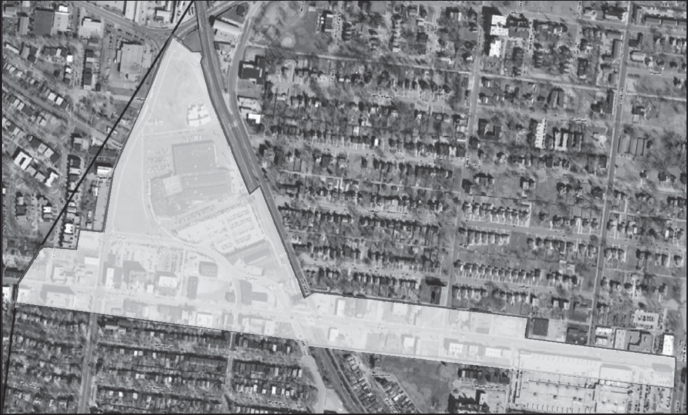
It covers the properties along Delmar from the city limits, including all of Washington University’s North Campus, to DeBaliviere on the south side of Delmar and to the History Museumowned lot on the north side of Delmar.
A CID levies an assessment which can pay for furthering economic development, enhancing public safety, and maintaining and improving infrastructure.
A board of directors administers the funds. Its creation requires a petition signed by more than 50% of the assessed value of real property and more than 50% per capita of all owners of real property within the district.
Then the Board of Aldermen passes and the mayor signs an ordinance (70322 passed June 2016).
The East Loop CID levies an assessment based on land area and square footage of buildings- $0.10 per sq. ft. of land, $0.20 per sq. ft. of improvements on the first story of any structure, and $0.125 per sq. ft. of improvements above the first story of any structure (except for parking structures).
The assessment doesn’t apply to tax-exempt property except the Loop Trolley Barn which will pay $500.
The assessment is phased in over three years in 1/3 increments starting in 2016. Washington University and Bi-State Development have voluntarily agreed to pay the assessment on their properties.
The rate will increase 10% every five years to keep pace with inflation.
The CID will last for 25 years when it can be renewed by another petition.
The CID replaces the East Loop/Parkview Gardens Special Business District which had a budget of less than $50,000 per year.
The CID is expected to have a budget ten times that. That level of funding would allow it to undertake initiatives like hiring full-time staff to focus on economic development, implement current studies (like the Loop Retail Study), maintain and update the “Lease the Loop” and “Visit the Loop” websites, and encourage transit-oriented development around the Delmar Metrolink station (including redevelopment of the Wabash Station building) and mixed-use development.
Also it will enhance public safety and maintain and improve existing infrastructure by providing additional security presence during nights, weekends and other times as needed, providing additional security cameras and equipment, addressing parking needs, maintaining and improving public areas, sidewalks, streetscape, and street lights, and providing for trash/ recycling receptacles, trash removal, street sweeping, tree grates, and garden beds.
The CID has a seven-member board of directors.
It consists of: • Two representatives of Washington University (Cheryl Adelstein and Mary Campbell) • One representative of an owner of property within the CID upon which is located a live performance venue with seating capacity of at least 1,000 (Joe Edwards) • Two representatives of owners of businesses licensed by the City and operating within the CID (Steve Rotskoff and Tamika Stigers) • One representative of Bi-State Development (Aliah Holman); and • One at-large member (Dave Mastin) At least two members must be property owners east of Des Peres and two must be property owners west of Des Peres. Members will serve four-year terms.
The initial board has four members with four-year terms and three with two-year terms to stagger them.
The board of directors will convene quarterly meetings of the property owners and business owners within the CID.
The initial CID board members were selected as part of the CID approval process.
The board is self-perpetuating as are all independent boards. Terms are staggered.
The meetings of the board are open to the public. Notice is sent to all property owners in advance of the meetings. Business owners or other interested individuals are welcome to come to the quarterly meetings.
The new designation and property tax will enable many more improvements to the business district. Joe Edwards said, “having a Community Improvement District will be a wonderful addition, giving us the ability to do special events, landscaping projects, and to make the area safer for all residents, businesses and visitors. Having sufficient resources to have dedicated staff will make it possible to seek out new businesses and will strengthen the entire East Loop.”
Original photograph caption
Original East Loop CID boundary illustration.
Originally published in The Times of Skinker-DeBaliviere, April–May 2017.
Read this article in the original newspaper issue.
Original source: SD_Times2017_04.pdf, printed page(s) 6; PDF page(s) 6.





