Original printed byline: Cecelia Nadal
Historical September 2014 article. Dates, prices, services and contacts describe the source period; current availability has not been established.
Ferguson by all appearances was an example of a St. Louis suburb where black and white neighbors and local businesses peacefully coexist and cooperate on mutual interests.
The community appeared to have no race or class problems.
On August 9th that myth was ruptured when an unarmed 18-year-old named Michael Brown was fatally shot by a white police officer, Darren Wilson.
The Brown family asked that a prayer vigil be held for their son. That vigil became a protest that would rock the region.
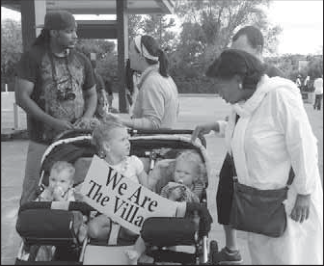
I have participated in the peaceful protests over the past week and sought to find out why some of the people were there and what was on their minds. One young white family including 3 children less than five years of age came out with a sign saying, “We Are A Village.” When I spoke to the father of these children he told me that he and his wife were residents of Ferguson and they wanted their African American neighbors to know that they supported them in their outrage over the killing of Michael Brown.
I asked if he and his wife were scared and he said no because he knew these people and they were good people. (pictured) A very pregnant African American woman in her twenties was sitting in a lawn chair holding a sign asking for justice.
I spoke with her and asked why she was protesting.
With tears in her eyes she told me that she was unjustly arrested and sexually assaulted by the police several years ago and had witnessed many young black men being harassed for nothing. “I’m just tired of the abuse and want my child not to have to go through what I have been through.” A black woman of 51 named Cynthia who owns a daycare center told me that she did not trust white people at all.
I asked her if she had any relationships with white people and Cynthia said no.
In the middle of our conversation, a white female protester who was sitting next to us heard what Cynthia said.
The white woman named Tracy asked Cynthia if she could share her story.
She was raised in Jackson, Mississippi by racist parents and at the age of 12 she witnessed members of her congregation escorting a visiting African American medical student out of the Baptist Church to which her family belonged. Unfortunately the student thought he would be welcomed because it was a Baptist church. Tracy was mortified said that from that moment on she decided that she would live a very different life than that of her parents. Tracy would stand up for the rights of African Americans.
She looked into Cynthia’s eyes and said “ I not only have fought for the rights of African Americans but the courage your people have shown has been an inspiration for me as a member of the LGBT community.” The two hugged each other and Cynthia said, “If you can do what you are doing I surely can find love for you!” On Sunday, August 17 eight Tibetan monks from India came to stand side by side with the protestors.
The crowds of mostly African American protestors were endeared to the visitors and surrounded them with handshakes and hugs.
The Tibetan monks raised their hands along with the protestors in a gesture of “surrender” symbolizing Michael Browns last gesture of surrender before the fatal shots.
When I asked one of their representatives why he had come from so far away his simple answer was “to be united with you in love.” Over this past week I have stood on the line of protest with former US Representative, Russ Carnahan and his wife, Louis Reed, President of the Board of Alderman with his wife and son, Alderman Antonio French and State Representative Eric Schmitt.
I have met incredible women from Boston and Oakland who are former residents of Ferguson and it has been an honor to stand beside dedicated men, women and children who simply decided that enough is enough. Going back to my original question, I had to ask myself why I was participating in this protest.
I am 64 years old, a steady defender of diversity and equity and have spent my life wrapped around these issues.
I made my contributions to the cause! Didn’t I deserve to stay home in peace? Ultimately, my answer was NO. Had I stayed at home I would have missed meeting the extraordinary people who are on the frontline.
I would have not met people who want to make a difference for their children and grandchildren.
I would have only relied on reporting that could not possibly give me the full reality of Ferguson and more importantly the full reality of continued inequality in our region.
These ordinary courageous people have given me inspiration and reaffirmed that we must stay vigilant when it comes to issues of race, class and equity.
Original photograph caption
Ferguson family carrying We Are A Village sign, described in writer’s account. Individuals unnamed.
Originally published in The Times of Skinker-DeBaliviere, September 2014.
Read this article in the original newspaper issue.
Original source: SD_Times2014_09.pdf, printed page(s) 4; PDF page(s) 4.





