Historical Summer 2011 article. Dates, prices, services and contacts describe the source period; current availability has not been established.
On my first visit to St. Louis, my then-fiancé took me to church at St. Roch parish.
We had both been living in New York when we became engaged, and he had accepted a job at St. Louis University for the fall term.
In August 1966, we had driven from New York to St. Louis, his native city, but one which I had never visited.
He chose to take me to church at St. Roch’s, he said, because it was reputed to be a most interesting parish, with a very large congregation — some of whom were also actively engaged in higher education, as he was. Among them was Thomas Neill, a long-time history professor at St. Louis University. That first Sunday we attended St. Roch’s for Mass, the church was packed.
We arrived fifteen minutes early, and the usher barely managed to find us a place to sit. Both my husband-to-be and I would have been surprised, that day, if someone had told us that we would start our new household in St. Roch parish only a few months later. (We were married that November at the Old Cathedral, and very briefly lived in an apartment in the Central West End.) We would have been even more surprised to hear that more than four decades in the future we would still be St. Roch parishioners — and to know that all four of our daughters would be baptized and confirmed in this church, and would attend St. Roch school, or that two of our children would be married at St. Roch’s, and three of our grandchildren would be baptized here. That our family history at St. Roch’s is not entirely unique is, perhaps, even more surprising. St. Roch parish, in 1966, was in what was then called a “changing neighborhood”.
When we bought our house on Kingsbury, there were ten houses for sale on this block alone, and “for sale” signs dotted the surrounding streets.
In light of what had happened in other similar neighborhoods in the city, it seemed unlikely that we would be able to live here for much more than five years.
But it seemed to us worth the effort, despite the daunting challenges. Three families on the block, the Neills, the Crosses, and the Leguey-Feilleuxs, were also St. Louis U. faculty — and within a few months there would be more: the Benders and the DiLorenzos.
All were St. Roch parishioners, as were the Sheas, a Washington University faculty family.
There was a shared commitment among the new residents, as with those already here, to overcome the obvious challenges to this “inner city” neighborhood — a unity of purpose that was strongly nourished by St. Roch parish.
There were many, many young children on the block during the late 1960s and 70s.
The largest family, who lived across the street from us, were the McCarthys, who had thirteen children.
But families with 6 or 8 or 9 children were not uncommon. Our family of four children was considered rather small.
When our older children attended St. Roch school, you could hear all the children gathering to walk to school — and again coming home after school. And the sound of children playing on the street in the summertime was the norm.
Another standard practice was “hand-me-down” St. Roch school uniforms — not only within families, but also to other families with younger children. (Once a friend and I counted 80 children 18 and under living on this block. And a similar account could doubtless be given of other sections of the parish.) By the early to mid- 1980s, however, the “kid-population” had considerably diminished — in part because the neighborhood had long since stabilized.
The kids grew up. And the new families who moved in had fewer children.
I realized this only when our youngest daughter started school at St. Roch in the mid-eighties. No more crowds of kids on the block to walk to and from school with! No more noisy summer afternoons with kids playing tag, Red Rover, Johnny Cross, Ghosts in the Graveyard, Hide and Seek, Sardines, and other street games! And, though the neighborhood was no longer under threat, the parish Masses were no longer “standing room only” as they had been a decade or so before. Things had changed during the more than twenty years — 1972- 1993 — that the Hitchcock children had attended St. Roch School. Still, the spirit of the neighborhood — and the parish — remained vigorous and forward-looking.
A new pastor, Father Sal Polizzi, who arrived in 1981, following the very popular Monsignor Robert Peet, did much to encourage involvement with parish and school activities — an effort that has borne much fruit for more than three decades. St. Roch parishioners on both sides of Skinker continued to be very engaged in school programs and parish initiatives.
If the church attendance at St. Roch declined, as it did, many social factors could account for this, including smaller families and fewer Catholics living in the parish. Nevertheless, the commitment — and the strong Catholic faith — of St. Roch parishioners has made this entire part of the city an unusual example of social and cultural stability that could never have been predicted when we first arrived.
Original photograph caption
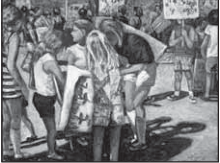
Kelly Hull painting of May 1974 St. Roch first-grade poster contest, with Kirsten Nelson, Alexandra Hitchcock, Theresa Vossen and Marty Cross.
Originally published in The Times of Skinker-DeBaliviere, Summer 2011.
Read this article in the original newspaper issue.
Original source: SD_Times2011_05.pdf, printed page(s) 3, 6; PDF page(s) 3, 6.





