Historical September–October 2008 article. Dates, prices, services and contacts describe the source period; current availability has not been established.
A Republican president finds his nearly eight years in office drawing to a close.
The Republican Party has chosen as his successor a sometimes-friend and sometimes-rival of the president. Meanwhile, Democrats gather for their convention in Denver to nominate a candidate known as an amazing speaker, but who still has skeptics in his own party.
The fall campaign is likely to hinge on public opinion of the current administration, but divisive questions of race and religion also swirl. And the question on everyone’s mind is who will win Missouri, which is shaping up as a major battleground state. Sound familiar? Of course: it’s the ’08 presidential campaign! 1908, that is.
In 1908, Republican President Theodore Roosevelt (who assumed office after William McKinley’s assassination in September 1901) was a strong supporter of his friend and ally, William Howard Taft.
This was Taft’s first run for elected office, but he previously led the US Territorial government in the Philippines, and served as Roosevelt’s Secretary of War. Roosevelt had been elected by a landslide in 1904, and was immensely popular.
His reputation as a “trust-buster” and opponent of political corruption gave him appeal across party lines.
His support for Taft was a major asset in the 1908 campaign, but their friendship would come undone a few years later as they battled each other for their party’s nomination. Meanwhile, the Democrats (meeting in Denver) nominated William Jennings Bryan.
This was Bryan’s third race for the White House. Bryan’s first presidential campaign was in 1896 when he became the youngest presidential nominee in US history at the ag of 36. Bryan ran on a message of economic populism and opposition to the gold standard.
He was a talented and charismatic speaker and his famous “Cross of Gold” speech mesmerized his audiences.
His message was popular with rural voters in the South and West, but rankled pro-business Democrats in the Northeast. Bryan lost the 1896 election to McKinley by 4% of the popular vote. By 1908, many Democrats were ready to give Bryan another chance. Others were not.
With a popular Republican incumbent and defections from members of their own party, Democrats faced a tough election.
The best opportunities for the Democrats were potential gains among African-American voters, and lingering questions about the religious beliefs of the Republican candidate. Since the end of the Civil War, AfricanAmerican voters had consistently supported the GOP, the party of Lincoln.
The segregated South, where blacks were denied their right to vote, was the most reliable base of Democratic s u p p o r t .
However, in 1908 many AfricanAmericans were outraged at President Roosevelt because of an incident in Brownsville, Texas two years earlier. White residents of the town blamed black soldiers at a nearby fort for a shooting that killed a white bartender. Although there was little evidence that any of the soldiers had been involved, Roosevelt dishonorably discharged all 167 black infantrymen stationed at the fort.
As Roosevelt’s Secretary of War, many held Taft responsible for this injustice.
As a result, the 1908 election is the first time that large numbers of black voters began to shift their support away from the Republican presidential candidate.
This gradual realignment would continue for several decades and ultimately pave the way 100 years later for Democrats to nominate the first African-American candidate for President. At the time, however, Bryan failed to reach out to potential black supporters, possibly for fear of alienating his party’s white southern base. Questions about the religious views of one of the candidates also played a role in the campaign. Taft was a member of the Unitarian Church, which does not adhere to some traditional Christian doctrines. Taft declined to discuss his religious views publicly, but there was much speculation about them.
There were rumors that Taft’s wife and brother were Roman Catholics (a major concern more than 50 years before JFK’s election), and one letter writer informed President Roosevelt that “it is constantly urged as a reason for not voting for Taft that he is an infidel.” After the campaign, Roosevelt responded publicly to this letter, saying that it was like many others he had received.
He denounced it as “an outrage” and “bigotry” to “question… a man’s religious convictions, with the purpose of influencing a political election.” While Roosevelt and Taft considered a candidate’s religious views strictly private, Bryan’s public image was largely defined by his religious convictions.
His campaign speeches were infused with religious imagery, and his newspaper interviews include quotations from Christ or the Disciples. Missouri emerged as one of the closest battleground states in the election. At the time, Missouri had more electoral votes than California, Florida, Massachusetts, or Michigan, and was tied with Texas for the 5th largest number of electoral votes.
In prior elections, Missouri had been reliably Democratic.
The state supported Bryan in his 1896 and 1900 losses, but in 1904 swung over to the Republican column in Roosevelt’s landslide election.
Most observers thought Missouri would go back to its support for Bryan in 1908.
But Republicans heavily contested the state, and Taft stepped up his campaign appearances during the final weeks before the election.
In the end, Taft eked out a 441 vote victory in Missouri.
This election established Missouri’s reputation as a swing state.
The state has continued to vote for the winner of each subsequent presidential election, except 1956, when Illinois neighbor Adalai Stevenson carried Missouri over Dwight Eisenhower.
While Missouri has remained a swing state for nearly 100 years, the coalition that each party needs to win the state has changed.
In 1908, Taft carried the City of St. Louis by a margin of 10% or nearly 14,000 votes.
This allowed him to overcome Bryan’s lead in the rural areas.
In contrast, 100 years later, Democrats rely on huge margins of victory in the urban areas, in the hopes of offsetting their losses in rural parts of the state.
The Skinker-DeBaliviere neighborhood, newly developing on the western edge of the City of St. Louis, voted slightly more Republican than the rest of the City and the country as a whole. At the time, the neighborhood was contained within two precincts of the 28th Ward.
These precincts also stretched north of Delmar to Cabanne and Maple Streets.
In the 1908 election, these two precincts produced 453 votes for Taft, 351 votes for Bryan, giving Taft a victory of about 12%. Nationally, Taft carried the popular vote by 9% and won the Electoral College by a vote of 321 to 162. Both Taft and Bryan remained in the national spotlight for the rest of their lives. Taft beat back a challenge from Roosevelt for the Republican nomination in 1912, but Roosevelt left the party to run on the Progressive or “Bull Moose” ticket.
With the Republicans divided, Democrat Woodrow Wilson won easily. Taft finished third, carrying only 2 states and 23% of the popular vote. Wilson appointed Bryan as his first Secretary of State. Bryan’s later career would be dedicated to supporting Prohibition and women’s suffrage, and in the final days of his life, he would argue against Darwinism in the famous Scopes Trial in Tennessee.
When Republicans reclaimed the White House in 1920, Warren Harding appointed Taft as Chief Justice of the US Supreme Court, where he served until his death in 1930.
Original photograph caption
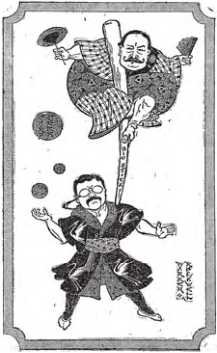
Original political cartoon reproduced with the 1908 presidential campaign history; artist and original publication not identified in issue.
Originally published in The Times of Skinker-DeBaliviere, September–October 2008.
Read this article in the original newspaper issue.
Archival transcription note: Printed age is ag and Adalai Stevenson spelling retained. Historical electoral interpretation reproduced as author account, not independently re-audited.
Original source: SD_Times2008_09.pdf, printed page(s) 7; PDF page(s) 7.





