Historical April–May 2003 article. Dates, prices, services and contacts describe the source period; current availability has not been established.
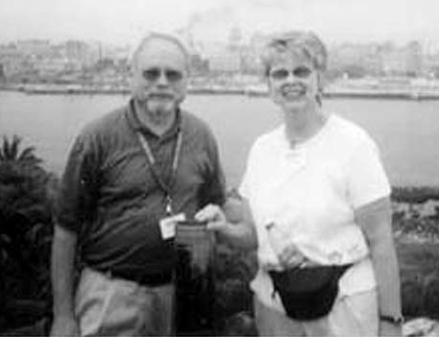
Sam and I had the most wonderful experience in early March.
We had the privilege of attending a tour to Cuba sponsored by Association of Fundraising Professionals (AFP) and People to People Ambassadors.
We spend a week there, most of the time in Havana, visiting nonprofit groups and learning about the country.
We really had no idea what to expect in Cuba and had relatively little knowledge of the history – other than it was a communist country ruled by Fidel Castro.
There were many things that are surprising in Cuba. You notice right away that there is very little visible signs of Castro around Havana.
He has chosen to have Che Gueverra be the symbol of the revolution and his photo is carried on souvenirs and in public places.
The average Cuban does not even know where Castro lives.
The people are very friendly to Americans. One person asked Sam if he was American and gave him the “thumbs up” to an affirmative answer. You meet many people who speak English.
The place is warm and friendly and you feel safe everywhere.
We were told that the crime rate is very low.
The streets are clean and while most of the buildings need paint there is no trash anywhere. Outside Havana the countryside is lush and green.
The Cuban people are very proud of their health care and education systems, and it appears they should be.
The country has over 46 Universities throughout Cuba.
We saw school children out and about everywhere visiting the museums and other cultural attractions.
The literacy rate is 96%, just one point lower than the United States.
In a meeting with the Federation of Cuban Women we were given some of the statistics for health care; the infant mortality rate is 6.5% where in Missouri it is 7.3%. Life expectancy is 76.
The immunization rate is 98.5% and there is one doctor for every 192 Cubans.
The family doctors live in the community and regularly visit the homes of all who are their responsibility. Although the doctors are apparently very well trained, the problem lies in the fact that they lack all types of medical supplies and medication. One of our interesting visits was to a block party of the Committee for the Defense of the Revolution (CDR). Started in 1960 and based in each neighborhood, the original intent was to form defense committees. Today they organize vaccination and blood drives, neighborhood clean ups, and recycling programs. Their current economic conditions have created a need for community gardening for food and medical plant harvesting. Religion has apparently not been subdued in Cuba.
We visited a nursing home, run by the Notre Dame nuns, that has been operating long before, and throughout, the Castro administration. Many religions are apparently active in Cuba. Probably the most interesting part of the trip for us was learning from our two guides the economic and political parts of Cuban life. Our guide, a 37 year old man from Havana named Evelio, was very forthcoming about everyday life and spend hours with us on the bus asking “Are there any more questions?” He had studied civil engineering in Russia for five years, had worked on a cruise ship for a couple of more years and yet was working as a tour guide because he could earn more money.
He lives in a two bedroom apartment with his mother, sister, wife and two small children. Hot water is heated on the stove, very few people own cars and the public transportation system is comprised of a few extremely crowded buses. Evelio told of life in Havana, especially in the last 12 years.
When the Soviet Union collapsed in 1990 it created an economic crisis in Cuba that the government refers to as the “special period”.
He referred to it as the crisis. Cuba was apparently receiving tremendous amounts of money and food from Russia, along with oil that powered their industries.
When that dried up in the early ‘90s Cuba saw many changes. Almost all of the factories closed, people all over the country became unemployed and food became extremely scarce. Evelio told a story of how during this period he was living with his mother and sister.
His mother was recently retired and his sister had been laid off and he had just returned from working on the cruise ships.
They had no food and could not find anything to buy.
He told of riding his bike with $1,000 in his pocket for 2 and 1/2 hours before he find a pound of rice to purchase.
The crisis forced Castro (our guides always said, “the government”) to make several changes that appear to be opening up the free market system; farmers are now allowed to keep some of their produce and sell it and keep the profit, likewise for artists and crafters.
The dollar was accepted as currency; and food and other items can be purchased by Cubans at the dollar store where only US currency is accepted. Apparently many Cuban receive US dollars from relatives in the States.
A major effort was made to bring tourism to Cuba. Castro signed deals with European corporations to build hotels and the beaches of Veradero, a resort community about 2 hours outside Havana, were filled with hotels, shopping centers and restaurants, but are declared off limits to Cubans. Every restaurant had roving musicians and each has their own CD. You had the feeling that Castro said, “We will have tourism” and all the tourist amenities appeared.
The average Cuban earns about $200 pesos per month or the equivalent of $10 US dollars.
There was much talk among our group about how food was on a ration system, with children only receiving the milk ration until the age of seven. Our guide’s answer to this was that “the ration system is there to prevent the same thing that happened in the early ‘90s when he could not find food.
It is not enough to live on, but it is enough so that you will not starve.” He explained that Cubans purchased the other food needed in the farmers market or the dollar store.
It seemed to us that there currently is a dual economic system in Cuba, partly free enterprise and partly communism.
We definitely had the sense that things were changing rapidly there and that more changes are on the horizon.
We asked Evelio, “Why are the Cubans so friendly to Americans after so many years of the embargo?” His response was, “Oh, those are things that governments do, we like Americans as people.” An incredible experience!
Original photograph caption
Sam and Lu Green in Cuba in early March. Photographer not credited.
Originally published in The Times of Skinker-DeBaliviere, April–May 2003.
Read this article in the original newspaper issue.
Archival transcription note: Printed infant mortality figures are 6.5% and7.3%; author reports figures received on tour, units not independently verified. Original Soviet-collapse1990 claim and source figures retained.
Original source: SD_Times2003_04.pdf, printed page(s) 6; PDF page(s) 6.





