Historical February–March 2002 article. Dates, prices, services and contacts describe the source period; current availability has not been established.
Dan Schesch, now finishing his second term as SDCC president, moved to St. Louis and Skinker DeBaliviere in 1967 to pursue graduate study at Washington University. Schesch was born in New York City and grew up in a New Jersey suburb. Although he did not complete that graduate program, he developed a strong affinity for St. Louis and our neighborhood and has continued to make his home here ever since.
He now owns both duplexes he has lived in.
In 1971 he bought out his landlord to come to own the dwelling he still calls home in 60xx McPherson.
In 1973, he bought the duplex next door where he had first lived on coming to St. Louis. Schesch has been active in the neighborhood at two separate intervals.
In 1970, he became the block captain for 6000 McPherson. Between 1971 and 1977, he served on the Council. Cal Stuart was SDCC director then.
In 1977, Schesch ran for the school board for an unexpired two year term.
He lost to Dan Schlafly but was elected to a full six year term in, 1985. Skinker DeBaliviere residents Marj Weir and Betty Klinefelter also served on the school board at that time. Schesch credits the board with putting together the plan that achieved a peaceful desegregation. Schesch had served on the Citizen Education Task Force before running for the school board.
He noted that only one K- 8 school at that time tested at national norms.
There had been middle class flight from the schools for some time.
He finds some schools better now but feels overall parents are not confident of the education their kids are getting.
The number willing to ride busses to the county schools is evidence of that. Schesch originally worked in labor relations/human resources.
In 1985, he began work on a master’s degree in management information systems.
He took one course at time and finished the M.A. in 1993. Since 1994, he has been utilizing his talent at Maritz. Schesch says that he stayed in St. Louis because he had a good living situation.
He also likes the midwest, in part perhaps because his father was from Chicago and there was family there.
In 1993, Schesch began to involve himself in the community again.
The demands of work and school had occupied him for the previous decade. Responding to a column in the Post-Dispatch, Schesch called Greg Freeman. Freeman had written about the lack of social interaction between blacks and whites and this was a concern that Schesch shared. Together they formed Bridges Across Racial Polarization which started with 3 pilot groups in the fall of 1993.
During the summer of 1994, the Leadership Center (now part of Focus St. Louis) began sponsoring these interracial gatherings and continues to do so.
In 1996, the proposed MetroLink expansion along the Forest Park Parkway portion of our neighborhood grabbed his attention.
It continues to do so.
He had not given up the hope of seeing the extension underground at Des Peres.
In 1997, Schesch was elected as a Rosedale representative to the council.
He has been president of the council for two years. Schesch noted that the neighborhood has experienced tremendous success.
In the 1960s and 1970s, there were people who wanted to be in a diverse neighborhood.
He strongly wants the racial and economic diversity to continue and will talk about that during the neighborhood planning process.
Another thing that has been a concern to him is that younger people didn’t know what the Council was and how to get involved. More representatives from Rosedale are younger and/or new residents.
He is proud of the Council having a web site and he has an e-mail distribution list. Schesch also mentioned Washington University.
He noted that they had purchased many multifamily properties.
In part, it was a good thing because some were owned by absentee landlords.
On the other hand, single family, two and three family buildings throughout the years had been owner occupied.
He feels the university should not own single, two or three unit buildings. Two and three families can be great starter homes.
He is happy that the university ended the right of first refusal because that could threaten single families.
He wants Washington University to create a long-range plan for substantial improvement of all of their properties in the neighborhood, giving them new kitchens and bathrooms.
He wants Washington University’s housing in Skinker DeBaliviere to compare favorably with their new small group housing.
He is aware that there is some concern regarding the strip mall on DeBaliviere and some of the uses the owners propose.
In addition, the Archway building across from the MetroLink parking may become available for different use. Schesch is interested in changing the zoning there to protect the neighborhood. Schesch summarized his goals: • Maintain the neighborhood stability, diversity and keep it familyfriendly • Build on our success in the planning effort where residents can say what they want for the next 20 years • Desires the widest possible participation, obtaining a consensus among residents Schesch said, “Ultimately I am a representative of my peer group.”
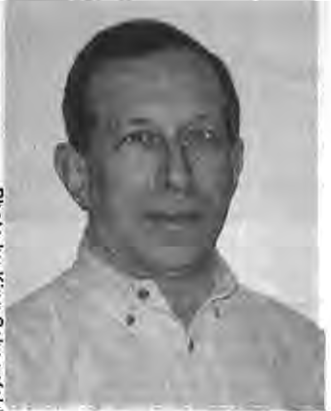
Original photograph caption
Dan Schesch. Photo by King Schoenfeld.
Originally published in The Times of Skinker-DeBaliviere, February–March 2002.
Read this article in the original newspaper issue.
Archival transcription note: Report says Schesch elected school board in 1985 and Weir and Klinefelter also served at that time. Prior recollections place their service earlier; original chronology retained for review.
Original source: SD_Times2002_02.pdf, printed page(s) 3; PDF page(s) 3.





